Pennsylvania Trails Open in July
Pennsylvania has several ATV and UTV riding options in July, from state forest trails to private riding parks. The frustrating part is that a trail being open for summer does not guarantee every route, permit area, or machine is allowed. This guide explains where to look, what to check before loading up, and how to plan a safer midsummer ride.
Where to ride an ATV in Pennsylvania in July
July falls within the usual summer riding season for many Pennsylvania ATV trails, but access depends on the specific trail system and its rules. State forest trails, national forest routes, and private parks each have different permits, operating schedules, and machine requirements. Check the operator’s current notices before you travel, especially if your plan depends on one particular trail or access road.
State forest trails and the Northcentral permit area
Pennsylvania’s state forest ATV trails include destinations such as Whiskey Springs, Bloody Skillet, and the Potter County Trail. Several well-known routes are in the Northcentral region, where a regional trail permit is required for designated routes in Clinton, Lycoming, Potter, and Tioga counties. Other state forest trails may have different access rules, so do not assume one permit covers every public trail in the state.
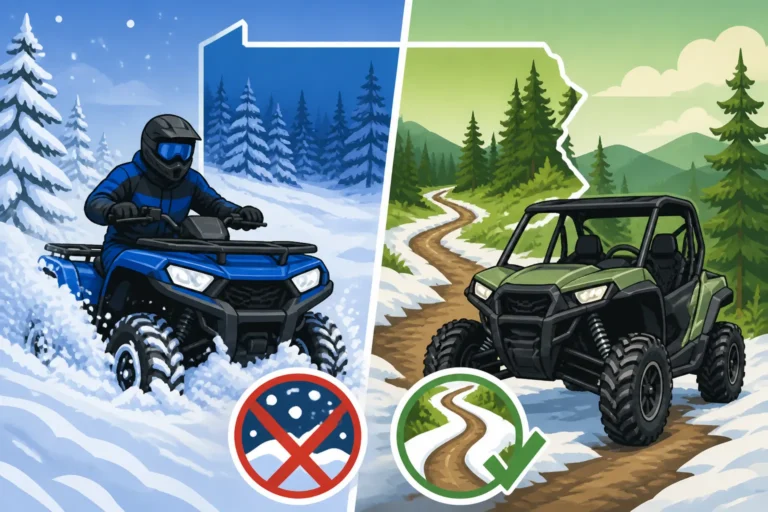
July can be a good time to explore this region because summer trail schedules are generally in effect. Still, a seasonal opening is not a promise that every segment will be passable on the day you arrive. Maintenance, storm damage, forestry work, or other temporary restrictions can affect access. Review [Pennsylvania's Summer Season Dates](Pennsylvania's Summer Season Dates) and [Pennsylvania's Northcentral Regional Trail Permit](Pennsylvania's Northcentral Regional Trail Permit) while planning, then check for trail-specific notices before leaving home.
A regional map can help you understand where the routes are and how access points relate to nearby towns. A tool such as onX Offroad can be useful for trip planning and orientation, particularly when you are comparing trailheads or trying to keep track of a route in an unfamiliar area. Treat any mapping app as a planning aid, not as permission to ride: a mapped line does not establish that a road is open to ATVs or that a temporary closure has been lifted.
Private parks and other riding areas
Private riding parks offer a different kind of July outing. The Anthracite Outdoor Adventure Area, near Shamokin, and Rock Run Recreation Area, near Patton, are examples of managed riding destinations. These parks may have their own entry process, hours, machine rules, age requirements, and safety expectations. Check each operator’s current information before you tow there; a general state trail schedule does not determine whether a private park is open.
Private parks can suit riders who want a managed destination with a defined entrance and riding area. They are not interchangeable with public trails, though. A park pass or day admission does not replace Pennsylvania registration, and it does not automatically satisfy rules for other public land. For a broader look at destinations, see [Best Places to Ride an ATV in Pennsylvania](Best Places to Ride an ATV in Pennsylvania) and [Pennsylvania Pay-to-Ride Parks Worth the Drive](Pennsylvania Pay-to-Ride Parks Worth the Drive).
| Riding area | What to check before going | Common planning concern |
|---|---|---|
| State forest ATV trail | Required permit, seasonal schedule, machine limits, and closures | Whether your machine fits the trail rules |
| Northcentral regional routes | Permit requirements and the specific route’s status | Whether the permit covers the route you chose |
| Allegheny National Forest routes | The forest’s separate permit and access conditions | Assuming a state forest permit applies |
| Private riding park | Admission process, operating hours, rider rules, and park notices | Arriving without completing required steps |
Check access, permits, and machine fit before you go
A July ride can still go sideways before the first mile if you bring the wrong paperwork or discover that your machine does not meet the trail’s limits. Registration, a trail permit, and permission to ride are separate issues. Confirm each one for the particular place you plan to visit rather than relying on what was accepted at a different trail system.
Registration is not the same as a trail permit
Pennsylvania ATV registration identifies the machine under the state’s registration system. A trail permit is a separate access requirement for certain riding areas. Some places require both; other locations may have their own access process. Carry the registration documents and any required permit proof, and check whether your destination asks for additional documentation.
Visitors should confirm how Pennsylvania treats an out-of-state registration before setting out. Do not assume that a home-state plate gives you access to every Pennsylvania trail, or that it replaces a local permit. The practical details are covered in [Pennsylvania ATV Trail Permits Explained](Pennsylvania ATV Trail Permits Explained) and [Does Pennsylvania Honor Out-of-State Registration?](Does Pennsylvania Honor Out-of-State Registration?).
Also make sure you know where you are allowed to ride. A trailhead, a forest road, and a nearby township road can have different rules. A route that appears to connect two areas on a map may cross land where ATV use is prohibited. If you use onX Offroad or another mapping tool to sketch a route, compare it with the land manager’s official trail information and posted signs. When those sources conflict, follow the posted restriction and ask the relevant land manager for clarification.
Confirm width and other machine restrictions
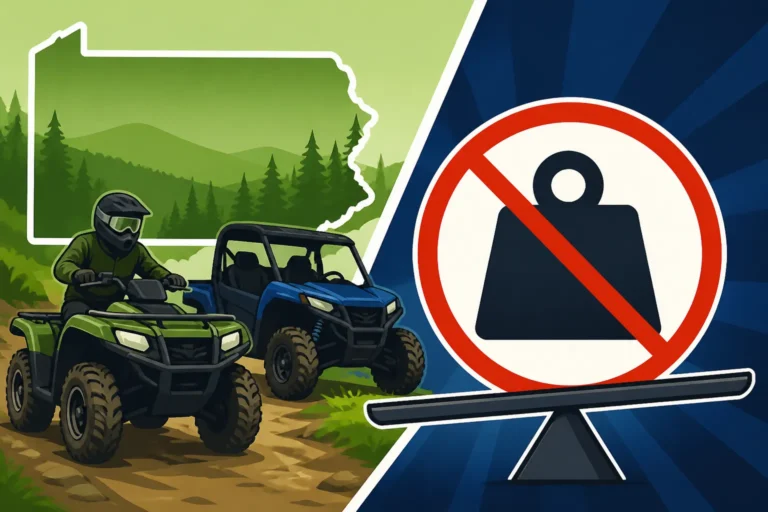
Machine fit matters on public trails. Some Pennsylvania state forest ATV trails have a 64-inch width limit, and there may also be a weight limit. Measure your UTV or ATV as it is actually configured, including accessories that could affect its width. A machine that clears a garage doorway is not necessarily compliant with a trail’s maximum width.
This is especially important for side-by-sides. Owners sometimes buy a machine for comfort and cargo space, then find that the trails they hoped to ride do not allow its size. Check the specific route’s restrictions before you make the drive. [The 64-Inch Width Limit in Pennsylvania](The 64-Inch Width Limit in Pennsylvania) and [Pennsylvania's Class II Trail Width Limit](Pennsylvania's Class II Trail Width Limit) are useful starting points for understanding why machine dimensions matter.
Bring only the equipment you need, but do not remove or alter safety equipment to make a machine fit. If a trail system excludes your vehicle, choose a destination that permits it rather than trying to squeeze through or continue past a posted restriction. That decision can save a long towing trip and help protect narrow trails from damage.
Plan for July weather, crowds, and trail conditions
Summer riding is not automatically easy riding. Heat, sudden storms, dust, slick roots, and heavy weekend traffic can all change how a route feels. A little planning can make the day more comfortable and reduce the chance that a minor problem turns into a long walk back to the trailhead.
Check conditions and closures close to departure
Look for notices from the land manager or park operator before you leave, then check again on the morning of the ride if conditions are changing. Summer thunderstorms can bring down limbs, wash out sections, or create muddy spots. A trail that was open earlier in the week may have a temporary closure or a newly posted hazard.
Be cautious about interpreting maps. Mapping apps can help with navigation, but they may not reflect a same-day closure, a gate, or a route that is restricted to highway vehicles. onX Offroad can help you prepare a route and keep your bearings; use official trail notices and signs to confirm where you may ride. For more planning advice, see [Pennsylvania Trail Conditions Before You Go](Pennsylvania Trail Conditions Before You Go) and [Pennsylvania Trail Closures to Check First](Pennsylvania Trail Closures to Check First).
If the trail is wet, avoid making deep ruts or widening the route to get around a muddy section. Turning around can be the better choice, even when it means giving up a loop you were looking forward to. Repeated wheelspin can damage a trail and make conditions worse for the next group.
Beat the heat and prepare for busy weekends
July weekends and holiday periods can bring more riders to popular trailheads. Arrive with enough time to park, unload, review the map, and complete any required check-in before setting off. If a small staging area is already crowded, do not block access lanes or assume overnight parking is allowed. Check the trailhead’s rules first.
Carry water for the group, including passengers, and take breaks before anyone feels unwell. Wear a helmet and suitable riding gear, and bring basic supplies such as a first-aid kit, a charged phone, and a way to communicate if the group becomes separated. Cell service can be unreliable in remote forest areas, so agree on a meeting point and what to do if someone stops or takes a wrong turn.
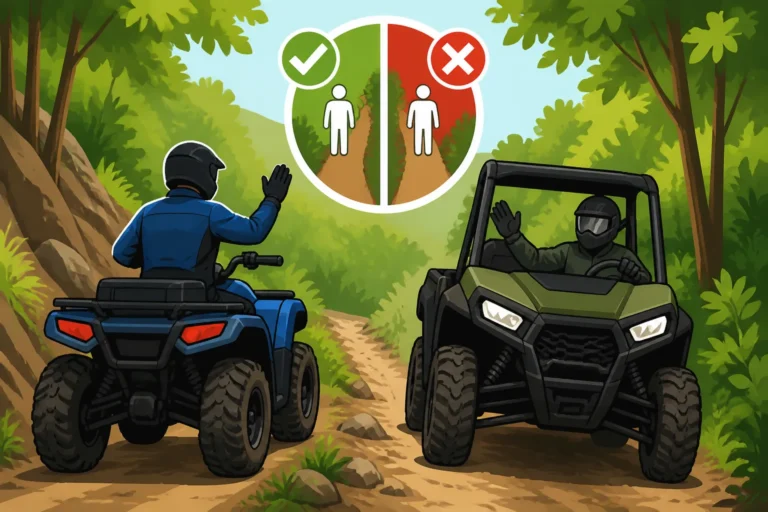
Dusty conditions can reduce visibility, particularly when several machines are traveling close together. Leave more space than you think you need and slow down when approaching blind corners, intersections, or other riders. Helpful reminders are available in [Pennsylvania Trail Etiquette on Narrow Trails](Pennsylvania Trail Etiquette on Narrow Trails) and [Pennsylvania Trail Maps From DCNR](Pennsylvania Trail Maps From DCNR).
Build a practical July ride plan
A good ride plan does not need to be complicated. It should answer a few basic questions before you hook up the trailer: Is the destination open? Are your machine and documents accepted? Where will you park? What is the backup plan if weather or a closure changes the day?
Use a simple pre-ride checklist
Before departure, work through these steps:
- Choose the riding area. Decide whether you are visiting a state forest trail, a national forest route, or a private park. Do not treat them as one connected system.
- Check access rules. Confirm the required registration, trail permit, admission process, and any special documentation.
- Verify your machine fits. Check width, weight, and any other posted vehicle restrictions using the machine’s actual setup.
- Look for closures and conditions. Review the land manager’s or park operator’s latest notices, and pay attention to signs at the trailhead.
- Plan the drive and parking. Confirm the correct staging area and whether trailers or overnight parking are allowed.
- Prepare for changing conditions. Pack water, protective gear, basic repair items, and a route or map that everyone in the group can understand.
- Set a turnaround plan. Agree on a time or condition that means the group will head back, even if the planned loop is not finished.
If someone in the group is new to the area, share the route plan before riding. A passenger who knows the destination and meeting point can help keep the group together if a machine needs attention. Save the land manager’s contact information in advance rather than trying to find it with a weak signal from the trail.
Have a backup destination
A backup plan is useful when rain, a temporary closure, or a crowded staging lot changes your original itinerary. Choose an alternative that is actually open to your machine and that has its own required access arrangements. Do not assume a nearby road or forest route is a legal substitute just because it appears to lead toward another trail system.
For visitors, it can help to keep the plan flexible: pick one primary destination, one realistic alternative, and a clear point at which you will call off the ride. For owners of wider UTVs, the backup destination should be one that explicitly allows the vehicle’s dimensions. A second option that has the same width restriction will not solve the problem.
Before loading up, revisit [Where to Ride an ATV in Pennsylvania](Where to Ride an ATV in Pennsylvania) and the destination-specific guidance for the area you have chosen. A little extra checking is less frustrating than reaching a gate with the wrong permit or a machine that cannot legally use the route.
Disclaimer
This article is for general informational purposes only and does not constitute professional advice. Laws, prices and regulations vary by location and change over time. Consult a qualified professional for guidance on your specific situation.