Pennsylvania’s Last Full Weekend in September
Pennsylvania’s summer ATV season can end sooner than riders expect: the final weekend may arrive while the weather still feels perfect for a day on the trail. This guide explains what the “last full weekend in September” means, how to plan around seasonal closures, and what to check before towing your machine to a Pennsylvania riding area.
What Pennsylvania’s Last Full Weekend in September Means
How to identify the last full weekend
“Last full weekend in September” generally means the final Saturday-and-Sunday weekend that falls entirely within September. It is not necessarily the weekend containing September 30. If September 30 falls on a Friday, for example, the last full weekend is the Saturday and Sunday before it. That distinction can make a difference when you are planning a trip late in the month.
For ATV riders, the phrase matters because some Pennsylvania state forest trails have seasonal operating windows. On trails that follow the summer schedule, the final full weekend in September can mark the end of the summer riding season. The exact dates on a calendar shift from year to year, and trail schedules can differ by location, so do not assume that one weekend applies everywhere.
Before you book a campsite or load the trailer, identify the specific trail system you want to ride and confirm its dates and current status. Start with [Pennsylvania's ATV Trail Season] and [Pennsylvania's Last Full Weekend in September], then check the latest information for the trail or forest district itself. A seasonal phrase is a useful planning clue, but the posted schedule for the actual riding area is what should guide your trip.
Why the date can be easy to misread
It is tempting to treat “last full weekend” as a casual description of “the last weekend near the end of September.” That can lead to a frustrating arrival after a trail has closed, especially if you have traveled several hours from Pittsburgh, Philadelphia, or out of state. The calendar wording is more specific: look for the last Saturday and Sunday that both fall in September, then verify whether the riding area’s official schedule uses that date.
Another source of confusion is assuming that every Pennsylvania trail closes on the same day. State forest trails, privately operated riding areas, club trails, and other destinations may follow different calendars. One system may close for seasonal maintenance while another is still operating under its own rules. A trail’s usual season is not a promise that every route will be open through the final day; weather, forestry work, trail conditions, and local notices can affect access.
When you see a date listed for one place, keep it attached to that place. Do not carry it over to a different forest or recreation area without checking. This is particularly important if your plan includes more than one stop, or if you are trying to connect two areas by road or trail. Pennsylvania’s trail access rules and seasonal schedules are not one statewide “open” or “closed” switch.
Which Pennsylvania Riding Areas May Have Different Schedules
State forest trails and designated riding areas
Pennsylvania state forest ATV trails are managed with seasonal operating windows, and the fall closure is part of that seasonal pattern. The summer window often runs from the Friday before Memorial Day through the last full weekend in September on trails that use that schedule. The dates and conditions still need to be checked for the specific forest and route you intend to ride.
Some well-known northcentral destinations, including areas around Sproul, Tiadaghton, Susquehannock, and Bald Eagle state forests, draw riders planning late-season trips. Names such as Whiskey Springs, Haneyville, the Potter County Trail, and East Kettle may appear in a broader itinerary, but their access details should be confirmed individually. A route that is open in one part of a forest does not automatically mean every nearby trail or connector is open.
Use [Pennsylvania Trail Maps From DCNR] to get oriented, then look for trail-specific closures and seasonal notices before departure. If you are considering a route in or near a national forest, remember that its access rules and permits may differ from state forest requirements. [Pennsylvania Riding in the Allegheny National Forest] is a useful next read when you are comparing destinations with different land managers.
Private parks and club trails
Privately operated riding parks and club-managed trail systems may have calendars that do not match the state forest schedule. They can set their own opening days, close for maintenance, limit access during poor conditions, or require a day pass or membership. A private park still has rules to check, but its operating status should not be inferred from a state forest closure date.
This difference can save a trip if you have some flexibility. If a state forest route is closing for the season, a private riding area may offer another option, but only if it is open to the public or you meet its access requirements. Confirm the operating day, machine restrictions, noise and safety rules, and whether your machine’s width is permitted before leaving home. A wide side-by-side may not fit every trail system, even when that system is open.
The reverse is equally important: a park’s late-season operating schedule does not extend the state forest season. Do not ride through a closed forest trail to reach an open private area, and do not assume a public road or connector is legal for ATV travel. For more context on the differences between areas, see [Pennsylvania Private Trail Systems] and [Pennsylvania Trails That Reopen for Winter].
| Riding area type | What the September date may mean | What to confirm before leaving |
|---|---|---|
| State forest ATV trail | May be the final weekend of the summer operating window | Exact opening and closing dates, route closures, machine limits, and permits |
| Private riding park | The park may use its own calendar | Operating hours, admission or membership requirements, machine rules, and conditions |
| Club trail | Access may depend on club rules, land agreements, or an event schedule | Whether nonmembers can ride, required permissions, and current trail status |
| National forest route | May follow a separate season and permit system | Forest-specific access rules, permits, and seasonal restrictions |
| Township or designated road | Access depends on whether the road is officially open to ATVs | Posted signs, local rules, and legal connections to your destination |
How to Plan a Late-September ATV Trip
Check the trail status before you travel
A date on a season calendar tells you when a riding window is scheduled to end. It does not tell you whether every route is in good condition on the day you plan to arrive. Heavy rain, trail damage, forestry operations, or other temporary issues can affect access before the seasonal closing date. A trail that appears open on an older map may have a current closure notice.
Make a simple check-in routine: verify the season dates, review the latest closure notices, confirm the trailhead and parking location, and make sure your intended route is allowed for your machine. If you are riding more than one system, repeat those checks for each one. Save the relevant information before you lose signal; mountain and forest areas can have uneven cell coverage.
Digital mapping tools can help you understand where you are and compare possible routes. Riders who use onX Offroad can prepare a map for the planned area and review it before heading out, but a mapping app should not replace the land manager’s current rules or posted closure signs. Treat the official trail status as the authority, and use your map as a navigation aid. A route line on a screen is not proof that a trail is open or legal.
Build a realistic schedule for the final weekend
The last weekend can be busier than an ordinary late-season Saturday, especially at popular trailheads. Arrive with enough time to park, unload, check your gear, and review the route rather than racing to get on the trail before a cut-off. If the area is unfamiliar, plan a shorter first loop and leave room to turn around if conditions are different from what you expected.
Avoid building your whole day around an optimistic estimate of riding time. A rocky section, a muddy climb, a slower rider in the group, or a mechanical problem can stretch a short route into a long one. Choose a turnaround time that lets everyone return before dark and before any stated closing time. It is also wise to agree in advance on what the group will do if someone gets separated or a machine breaks down.
For a late-season trip, check weather and trail conditions close to departure, not just when you first make the booking. Rain can make a trail slower and more difficult, while cool mornings and early sunsets change what you need to carry. For preparation ideas, see [Pennsylvania Trail Conditions Before You Go] and [Pennsylvania Trails After Heavy Rain]. A little flexibility in the day’s plan is usually more useful than trying to squeeze in one last loop at any cost.
What to Do When a Trail Closes
Respect closure signs and barriers
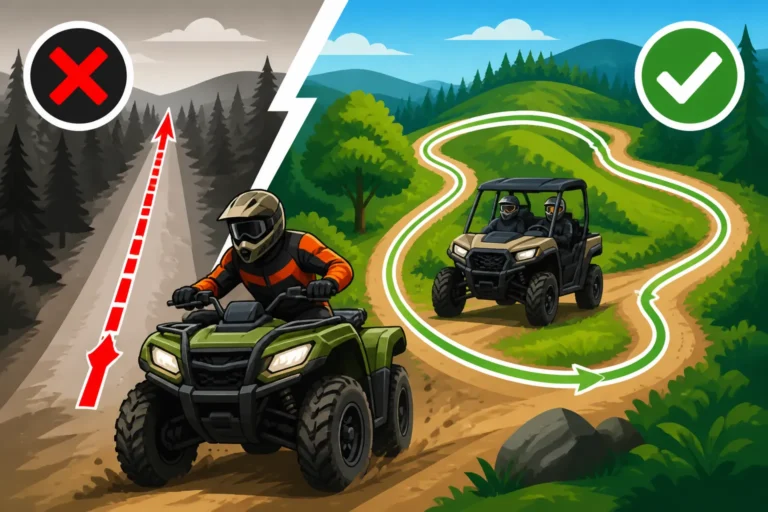
When a trail is marked closed, treat the closure as applying even if the surface looks rideable or another rider says they have used it recently. Barriers and signs may protect a trail during repairs, wet conditions, wildlife concerns, hunting activity, or a scheduled off-season. Riding around a gate can damage the route, put you in conflict with land managers, and make future access harder for everyone.
The same principle applies to unofficial shortcuts and connecting tracks. A line visible on an app, a path cut through the woods, or a tire mark leading beyond a barrier does not establish legal access. Stay on routes that are open and designated for your machine, and turn around when signs or staff direct you to do so. If you are not sure whether a route is open, pause and verify rather than treating uncertainty as permission.
Seasonal closures are not just administrative inconveniences. Trails need time for repairs and may be especially vulnerable when the ground is wet or thawing. Riders who respect closures help reduce avoidable damage and support continued access. If you want more detail on what to expect, [Pennsylvania Trail Closures to Check First] and [Why Mud Season Closes Trails] explain why conditions can lead to restrictions at different times of year.
Make a backup plan rather than forcing the route
A good late-season plan includes a second option that does not rely on entering closed land. That could mean choosing another open trail system, visiting a private park with a confirmed schedule, shortening the trip, or saving the ride for the next authorized season. Call or check the riding area’s official information before changing destinations; the backup only works if it is actually open and suitable for your machine.
If a group has traveled a long way, disappointment can make it tempting to improvise. For example, a rider may suggest using a forest road to reach a trailhead or following a local road to another section. That is not automatically lawful. Roads have their own rules, and permission to ride a trail does not grant permission to use every road leading to it. Check road access separately, including any signs or local restrictions.
Keep your group together while deciding what to do. Pick a safe place to stop, make sure everyone has fuel and water, and avoid splitting up to search for an alternate route. If the trail is closed due to weather or damage, riding elsewhere in the same area may cause the same problem. A canceled loop is frustrating; an avoidable citation, recovery, or injury is worse.
Getting Ready for the Next Riding Window
Use the seasonal break to maintain your ATV or UTV
The close of the summer window is a natural time to inspect your machine before storage or before planning a different kind of ride. Wash off mud without directing high-pressure spray at seals or electrical connections, check for loose fasteners, and look over tires, brakes, lights, and underbody protection. Mud and grit can hide a small issue that becomes more expensive after it sits unnoticed.
For a machine that will be parked for a while, follow the owner’s manual for fuel, battery, and storage preparation. A battery tender, clean and dry storage area, and a written note about maintenance needs can make the next ride easier. If you noticed a belt slipping, a tire losing pressure, or a winch acting up during the final trip, record it now rather than relying on memory months later.
Do not assume winter riding will be available at the same place or on the same route. Some trails reopen during a separate winter window, while others remain closed or require additional conditions. Seasonal dates, snow conditions, and trail-specific notices all matter. Read [Pennsylvania Trails That Reopen for Winter] and [Pennsylvania's Winter Season Dates] before planning a cold-weather ride.
Keep paperwork, permits, and equipment in order
Use the break to check that your registration information and required documents are easy to find. If you plan to ride a different forest or a private system next season, learn its access requirements early rather than discovering them at the trailhead. Keep any required permit or proof with your riding gear, and make sure the machine meets the area’s width and equipment rules.
A pre-season checklist can be simple but useful. Confirm that helmets fit, eye protection is ready, tie-downs are in good condition, and the trailer lights work. Check your route, fuel plan, and parking arrangements before the morning of the trip. If you rely on a phone for navigation, carry a backup power source and save maps or key information in advance. Do not assume you will have reliable service at a remote staging area.
Finally, remember that “the trails reopen” does not mean every trail reopens at once or under identical conditions. Use the official calendar and local notices for the specific location, then make the decision based on your machine, your group, and the day’s conditions. That routine keeps a late-September closure from becoming a surprise and makes the next Pennsylvania ride easier to plan.
Disclaimer
This article is for general informational purposes only and does not constitute professional advice. Laws, prices and regulations vary by location and change over time. Consult a qualified professional for guidance on your specific situation.