Riding Clinton County on the Permit
Clinton County is one part of Pennsylvania’s Northcentral Regional ATV Trail, but buying a permit does not mean every nearby road or trail is open to riding. The key is knowing what the permit covers, when the network is open, and which registration, insurance, and safety requirements still apply. Here’s how to plan a Clinton County ride without confusing a trail permit with permission to ride anywhere.
What the Northcentral permit covers in Clinton County
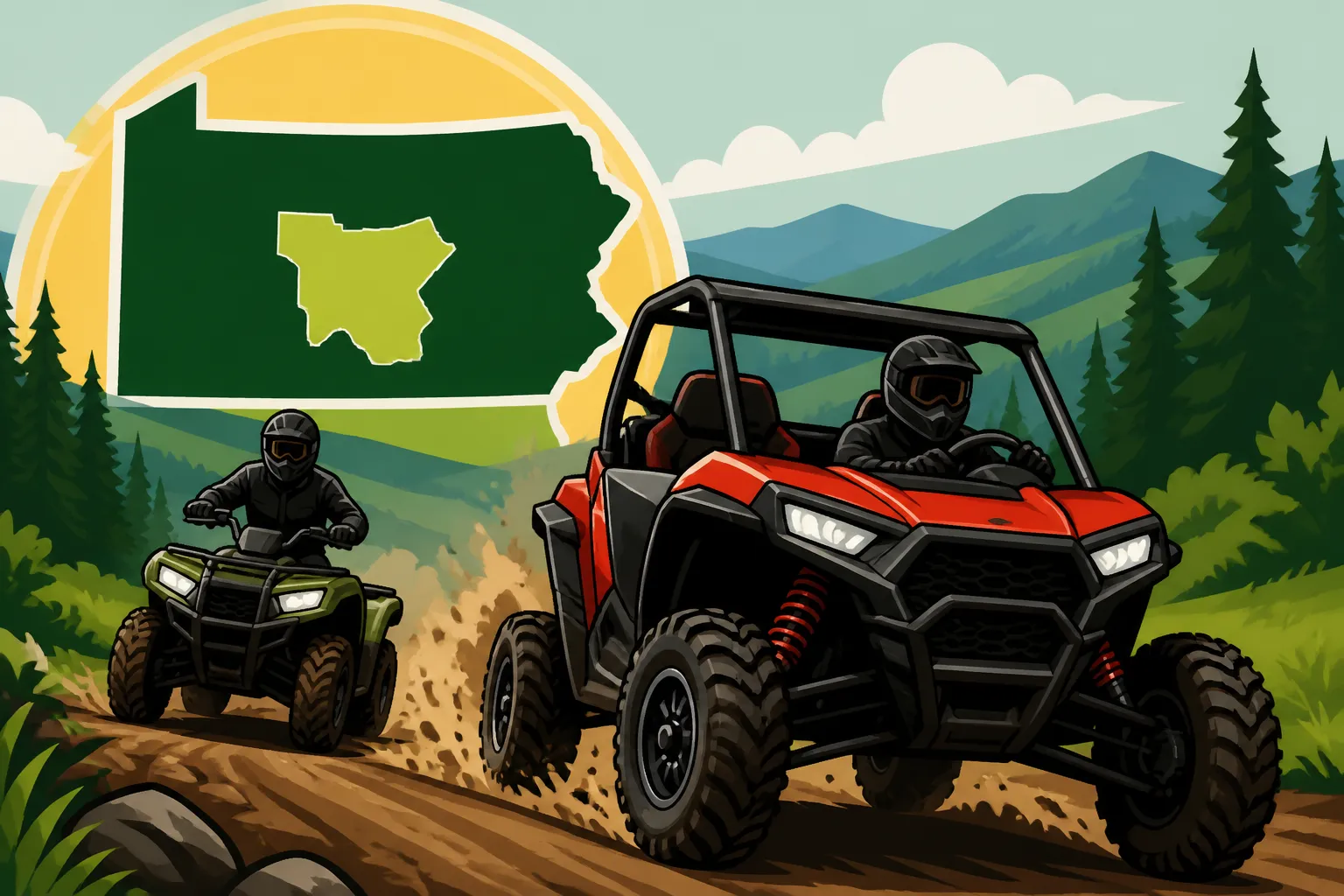
The Northcentral Regional ATV Trail, often shortened to NRAT, crosses parts of Clinton, Lycoming, Potter, and Tioga counties. A yearly permit is required for riders using the trail system, according to the Pennsylvania Department of Conservation and Natural Resources (DCNR). That makes the permit relevant to a ride in Clinton County, but it is not a general pass for all ATV-accessible land in the county.
The permit applies to the designated NRAT network. It does not, by itself, authorize riding on private property, on trails outside the system, or on roads that are not open to ATVs. Before heading out, confirm that your planned route is part of the current trail network and that it is open. The permit and trail boundaries are separate questions: you need the permit, and you need to stay on a route where riding is allowed.
For a broader view of the four-county coverage, see One Pennsylvania Permit Covers Four Counties of Trail and Pennsylvania’s Northcentral Regional Trail Permit. Those topics can help put Clinton County in context if you plan to ride across county lines. They do not replace checking the current route information before departure.
A useful distinction is that a trail permit is not the same as state ATV registration. Registration identifies the machine under Pennsylvania’s registration system; the NRAT permit provides access to this particular trail network. According to DCNR, Pennsylvania ATVs generally must be registered and titled, with stated exceptions for machines used solely for business or agricultural purposes. A permit does not replace registration, and registration alone does not provide NRAT access. For more on the difference, see Pennsylvania ATV Registration and Trail Access.
| Question | What it means for a Clinton County ride |
|---|---|
| Does the NRAT include Clinton County? | Yes. The network covers parts of Clinton County and three other counties, according to DCNR. |
| Is a permit required? | Yes. DCNR says riders need a yearly permit to use the Northcentral Regional ATV Trail. |
| Does the permit open every nearby road? | No. It applies to the designated trail network, not every road or property in the county. |
| Does the permit replace registration? | No. Registration and trail access are separate requirements. |
| Is the trail open all year? | No. The designated riding season has opening and closing dates. |
For the 2026 season, DCNR listed the Northcentral Regional ATV Trail as open from Friday, May 22, through Sunday, September 27. The 2026 season has now ended. For a later trip, check DCNR’s current season notice and trail updates rather than assuming the same dates will apply.
The wider Pennsylvania state forest trail season also has a defined window. DCNR says designated ATV trails on state forest lands are open from the Friday before Memorial Day through the last full weekend in September. This schedule is useful context, but do not assume every NRAT segment follows the state forest schedule without checking the trail’s current notice.
Plan the route, not just the permit
Start by deciding which designated NRAT segment you intend to ride in Clinton County. Then verify that the segment is open, accessible, and suitable for your machine. Do not rely on a county map alone: a county boundary does not tell you whether a particular road or trail is part of the permitted network.
DCNR has approved Route 144 from Button Hollow Road for inclusion in the NRAT to establish a connection to Galeton. Treat that as a route-development detail, not as a blanket authorization to ride Route 144 wherever you choose. Confirm the current route designation and any posted restrictions before using it. In particular, distinguish a road that has been formally designated for ATV use from a road that simply appears to connect two places.
Road work can affect access, too. DCNR has scheduled work on Crippen Run Road in West Branch Township. Before traveling, check for current closures or detours that could affect the segment you have planned. A trail permit does not override a closure, temporary restriction, or local road rule.
A practical pre-ride check looks like this:
- Confirm that your intended route is within the Northcentral Regional ATV Trail and includes a Clinton County segment.
- Check DCNR’s current trail-season dates, closures, and notices for the route.
- Verify that your machine has the required registration or qualifies for an applicable exception.
- Confirm your permit is valid for the riding season and trail system.
- Check that you have liability insurance and proof of coverage if you will ride beyond property you own or lease.
- Review the route and access points with your group, and have a backup plan if a segment is closed.
If you are coming from another state, do not assume that your home registration automatically settles every Pennsylvania requirement. DCNR says a nonresident ATV with valid out-of-state registration does not need Pennsylvania registration, but that is not the same as an NRAT trail permit. Check both questions separately: whether your machine’s registration is accepted and whether you have the permit needed for this trail system. See Does Pennsylvania Honor Out-of-State Registration? and Carrying Proof of an Out-of-State Registration.
The distinction also matters for residents who ride on trails outside the NRAT. Pennsylvania has other state forest routes and other access rules; a Northcentral permit should not be treated as a statewide permit. Some routes may require a separate permit, while others may have different conditions. Pennsylvania’s Free State Forest Trails can help clarify why “state forest trail” and “Northcentral trail” are not interchangeable terms.
Registration, insurance, and safety still matter
A trail permit is only one part of preparing the machine and rider. According to DCNR, Pennsylvania ATVs generally must be registered and titled through the department, except for machines used solely for business or agricultural purposes. The registration type matters: General Registration allows use off private property, while Limited Registration is for use on the owner’s property only. If you need the difference explained, see Pennsylvania’s Limited and General Registrations.
Registration requirements and trail access are separate. A properly registered ATV does not automatically qualify for the NRAT without its required permit, and holding the trail permit does not make an otherwise unauthorized machine legal to operate. Check both before setting out, especially if you recently bought the ATV, are visiting from another state, or have changed how you use it.
Insurance is another separate requirement. DCNR says liability insurance must be carried when riding on property that the rider does not own or lease, and proof of insurance must be carried while riding. The department does not set minimum coverage standards for ATV liability insurance, so check the terms of your policy and make sure it actually covers the way and places you intend to ride. More detail is available in Pennsylvania ATV Insurance Requirement.
Youth riders also have specific requirements. DCNR says children ages 8 through 15 must complete an ATV safety course and obtain a certificate to ride on land that does not belong to their parents or guardians. Riders ages 8 and 9 are limited to machines with engines of 70cc or smaller, and children under 8 are not permitted to operate an ATV on state-owned property. DCNR also says children aged 16 or older must take its online ATV Safety Training course. Review the rules that apply to the particular rider before planning a family outing; Pennsylvania Safety Certificates for Ages 8 to 15 covers the certificate requirement.
On the ride, DCNR requires operators to wear a securely fastened helmet and eye protection. Carrying passengers on an ATV is prohibited, and riders must stay on trails specifically designated for ATV use. Young or inexperienced riders should not operate without proper training and supervision. Riding under the influence of alcohol or other drugs is prohibited.
Those rules are not optional just because you are on a permitted trail. A helmet, eye protection, a correctly registered machine, insurance proof, and the relevant permit are separate pieces of preparation. Keep the documents protected but accessible. A small waterproof document pouch can help keep a wallet card or insurance details dry; if you shop for one through Amazon or another retailer, choose a secure style that will not interfere with riding or become loose on the machine.
Timing, closures, and a final pre-ride check
The riding season is a major planning constraint. DCNR’s published 2026 NRAT season ran from May 22 through September 27, so a ride planned after that closing date needs a different legal riding location. Do not assume that a cold-weather or snow-covered road remains open to ATVs simply because it was part of a summer route. Check the latest official notice before loading the machine.
The same caution applies to routes that cross or connect with roads. DCNR says PennDOT roads that were part of the NRAT closed to riding on September 29, 2025. That date is a reminder that road access can change independently of a rider’s permit. For any road segment, confirm that it is currently designated and open, and follow posted signs and closures. A green ATV sign identifies certain township roads designated for ATV use, but a sign or route on a map should be checked in context rather than assumed to authorize every connecting road.
If your planned ride involves a road crossing, remember that road rules are distinct from trail rules. DCNR says drivers crossing a street or highway must be at least 16 unless they hold a safety certificate and are supervised by someone at least 18. Operators on joint-use roads open to ATVs and licensed motor vehicles must be at least 16. Those provisions do not turn ordinary roads into ATV routes; only use a road where riding is specifically allowed.
Use this final checklist before leaving:
- Permit: Confirm that each rider using the NRAT has the required current permit.
- Route: Verify the Clinton County segment is open and designated for ATV use.
- Machine: Check registration status, plate visibility, tires, brakes, lights, and fuel.
- Insurance: Carry proof of liability insurance when riding away from property you own or lease.
- Rider gear: Wear a securely fastened helmet and eye protection.
- Youth requirements: Confirm the rider’s age, safety certificate, supervision, and machine-size limits where applicable.
- Current conditions: Check for seasonal closures, road work, and temporary restrictions.
- Riding conduct: Stay on designated trails; do not ride while impaired or carry a passenger on an ATV.
If an accident occurs, stop and exchange the required personal and vehicle information with the other involved party or a police officer. DCNR says accidents involving injury, death, or property damage over $100 must be reported within seven days. If the incident meets that threshold, do not treat the trail permit or a verbal exchange as a substitute for the reporting requirement.
The best way to avoid a wasted trip is to confirm three things close to departure: the permit, the route’s current open status, and the machine’s separate registration and insurance obligations. That small check prevents the most common planning mistake—assuming a permit makes every route in Clinton County available.
Sources
- Pennsylvania Department of Conservation and Natural Resources — Home Page – Snowmobile/ATV Registration (checked November 3, 2026)
- Department of Conservation and Natural Resources — Safety and Training | Department of Conservation and Natural Resources| Commonwealth of Pennsylvania (checked November 3, 2026)
- Pennsylvania Department of Conservation and Natural Resources — Request Youth ATV Rider Training | Commonwealth of Pennsylvania (checked November 3, 2026)
- Department of Conservation and Natural Resources — Riding Rules and Enforcement | Department of Conservation and Natural Resources| Commonwealth of Pennsylvania (checked November 3, 2026)
- Pennsylvania Department of Conservation and Natural Resources — Trail Conditions – Snowmobile/ATV Registration (checked November 3, 2026)
- Department of Conservation and Natural Resources — Northcentral Regional ATV Trail | Department of Conservation and Natural Resources| Commonwealth of Pennsylvania (checked November 3, 2026)
- DEPARTMENT OF CONSERVATION AND NATURAL RESOURCES — Report an ATV or Snowmobile Accident | Commonwealth of Pennsylvania (checked November 3, 2026)
Disclaimer
This article is for general informational purposes only and does not constitute professional advice. Laws, prices and regulations vary by location and change over time. Consult a qualified professional for guidance on your specific situation.