Riding Pennsylvania on a New York Registration
A New York registration may let a visiting ATV avoid registering it again in Pennsylvania, but it does not grant access to every trail or road. The key is to separate vehicle registration from riding permits, insurance, and local access rules. Here’s what to check before bringing a New York-registered machine across the state line.
Does a New York registration count in Pennsylvania?
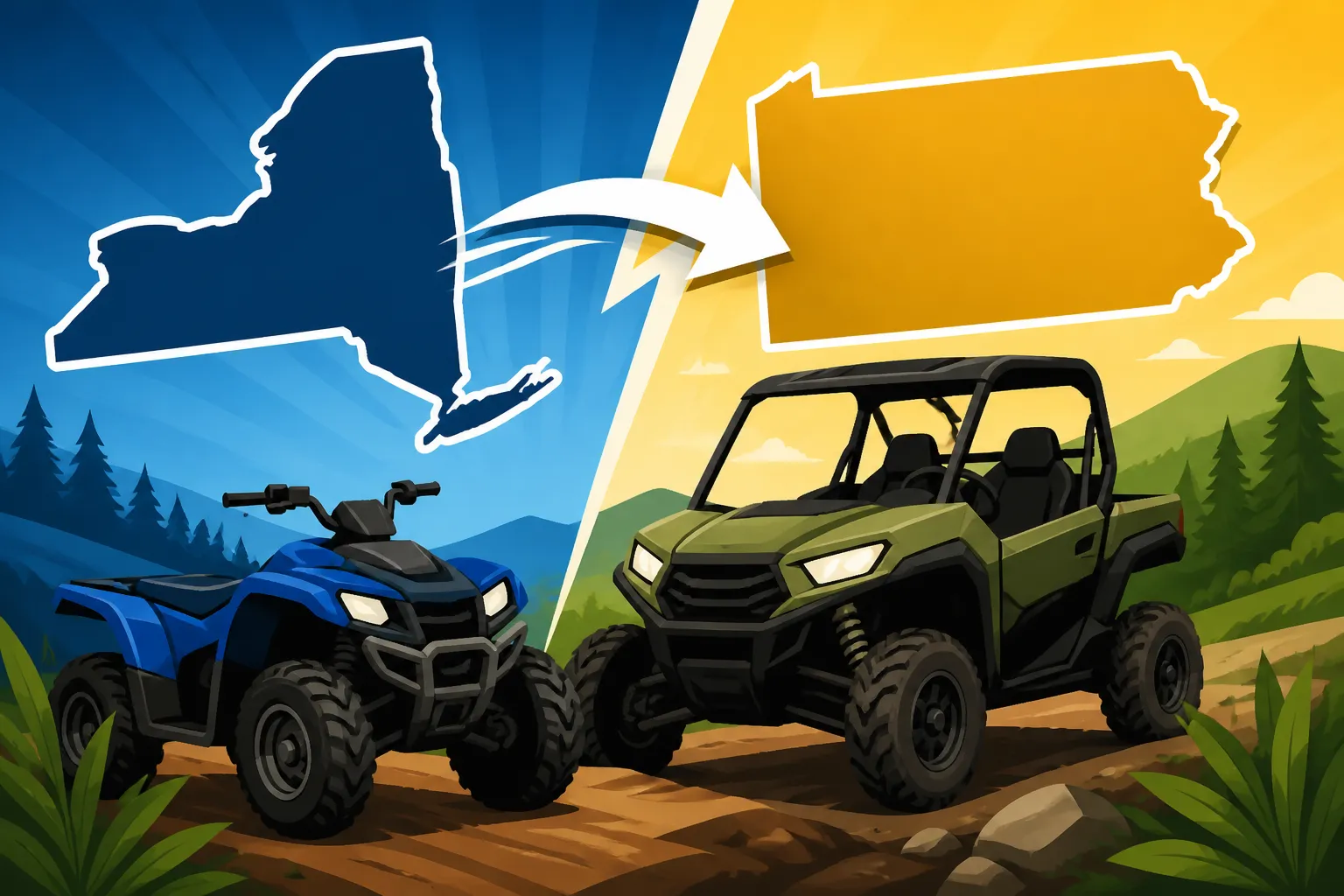
According to the Pennsylvania Department of Conservation and Natural Resources (DCNR), a nonresident ATV with valid out-of-state registration does not need Pennsylvania registration. That exception can apply to a New York-registered ATV while its owner is visiting Pennsylvania.
The important condition is that the out-of-state registration must be valid. If it has expired, or if you cannot show that the machine is registered, do not assume the visitor exception applies. Check the registration status and carry proof with you. For the broader rule, see Pennsylvania ATV Reciprocity With Other States and Carrying Proof of an Out-of-State Registration.
This exception is about Pennsylvania registration. It does not automatically authorize riding on a particular trail, forest road, township road, or parcel of private land. It also does not replace any separate permit a riding area requires. Before setting out, check the rules for the specific destination as well as the machine’s registration documents.
| What you are checking | What a New York visitor should know |
|---|---|
| Pennsylvania registration | DCNR does not require a nonresident ATV with valid out-of-state registration to register again in Pennsylvania. |
| Riding-area permit | A permit may still be required for a particular trail system or land manager. |
| Insurance | Liability insurance is required when riding on property you do not own or lease, and proof must be carried while riding. |
| Access and route rules | Registration does not make a closed route, undesignated trail, or private property open to riding. |
| Rider requirements | Pennsylvania safety, helmet, and age rules may apply even when the ATV is registered in New York. |
Pennsylvania generally requires ATVs to be registered and titled with DCNR, with exceptions for machines used solely for business or agricultural purposes. The out-of-state registration exception is a separate rule for nonresident machines, not a way for a Pennsylvania resident to avoid the state’s registration process. If your home or residency situation is complicated, compare Pennsylvania Registration for a Machine Registered Elsewhere with When a Pennsylvania Resident’s Quad Is Plated Elsewhere.
A useful test is to ask two separate questions: “Is this machine properly registered for a visitor?” and “Am I allowed to ride it at this location?” A yes to the first does not answer the second.
Registration is not the same as a trail permit
Pennsylvania’s riding areas do not all operate under one access system. Some require a permit in addition to valid vehicle registration, and the rules can depend on who manages the land. Check the destination before traveling rather than assuming that a New York plate or registration card is enough.
For example, DCNR requires a yearly permit for every rider using the Northcentral Regional ATV Trail. That trail covers parts of Clinton, Lycoming, Potter, and Tioga counties. The details are explained in Pennsylvania’s Northcentral Regional Trail Permit. A different permit applies to the federally operated Allegheny National Forest trail system; see Pennsylvania’s Allegheny National Forest Permit.
These examples matter because a permit requirement can apply even when Pennsylvania does not require you to register the ATV. Think of the documents as serving different purposes:
- Registration identifies the vehicle and shows it is registered under the applicable system.
- A riding-area permit grants access under the rules of a specific trail system or land manager.
- Insurance proof shows that you have liability coverage when it is required.
- A safety certificate may be required for certain younger riders.
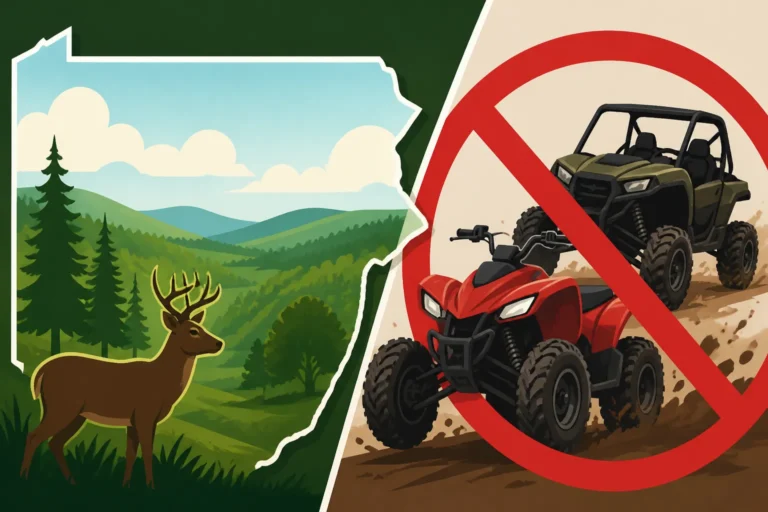
Pennsylvania has designated ATV trails, but a state forest is not an open riding area. According to DCNR, ATV riding in state forests is restricted to designated trails; state forest roads, state parks, and state game lands are not included in that permission. On state-owned property, ATVs may be operated only on clearly marked and designated trails. Before choosing a route, check Pennsylvania ATV Trail Permits Explained and the information for the specific trail.
Private property works differently. DCNR says an ATV may be operated on private property with the owner’s consent. Do not treat a trail visible on a map, a gate that happens to be open, or permission to park as permission to ride across private land. Confirm access with the landowner.
Road access is another separate issue. A machine’s New York registration does not by itself make a Pennsylvania road open to ATVs. Some township roads are designated for ATV use, and DCNR identifies those roads with a green sign featuring a white ATV-and-rider silhouette. Check the route and its posted status before riding on or crossing a road. A registration card is not a substitute for route authorization.
If you are planning a trip around a specific trail network, verify its current status, season, permit process, and machine restrictions directly before departure. Trail access can depend on the area and the route, so a permit for one system should not be assumed to cover another.
Insurance and documents to carry
A New York registration does not remove Pennsylvania’s insurance requirement. According to DCNR, riders must carry liability insurance when operating an ATV on property they do not own or lease, and they must carry proof of that insurance while riding. DCNR has not established minimum coverage standards for ATV liability insurance, so confirm with your insurer that your policy covers the use you plan to make of the machine.
A policy that covers an ATV at home may not cover every off-property use or every type of trail. Ask your insurer directly about recreational riding in Pennsylvania, the machine listed on the policy, and any exclusions that could affect coverage. Keep a way to show proof with you rather than relying on being able to retrieve it later. For more detail, see Pennsylvania ATV Registration and Insurance Proof and Finding an Insurance Policy That Covers Off-Road Use.
Before leaving, gather the documents and details that establish your eligibility to ride:
- The ATV’s current New York registration and any supporting ownership or registration paperwork you normally keep with the machine.
- Proof of liability insurance.
- Any trail-system permit required for your destination.
- A safety certificate if a young rider needs one.
- The destination’s rules, access instructions, and current trail status.
It can help to keep paper documents protected from water, mud, and abrasion. A small waterproof document sleeve from an outdoor retailer such as Amazon is one option; a secure compartment on your machine can work too. The main point is to keep the documents readable and available, not to rely on a phone or a loose paper that can be lost on the trail.
If the machine’s registration is close to expiring, confirm its status before you travel. If it is registered to someone else, or the name or machine details do not match what you are carrying, sort that out before riding. The visitor exception depends on a valid out-of-state registration; it is not a blanket waiver for machines with unclear paperwork.
Rules that still apply to visitors
A New York registration does not exempt a rider from Pennsylvania operating rules. The rules below are especially important for families and for anyone planning to ride away from private property.
According to DCNR, operators must wear a securely fastened helmet and eye protection while riding, and operating without a securely fastened helmet is illegal. Carrying passengers on an ATV is prohibited. Riders should also stay on trails specifically designated for ATVs, and riding under the influence of alcohol or other drugs is prohibited.
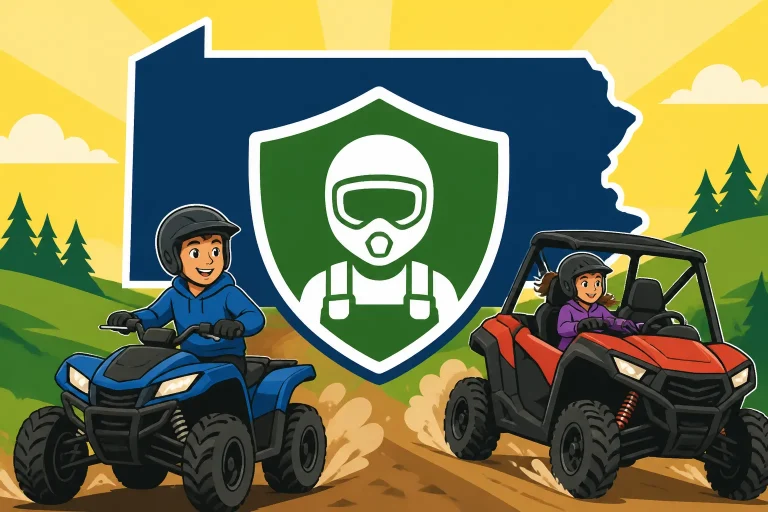
Age requirements can affect which areas a young visitor may use. According to DCNR, children aged eight through fifteen must complete an ATV safety course and receive a certificate to ride on land that does not belong to their parents or guardians. Children under eight are not permitted to ride ATVs on state-owned property. Riders aged eight and nine are restricted to ATVs with engines of 70cc or smaller. Review Pennsylvania Safety Certificates for Ages 8 to 15 before bringing a young rider.
Rules can also apply when a route crosses or uses a road. For example, DCNR says operators on joint-use roads open to ATVs and licensed motor vehicles must be at least sixteen years old. If your planned route includes a road, check the local designation and the applicable rider requirements rather than relying on the New York registration as evidence of road access.
A practical pre-ride check is to confirm the machine’s registration is valid, identify every permit required for the chosen area, confirm insurance coverage, and make sure each rider meets the applicable requirements. Then verify that the route is open to ATVs. If any part is uncertain, contact the relevant land manager before unloading.
The short version: a valid New York registration can satisfy Pennsylvania’s registration exception for a nonresident, but it does not serve as a trail permit, insurance policy, or permission to ride wherever you choose. Treat each requirement separately and carry the proof that applies to your trip.
Sources
- Pennsylvania Department of Conservation and Natural Resources — Home Page – Snowmobile/ATV Registration (checked November 3, 2026)
- Department of Conservation and Natural Resources — Safety and Training | Department of Conservation and Natural Resources| Commonwealth of Pennsylvania (checked November 3, 2026)
- Department of Conservation and Natural Resources — Riding Rules and Enforcement | Department of Conservation and Natural Resources| Commonwealth of Pennsylvania (checked November 3, 2026)
- Pennsylvania Department of Conservation and Natural Resources — Trail Conditions – Snowmobile/ATV Registration (checked November 3, 2026)
Disclaimer
This article is for general informational purposes only and does not constitute professional advice. Laws, prices and regulations vary by location and change over time. Consult a qualified professional for guidance on your specific situation.