When a State Refuses to Honor Pennsylvania Registration
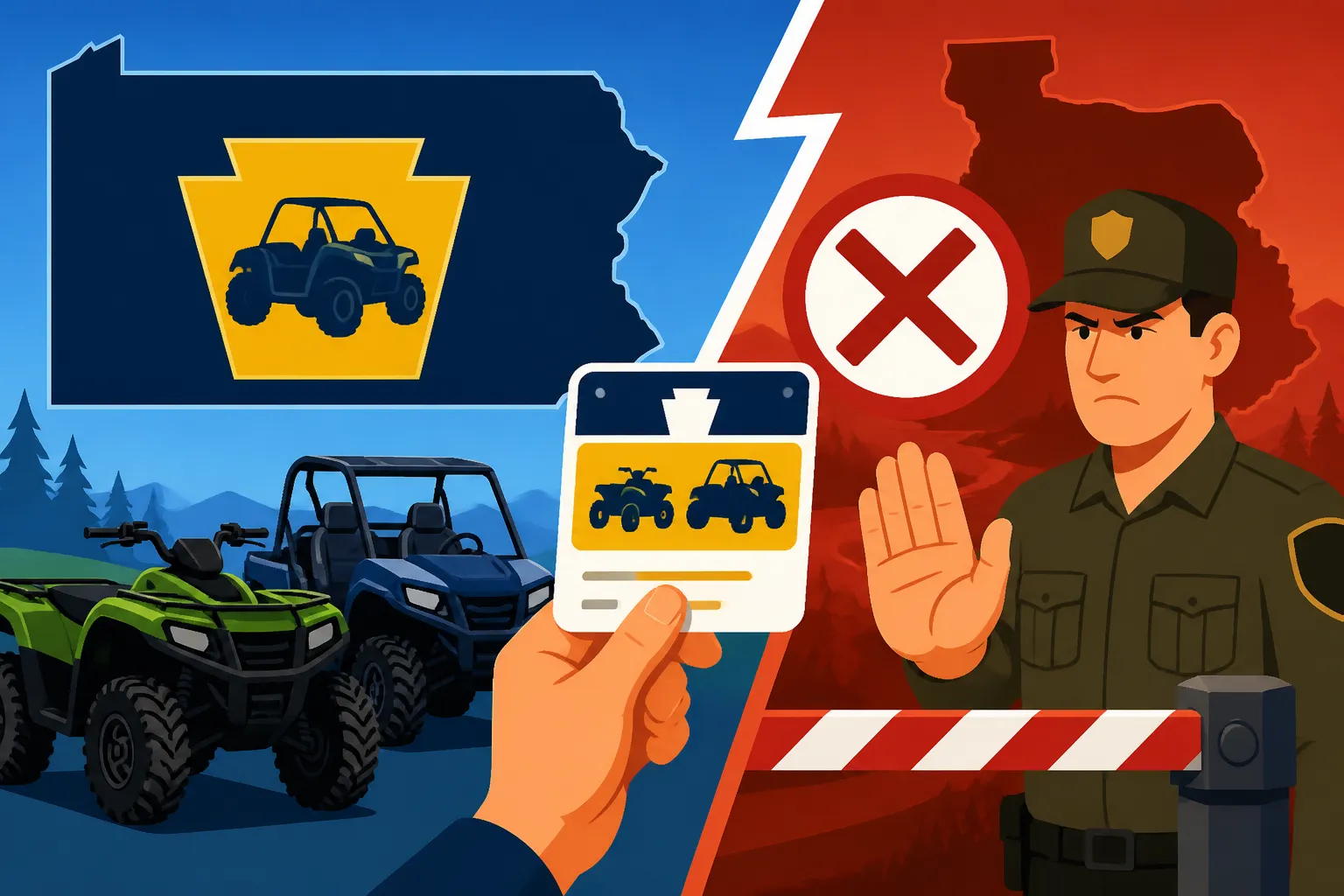
A Pennsylvania ATV or UTV registration does not guarantee that another state will accept it. Reciprocity can depend on that state’s rules, the machine’s use and the documents you carry. Before crossing the border, check whether your destination recognizes Pennsylvania registration, requires its own permit, or limits where a visiting machine may operate.
Why another state may not honor Pennsylvania registration
Registration generally connects a machine to the rules of the state that issued it. Reciprocity is a separate policy: the state you visit decides whether it will accept an out-of-state registration, and on what conditions. A Pennsylvania plate or registration card is useful proof, but it is not a nationwide trail pass.
A state may decline to recognize Pennsylvania registration because its law does not provide reciprocity, because reciprocity applies only to certain types of machines or uses, or because a visitor has not met a separate local requirement. The rules may also differ depending on whether you are riding on public land, a managed trail, a private park or a road.
These distinctions matter because “registration” can mean different things in different places. One state may use registration mainly to identify a machine, while another may require a trail permit, an off-highway vehicle sticker or additional proof before allowing trail use. A state can recognize your Pennsylvania registration for identification purposes yet still require a separate permit for a particular trail system.
Pennsylvania’s reciprocity rules are conditional, too. Do not assume that recognition works in both directions or applies automatically to every state. Review Pennsylvania ATV Reciprocity With Other States and Pennsylvania’s Conditional Reciprocity Rule to understand why the rules depend on the state involved. For a trip outside Pennsylvania, the destination state’s current requirements are the ones to verify.
A refusal does not necessarily mean the registration itself is invalid. It may mean the destination does not accept it as a substitute for its own requirement. For instance, an officer or trail operator might accept the card as evidence that the machine is registered in Pennsylvania but still require a local permit, proof of insurance or permission to ride that property.
| What the destination may do | What it means for your trip |
|---|---|
| Recognize Pennsylvania registration | You may still need to meet trail, insurance, age or equipment rules. |
| Recognize it only for certain machines or uses | Confirm that your ATV or UTV and planned riding area qualify. |
| Require a local permit or sticker | Carry the Pennsylvania registration and obtain the additional permit if required. |
| Not recognize it | Ask what registration or permit a visitor must obtain before riding. |
| Treat road use differently from trail use | Check road rules separately; trail eligibility does not automatically authorize road travel. |
The safest approach is to separate three questions: Is the machine properly registered? Is it permitted on the specific land or trail? Is the planned route legal for that type of machine? A yes to one does not answer the others.
What to check before you travel
Check the destination’s rules before loading the machine. Use the official state agency or land manager responsible for the place you plan to ride, rather than relying only on an old forum post, a friend’s past trip or a general statement that a state “has reciprocity.” Requirements can vary between state parks, forests, public trails, private riding areas and roads.
Start with the exact riding location and route. A state may have one rule for a public trail system and a different one for a road or a privately operated park. Ask whether a visiting Pennsylvania machine needs a destination-state registration, temporary permit, trail pass or other authorization. If you plan to cross into more than one state, check each one separately.
Then confirm which documents and conditions apply. A useful pre-trip checklist includes:
- Registration recognition: Ask specifically whether the destination recognizes a Pennsylvania ATV or UTV registration for a nonresident.
- Additional permits: Find out whether the trail, land manager or park requires its own permit even when it accepts the Pennsylvania registration.
- Proof to carry: Confirm whether you need the original registration card, a copy, a plate, a decal or another document displayed on the machine.
- Insurance: Check whether insurance is required for the planned riding area and what proof must be carried. Do not assume your home-state requirement answers the destination’s rule.
- Machine eligibility: Ask about limits or special rules for machine type, size, width, age or equipment if relevant to the area.
- Rider requirements: Check any minimum-age, supervision, helmet or safety-certificate rules that apply to your rider and route.
- Road use: If the trip involves a public road, verify road access separately. Registration reciprocity does not make a road open to ATVs or UTVs.
For a Pennsylvania resident riding elsewhere, Riding Pennsylvania With an Out-of-State Plate may help clarify the separate question of how Pennsylvania treats a machine registered in another state. If you are a visitor bringing a machine into Pennsylvania, see Does Pennsylvania Honor an Out-of-State Registration? and Carrying Proof of an Out-of-State Registration. The rules in one direction should not be treated as proof of the rules in the other.
When the written rules are unclear, contact the agency or land manager directly. Be precise: give the machine type, the state where it is registered, your visitor status and the exact trail or property you intend to use. Ask what document you should carry and whether you need to obtain anything before arrival. Save the agency’s written response or the relevant official instructions with your trip paperwork. A phone answer can be useful, but a written record is easier to refer to later.
Do not rely on a registration search or a plate alone to establish that you can ride. A plate may identify the machine without showing that it meets the destination’s permit requirements. Likewise, a park’s admission or day pass may cover access to that private property without satisfying state registration rules. Confirm each layer separately.
What to do if an officer or trail operator refuses the registration
If someone tells you that Pennsylvania registration is not accepted, stay calm and ask what requirement is missing. A clear question can distinguish between a missing permit, a document that is not being recognized, a machine that is ineligible for the route, or a misunderstanding about the rules.
Have your Pennsylvania registration card and other required paperwork ready. If you have a permit or written instructions from the land manager, show them without assuming that they override an officer’s direction. You can ask politely which rule applies and where to find the official requirement. Avoid arguing on the roadside or continuing to ride while the issue remains unresolved.
If the refusal comes from a trail operator or private park employee, ask whether the issue is the property’s own admission policy or a state requirement. A private operator can impose access conditions beyond what the state requires. If the machine is not allowed under those conditions, do not ride there until you have permission or meet the stated requirements.
If an officer issues a citation, follow the instructions on the citation and keep copies of your registration, permit, insurance documents and any written guidance you received before the trip. Record the date, location and the reason given for the refusal while the details are fresh. Do not treat a roadside discussion as a final legal determination, and do not ignore a citation because you believe your Pennsylvania registration should have been accepted. For Pennsylvania-specific citation concerns, Appealing a DCNR Citation explains a separate process; procedures elsewhere depend on the state that issued the citation.
A refusal may also reveal a genuine gap in your paperwork. If the destination requires its own permit, obtain it through the proper channel before riding again. If you believe the requirement was misapplied, contact the responsible agency after the encounter and ask how to request clarification or review. Keep the communication factual and provide copies rather than surrendering your only documents unless an official procedure requires it.
Avoid trying to solve the issue by changing a plate, displaying a decal that does not belong to the machine or presenting a registration from a different vehicle. That can turn a confusion about reciprocity into a more serious compliance problem. If you cannot verify that the machine is authorized for the area, stop riding there until you can.
How to reduce the chance of a problem on the next trip
Build a short document folder for the machine and keep the original registration card secure. Carry the required proof in a place where it is protected from water and mud but can be reached during a check. A waterproof pouch or document holder can help keep papers legible; it does not replace any document the destination requires. If you use a digital copy as backup, do not assume it will be accepted instead of the required original.
Before departure, compare the paperwork to the machine. Check that the registration applies to the machine you are transporting, that the plate or decal is displayed as required, and that the identification details are consistent. If you have questions about Pennsylvania documents, What the DCNR Wallet Card Is For and Carrying Proof of an Out-of-State Registration cover why registration proof matters and how visitors should prepare.
Keep a copy of the destination’s official instructions with the trip plan. Note the agency or property contact and ask whether rules change by season, trail or machine class. If a permit must be displayed, confirm where it goes and whether each machine needs its own. A group should check every machine individually rather than assuming that one rider’s permit covers everyone.
Use this final check before leaving home:
- Confirm reciprocity with the destination, not just with a general travel website.
- Verify the specific trail, property and route you plan to use.
- Obtain any separate local permit before riding.
- Carry the registration and other required documents for each machine.
- Check insurance, rider, equipment and road rules independently.
- Keep official contact details and written guidance accessible.
- Stop and clarify the rule if someone says the registration is not accepted.
The practical takeaway is simple: Pennsylvania registration is important evidence, but it does not guarantee access in another state. Treat reciprocity as a destination-specific rule, verify it before the trip, and prepare for additional permits or conditions. That small check can prevent a wasted ride, a denied trail entry or an avoidable citation.
Disclaimer
This article is for general informational purposes only and does not constitute professional advice. Laws, prices and regulations vary by location and change over time. Consult a qualified professional for guidance on your specific situation.