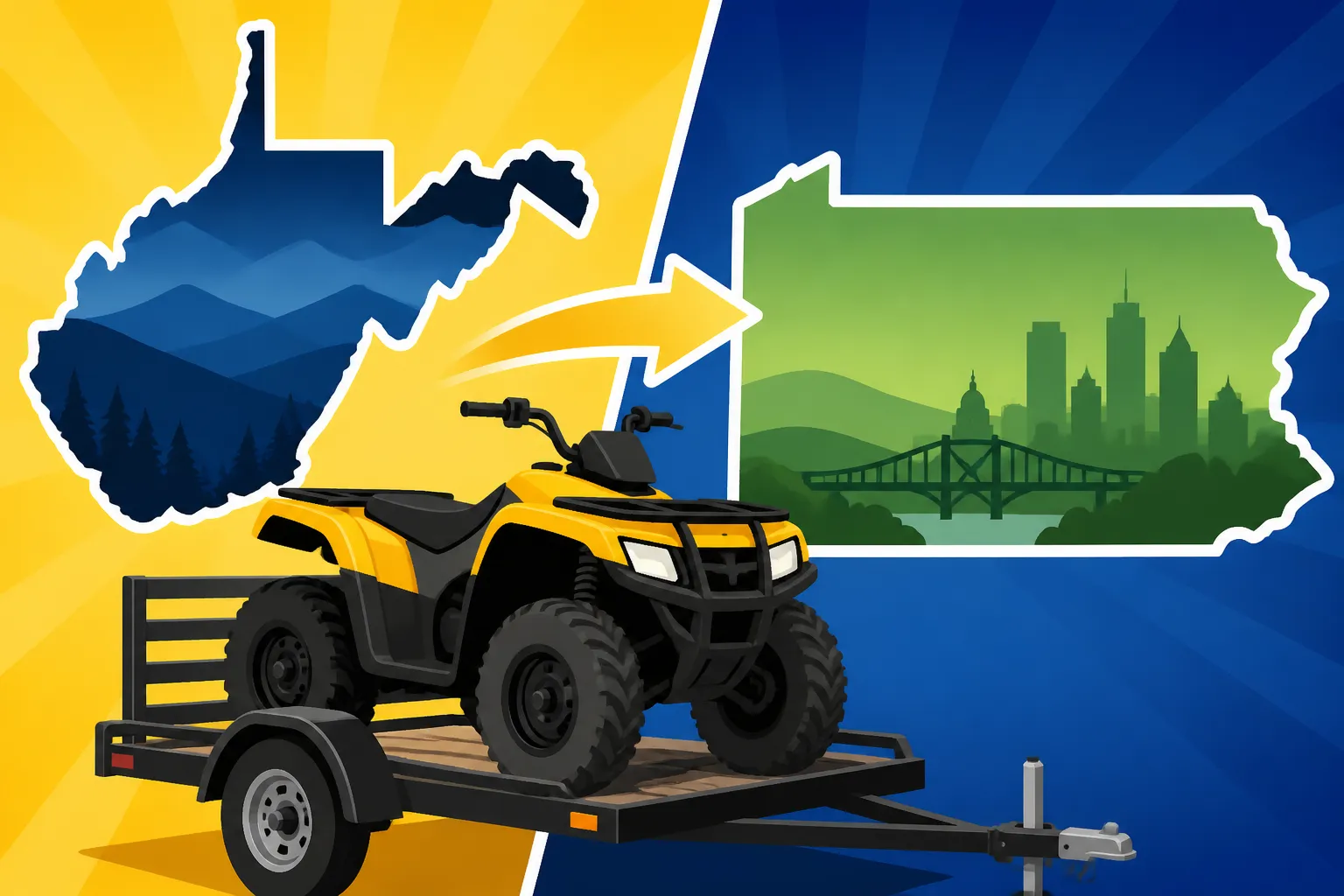
Bringing a West Virginia Registered Quad Into Pennsylvania
A West Virginia plate does not automatically settle every Pennsylvania riding requirement. If you are visiting with a quad that has valid out-of-state registration, Pennsylvania generally does not require a second registration—but insurance, trail access, permits, and rider rules still matter. The key is to confirm where you plan to ride and carry the documents that show your machine is properly registered and insured.
Does a West Virginia registration work in Pennsylvania?
According to the Pennsylvania Department of Conservation and Natural Resources, a nonresident ATV with valid out-of-state registration does not need Pennsylvania registration. That means a visitor with a properly registered West Virginia quad can generally ride in Pennsylvania without applying for a Pennsylvania plate.
That exemption is about registration. It does not give you automatic access to every trail, replace insurance, or make a quad legal on roads that are closed to ATVs. For a closer look at the out-of-state registration rule, see Does Pennsylvania Honor an Out-of-State Registration? and Pennsylvania Reciprocity With West Virginia.
| Your situation | Pennsylvania registration requirement | What to check |
|---|---|---|
| You are visiting with a valid West Virginia registration | Pennsylvania registration is not required for a nonresident ATV with valid out-of-state registration, according to the Pennsylvania Department of Conservation and Natural Resources | Keep your registration current and carry proof |
| Your West Virginia registration is expired or otherwise invalid | The nonresident exemption is stated for valid out-of-state registration, according to the Pennsylvania Department of Conservation and Natural Resources | Confirm your registration status before traveling |
| You are moving to Pennsylvania or are a Pennsylvania resident using a West Virginia registration | The nonresident exemption may not fit your situation | Confirm the applicable rule with DCNR; see When a Pennsylvania Resident’s Quad Is Plated Elsewhere |
| You plan to ride private property only | The out-of-state registration rule still applies to registration, but property permission matters | Get the owner’s consent; see Pennsylvania Rules for Riding Private Property |
| You plan to use a designated trail system | A valid West Virginia registration does not, by itself, establish that you have every required trail permit | Check the requirements for that particular trail |
The practical distinction is between your status and the machine’s paperwork. The exemption specifically refers to nonresident ATVs with valid out-of-state registration. If you live in Pennsylvania, have recently moved there, or are unsure whether you count as a nonresident for this purpose, do not assume the visitor exemption applies. Start with Pennsylvania ATV Registration After Moving to the State or When a Pennsylvania Resident’s Quad Is Plated Elsewhere, then confirm your circumstances with DCNR.
Also keep your West Virginia registration current and bring evidence of it. A plate alone may not answer questions about the registration’s validity, especially if the document is stored at home or the plate is hard to read. Keep the registration information with you, and make sure the details match the quad you are bringing.
Pennsylvania generally requires ATVs to be registered and titled with DCNR, according to the Pennsylvania Department of Conservation and Natural Resources, but it lists nonresident machines with valid out-of-state registration as an exception. That does not mean every other exception or registration category applies to an out-of-state visitor. For example, do not assume that a machine’s farm use, age, or ownership status creates an exemption unless the applicable rule covers your specific situation.
If you are buying a quad in West Virginia and bringing it to Pennsylvania, that is a different question from visiting with a machine already registered there. The visitor exemption does not settle the paperwork required after a purchase or a change of residence. See Registering an Out-of-State Machine in Pennsylvania and Pennsylvania Use Tax on an Out-of-State Purchase for those situations.
Insurance and documents to carry
Registration reciprocity does not remove Pennsylvania’s insurance requirement. According to the Pennsylvania Department of Conservation and Natural Resources, you must carry liability insurance when riding an ATV on property you do not own or lease. You must also carry proof of liability insurance with you while riding.
That requirement can affect a visiting rider even when the quad is properly registered in West Virginia. If you leave your own property and ride somewhere else, make sure your policy provides liability coverage for ATV use and that you can show proof of coverage. Pennsylvania does not establish minimum coverage amounts or other coverage standards for ATV liability insurance, according to DCNR. Ask your insurer what the policy covers rather than relying only on the fact that the machine is registered.
A useful pre-trip document check includes:
- The current West Virginia registration or other proof that the out-of-state registration is valid.
- Proof of liability insurance that you can carry while riding.
- Any trail-specific permit or pass required for your destination.
- A safety certificate if a young rider needs one under Pennsylvania rules.
- A phone number or policy details for your insurer in case you need to confirm coverage.
Keep paper documents in a secure, weather-resistant holder, or use a protected digital copy where that is practical. A small waterproof document pouch, such as one available through Amazon, can help protect papers from rain and trail mud; it does not replace carrying any original or physical proof that the rules require.
For the insurance details and what proof to have on hand, see Pennsylvania ATV Registration and Insurance Proof. The important point is simple: a valid West Virginia registration answers the registration question for a nonresident, but it does not prove that you have the insurance required for riding away from property you own or lease.
It is also wise to check that the registration plate is secure and readable before loading the quad. Pennsylvania specifies that its registration plate must be mounted on the upper rear, away from the tires, and visible from behind, according to the Pennsylvania Department of Conservation and Natural Resources. The sticker for a Pennsylvania-issued plate goes in the bottom corner of the plate area. If your quad has a West Virginia plate, follow the requirements attached to that registration and avoid modifying or obscuring it. For Pennsylvania plate placement details, see Pennsylvania ATV Plates and Where They Mount.
Do not treat a registration card, insurance card, or trail permit as interchangeable. Each answers a different question: whether the quad is registered, whether the required liability insurance is in place, and whether you can use a particular riding area. Why Both Might Be Required explains why state registration and trail access can be separate requirements.
Registration is not trail permission
Pennsylvania’s out-of-state registration exemption does not open every trail to visitors. Access rules depend on the land and trail system. The Pennsylvania Department of Conservation and Natural Resources says ATVs may be operated on private property with the owner’s consent and on state-owned property only on clearly marked and designated trails. In other words, do not use an ATV trail map as permission to ride every nearby road or track.
For state forest trails, Pennsylvania has designated routes and a defined riding season. According to the Pennsylvania Department of Conservation and Natural Resources, designated ATV trails on state forest lands are open from the Friday before Memorial Day through the last full weekend in September. Riding is restricted to designated trails; state forest roads, state parks, and state game lands are not included as general ATV riding areas under that rule. Check the current status of the specific trail before setting out, since access can depend on closures or other restrictions.
Some trail systems also require their own permits. For example, the Northcentral Regional ATV Trail requires a yearly permit for all riders, according to the Pennsylvania Department of Conservation and Natural Resources. The Allegheny National Forest has a separate ATV trail permit requirement; DCNR lists its annual permit fee as $35 as of November 2026. A valid West Virginia plate does not replace either permit. Check Pennsylvania ATV Trail Permits Explained and Pennsylvania’s Allegheny National Forest Permit before choosing a destination.
| Where you want to ride | What to confirm before unloading |
|---|---|
| Private property | The owner has given consent; Pennsylvania permits ATV use on private property with the owner’s consent, according to DCNR |
| State forest ATV trail | The route is clearly designated, open for riding, and suitable for your machine |
| Northcentral Regional ATV Trail | You have the yearly permit required for all riders, according to DCNR |
| Allegheny National Forest ATV trail system | You have the separate permit required for that system |
| A road or connector | The road is specifically open to ATVs; a nearby trail connection does not automatically make the road legal |
Road riding deserves particular care. Pennsylvania does not allow a visitor to assume that a road is open just because it connects two trails or leads to a staging area. Township roads designated for ATVs are identified with a green sign featuring a white side-view silhouette of an ATV and rider, according to the Pennsylvania Department of Conservation and Natural Resources. On joint-use roads open to ATVs and licensed motor vehicles, operators must be at least 16 years old, according to DCNR. For crossings and road access, see Pennsylvania Rules for Crossing a State Route and Pennsylvania Rules for Riding a Township Road.
Machine width can also affect where you ride. DCNR defines Class I ATVs as motorized off-highway vehicles with three or more inflatable tires, a maximum width of 50 inches, and a maximum dry weight of 1,200 pounds. Class II machines exceed 50 inches in width or 1,200 pounds in dry weight and may be used on state forest land only where a trail is specifically posted open to them, according to the Pennsylvania Department of Conservation and Natural Resources. Check the limits for your destination before towing a wide machine across the state.
Before you ride: a practical Pennsylvania checklist
A smooth visit starts with a few checks at home and another check at the trailhead. Pennsylvania’s rules apply to riders using Pennsylvania land even when the quad carries a West Virginia registration.
Before leaving:
- Confirm that your West Virginia registration is valid and that the registration details match the quad.
- Check your insurance policy for ATV liability coverage, and put proof where you can carry it while riding.
- Choose a legal riding area and verify its current access rules and permit requirements.
- Confirm that your machine fits the width and other limits for the trails you intend to use.
- If a child will ride, check Pennsylvania’s age, training, and machine-size requirements before the trip.
Pennsylvania requires children between 8 and 15 years old to complete an ATV safety course and obtain a certificate to ride on land that does not belong to their parents or guardians, according to the Pennsylvania Department of Conservation and Natural Resources. Children under 8 are not permitted to operate an ATV on state-owned property, and children aged 8 and 9 are restricted to machines with engines of 70cc or smaller, according to DCNR. Children aged 16 or older must take the online ATV Safety Training course, according to the Pennsylvania Department of Conservation and Natural Resources. See Pennsylvania Safety Certificates for Ages 8 to 15 for more on the youth requirements.
Before unloading at the destination:
- Read signs at the entrance and at trail junctions; do not assume an unmarked route is open.
- Confirm that the trail system’s permit covers your machine and the riding area.
- Keep required documents and proof of insurance accessible.
- Check that the plate is secure and visible and that nothing blocks it.
- Wear a securely fastened helmet and eye protection.
Pennsylvania requires ATV operators to wear a securely fastened helmet and eye protection at all times, according to the Pennsylvania Department of Conservation and Natural Resources. DCNR also prohibits carrying passengers on an ATV and riding under the influence of alcohol or other drugs. Young or inexperienced riders should have proper training and supervision. These rules are separate from the registration question, so a properly registered visitor still needs to follow them.
If an accident occurs, stop and exchange personal and vehicle information with the people involved or a police officer, as required by the Pennsylvania Department of Conservation and Natural Resources. DCNR also requires reporting qualifying accidents involving injury, death, or property damage over $100 within seven days. Keep the trip focused on permitted routes, carry your documents, and check the specific trail rules rather than relying on the West Virginia plate as proof that every kind of riding is allowed.
Sources
- Pennsylvania Department of Conservation and Natural Resources — Home Page – Snowmobile/ATV Registration (checked November 3, 2026)
- Department of Conservation and Natural Resources — Safety and Training | Department of Conservation and Natural Resources| Commonwealth of Pennsylvania (checked November 3, 2026)
- Pennsylvania Department of Conservation and Natural Resources — Request Youth ATV Rider Training | Commonwealth of Pennsylvania (checked November 3, 2026)
- Department of Conservation and Natural Resources — Riding Rules and Enforcement | Department of Conservation and Natural Resources| Commonwealth of Pennsylvania (checked November 3, 2026)
- Department of Conservation and Natural Resources — ATV Riding | Department of Conservation and Natural Resources| Commonwealth of Pennsylvania (checked November 3, 2026)
- Pennsylvania Department of Conservation and Natural Resources — Trail Conditions – Snowmobile/ATV Registration (checked November 3, 2026)
- Department of Conservation and Natural Resources — Northcentral Regional ATV Trail | Department of Conservation and Natural Resources| Commonwealth of Pennsylvania (checked November 3, 2026)
- DEPARTMENT OF CONSERVATION AND NATURAL RESOURCES — Report an ATV or Snowmobile Accident | Commonwealth of Pennsylvania (checked November 3, 2026)
Disclaimer
This article is for general informational purposes only and does not constitute professional advice. Laws, prices and regulations vary by location and change over time. Consult a qualified professional for guidance on your specific situation.