Pennsylvania Rules for a Rented Machine
Pennsylvania Rules for a Rented Machine
Renting an ATV or UTV can make a Pennsylvania trail trip simple, but the rental does not automatically cover every legal requirement. You still need to know where the machine may go, whether a trail permit is required, what paperwork must be on board, and which rules apply to you as the rider. This guide explains what to confirm before you sign and ride.
Start With the Difference Between the Machine and the Rider
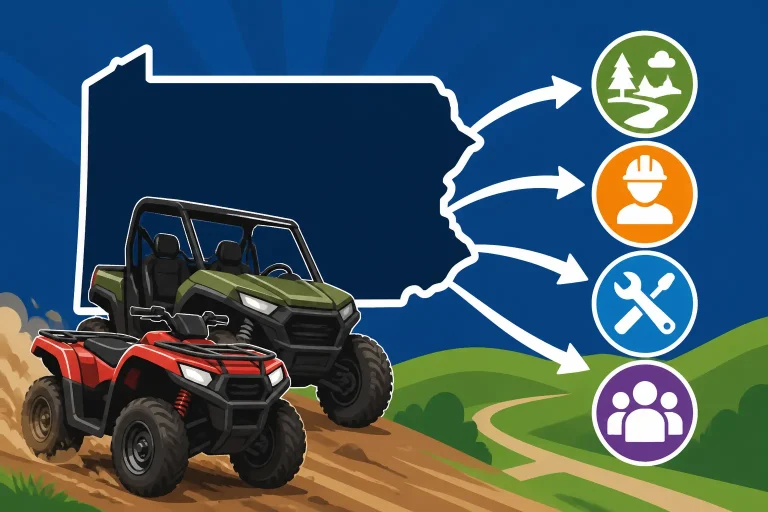
A rental machine comes with an owner, a contract, and often some paperwork. It does not turn every trail, road, or piece of public land into an approved place to ride. The first useful distinction is between requirements tied to the vehicle and requirements tied to the person operating it.
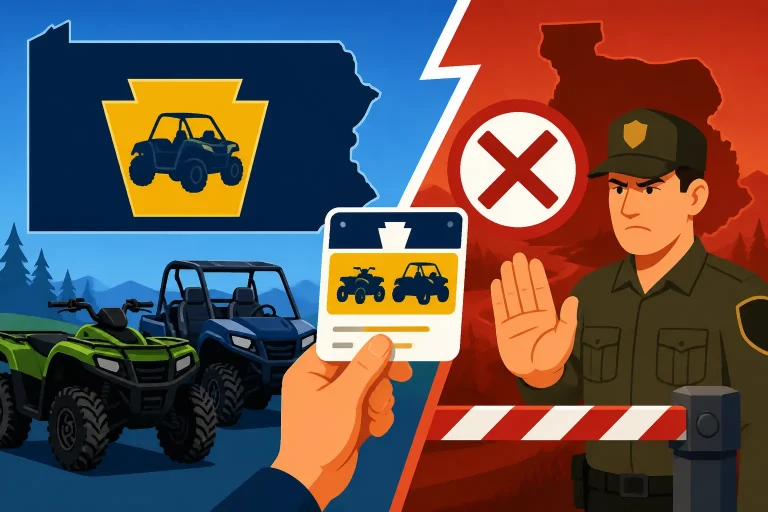
The rental company may handle the machine’s registration, insurance, maintenance, and permission to use its equipment. You are still responsible for following riding rules, staying within the allowed area, and meeting any age or safety requirements. Some access permits also apply to a particular machine or location, so the company’s statement that the ATV is “registered” may not answer whether you can take it onto a specific trail.
Before booking, establish three things:
- Where can the rental be ridden? Ask for the exact trail system, property, or route included in the rental.
- What paperwork and permits are included? Ask specifically about registration, liability insurance, and any land- or trail-specific permit.
- Who may operate it? Confirm the minimum age, supervision rules, passenger limits, and whether every driver must be named or approved in the rental agreement.
Those answers should match your actual ride plan. “It’s legal in Pennsylvania” is not enough. A machine can be properly registered and insured while still being prohibited on a particular trail or road.
| Question | Usually connected to | What to confirm with the rental company |
|---|---|---|
| Is the machine registered? | The machine and its owner | Registration is current and the proof will be available during the ride |
| Is insurance in place? | The machine, policy, and approved use | The policy applies to this rental and the places you plan to ride |
| Is a trail permit needed? | The land, trail system, or machine | Whether the required permit is included and where it is valid |
| May I operate it? | The rider and rental contract | Minimum age, license or certificate requirements, and approved drivers |
| May I carry a passenger? | The machine’s design and the rules where you ride | The machine is built for a passenger and your agreement allows one |
| May I use a road connector? | The road and local designation | The route is specifically open to ATVs or UTVs and the rental allows road use |
A rental outfitter’s rules can be stricter than the state’s minimum rules. It may limit riders by age, require a guided tour, prohibit passengers, or keep the machine on its own property. Those restrictions still matter even if a state law would otherwise allow the ride.
For an overview of how access permits differ from registration, see Pennsylvania ATV Trail Permits Explained. If your trip is a short visit rather than a local rental, What a Weekend Visitor Needs to Ride Pennsylvania can help you organize the other requirements.
Ask Exactly What the Rental Includes
Rental listings often group several things under words such as “ready to ride,” “permit included,” or “fully equipped.” Ask what each phrase means. One company may include a guided route and safety gear; another may provide only the machine and a map. Even when the rental company handles its own paperwork, you need to know what you are expected to carry.
Registration is not the same as permission to use every trail
Pennsylvania has different registration types, and access rules depend on where you ride. A machine’s registration is not a universal trail pass. Nor does a rental company’s registration necessarily cover an access permit required by a particular land manager, club, or private riding park.
Ask the company to identify the registration type and confirm that it is valid for the planned use. If you are riding a public trail, ask whether the machine has the registration and any additional permit required for that trail. If the company says “the machine is registered,” follow up with: “Does that include the permit for this specific riding area?”
This distinction is especially important if you plan to leave the rental property. A machine may be intended for a private course or guided route and not be approved for public roads or other trail networks. A rental agreement may prohibit you from taking it beyond a defined boundary, regardless of whether another trail is nearby.
Permits may be tied to a particular place
Pennsylvania has several kinds of riding access, and the requirements are not interchangeable. A permit for one public-land system does not necessarily authorize riding in another. Some trail systems are free to use when open, while others require a separate permit or have their own access arrangements. Private parks and club trails set their own entry requirements.
When a rental company says a permit is included, ask:
- Which exact riding area does it cover?
- Is it valid for the date of your rental?
- Is it already associated with the machine, or must you display or carry something?
- Does it cover everyone in your group or only the rented vehicle?
- Does it allow the route you have in mind, including any connector roads?
- What happens if you want to ride outside the company’s usual area?
For a machine intended for state forest riding, check the specific trail and permit rules rather than relying on a general statement about Pennsylvania access. Do You Need a Permit for Pennsylvania State Forest Trails? explains why the answer can vary by location. Visitors considering a Northcentral trail should also review Pennsylvania’s Northcentral Regional Trail Permit.
Ask about the Allegheny National Forest separately
The Allegheny National Forest has its own ATV access requirements. Do not assume that a rental company’s state registration, general trail permission, or another permit satisfies those requirements. Ask whether the rented machine is eligible for the planned route and whether the required forest permit is supplied or must be obtained separately.
The rental company should be able to tell you what documents you need to show and where the permitted route begins and ends. If the answer is unclear, use What the Allegheny Permit Requires You to Show as a checklist, then confirm details with the official land manager before going.
Get the answer in writing
A phone conversation can help, but put important details in a booking message or rental agreement. Ask the company to state the trail area included, the permit arrangements, whether road use is allowed, and what paperwork it will provide.
Written confirmation is useful when you arrive at a trailhead, when a ranger or officer asks about the machine, or if a last-minute route change comes up. It also helps you spot a mismatch before paying. If you were told that permits were included but the agreement excludes them, resolve that before your reservation begins.
For more detail about rental-permit expectations, see Does a Rental Include the Permit?.
Confirm Registration, Insurance, and Documents Before Leaving
A rental company should tell you what documents accompany its machine and how you are expected to carry them. Do not assume that a photo of a document on the company’s phone is enough, or that the company will be reachable whenever you need help. Ask what the law and the rental operator require you to have with you.
Registration proof
Before departing, confirm that the machine’s registration is current and that the required registration display is present and readable. Ask whether you will receive a wallet card, paper proof, or another document, and where it should be carried. If the rental has an enclosed storage compartment, learn how to access it without damaging or losing anything.
If the machine is registered in another state, that fact alone does not settle whether its registration is accepted for the planned Pennsylvania ride. Reciprocity can depend on the home state and the circumstances. See Pennsylvania ATV Reciprocity With Other States and ask the rental company to explain how its machine qualifies.
Do not alter, remove, cover, or relocate a registration plate or sticker. If a plate is loose, missing, or difficult to read, tell the company before riding. A rental machine’s paperwork issue is not something to repair on your own.
Insurance proof and rental coverage
Ask whether liability insurance applies to the rental, the driver, and the riding area. A machine may have insurance for some uses but not others. A policy may also place conditions on who can operate it, whether passengers are allowed, or whether the machine can be used off the rental property.
Ask the rental company:
- Is liability coverage in place for the planned ride?
- Does it cover every person who may operate the machine?
- Is the coverage valid on the specific trail or road route?
- Is there a deductible or a damage responsibility under the contract?
- Does the contract distinguish collision damage from liability claims?
- What should you do immediately after an accident?
Do not treat a damage waiver as the same thing as liability insurance. A waiver may address damage to the rental machine under the contract, while liability coverage concerns harm or damage involving other people or property. Read the terms and ask the company to explain any distinction you do not understand.
Pennsylvania insurance rules can depend on where and how the machine is operated. For a broader explanation of the paperwork question, see Pennsylvania ATV Registration and Insurance Proof. If you are asked to show proof of coverage to access a particular area, verify that the document and policy meet that location’s requirements.
The rental agreement is part of your ride plan
Read the contract before you arrive if possible. Pay attention to the approved riding area, driver qualifications, passenger rules, return time, fuel expectations, damage responsibilities, and procedures for a breakdown or injury. Ask whether the machine may be used after dark, on public roads, or on trails outside the company’s normal route.
Make sure every intended operator is approved. Do not assume that a friend or family member may take a turn just because they are present at the rental. A contract may restrict operation to named or otherwise authorized drivers. If a second person will drive, ask the company to add or approve that person before the ride.
Save the rental company’s emergency number and the machine’s identifying information. Know how to report your location if you are on a remote trail and lose cell service. If the company provides a map, ask whether it marks boundaries, closed sections, approved connectors, and return points.
Match Your Age, Experience, and Group to the Machine
The machine may be available to rent, but that does not automatically mean every person in your group can legally or safely operate it. Pennsylvania rules can depend on the rider’s age, the location, and the kind of machine. Rental operators may set higher age limits or require adult supervision beyond what a rider expects.
Check age and safety requirements before booking
Tell the company the age of each person who plans to operate, not only the person making the reservation. Ask whether young riders need a safety certificate, whether a supervising adult must be present, and whether age restrictions change between private property and public land.
If a child will ride, do not treat a child-sized machine as an automatic exception to public-land rules. Confirm the requirements for the specific trail and the specific machine. Pennsylvania Rules for Riders Aged 8 to 15 is a useful place to start, and Does Pennsylvania Accept an Out-of-State Safety Certificate? may help if a young rider completed training elsewhere.
Also confirm what counts as supervision. A company may require an adult to ride alongside a minor, not merely remain at the staging area. Do not book first and hope to resolve this at check-in; age rules can affect whether the rental can go ahead.
Choose a machine that fits the rider and terrain
A rental machine can feel very different from a personal ATV. Ask for a brief explanation of the controls, gear selection, braking, throttle, four-wheel drive, and any transmission or differential settings. If you have never operated a similar machine, say so. A responsible outfitter should be willing to explain the basics and help you choose a suitable route.
For a UTV, confirm that everyone has a designated seat and restraint. Do not carry someone on a fender, cargo bed, or other area not designed for passengers. For an ATV, confirm whether the machine is designed for a passenger and whether the rental company allows one. A second seat or footrests do not override a trail rule or contract restriction.
A passenger also changes how a machine handles. Ask the company whether the machine is suitable for two people on the route and whether passengers must meet age or size conditions. If the answer is vague, choose a single-rider plan or a UTV with proper seating rather than improvising.
Helmets and protective equipment
Ask whether helmets, eye protection, and other gear are supplied, and whether the supplied equipment fits each rider. A helmet that is damaged, poorly fitted, or the wrong size is not a good substitute for properly fitting gear. Confirm what is required by law and what the rental company requires; the company may set a stricter standard.
Pennsylvania has helmet rules for ATV riders, with details that can depend on the rider and circumstances. Review Pennsylvania Helmet Law for ATV Riders before setting out, and ask the rental operator what it expects for both operators and passengers. Do not assume that a helmet is optional because the rental company has one available or because the ride is short.
If you prefer your own helmet or goggles, bring them only if they are suitable and accepted by the operator. If you need to fill small gear gaps, Amazon can be one place to compare items such as gloves or a waterproof phone pouch, but do not rely on a retailer description as proof that protective equipment meets a legal or safety standard. Ask the rental company what specifications it accepts.
A second Amazon mention can be useful for non-protective items: a small dry bag for personal belongings may help keep keys and documents dry, but confirm that it can be secured without interfering with controls or passenger space. Keep loose objects out of the rider’s way. The machine’s cargo limits and storage instructions take priority over convenience.
Stay Within the Approved Route and Understand Road Limits
One of the easiest ways to get into trouble with a rental machine is to assume that a visible trail, forest road, or connector is open to ATVs and UTVs. Pennsylvania access is location-specific. A route may be closed, private, posted, seasonally restricted, or open only to certain vehicles.
Follow the route the rental company authorizes
Get a map or route briefing before you leave. Ask which trail markings to follow, where you may turn around, and what signs indicate a boundary or closure. If a trail is blocked or a route looks different than expected, do not ride around a gate or create your own detour. Contact the rental operator and follow the official closure or direction.
A rental agreement may define a permitted route more narrowly than the land manager does. The company may also prohibit certain terrain to reduce risk of rollover, damage, or getting stranded. You are bound by those contract conditions even if another rider appears to be using a nearby route.
Before taking the machine onto another trail network, call the rental company. A map app may show a connecting road without showing whether ATVs are allowed there. Do not use a shortcut through private land, a closed trail, or a road simply because it appears to connect two places.
Roads are not ordinary trail connectors
Pennsylvania does not make every public road available to ATV or UTV traffic. A road must qualify for the relevant legal use, and additional conditions may apply. The rental company may prohibit road use entirely, even if a particular road has been designated for ATV traffic.
Ask whether the planned route includes any road segment and have the company identify each approved segment. Do not ride along a road shoulder or cross a highway unless the location and circumstances are permitted. Rules for designated roads, crossings, age, equipment, and insurance can differ from trail rules. Pennsylvania’s Designated ATV Road List and Pennsylvania Joint-Use Road Rules offer more detail on this distinction.
If the rental operator tells you that a route is legal because “people ride there,” ask for the specific road designation or an official map. Local custom does not make a road open. Road use can also be changed or restricted, so check current official information for the location before your rental date.
Respect closures and seasonal conditions
Trail availability can change with weather, maintenance, hunting activity, or land-management decisions. A trail that was open on a previous visit may be closed now. Follow signs at the trailhead and any instructions from the land manager or rental operator.
A rental company may cancel, reroute, or restrict a trip because conditions are unsafe. Mud, standing water, fallen trees, snow, and poor visibility can make a familiar route hazardous. Avoid trying to bypass a closure; it can cause damage, create liability, and put you farther from help.
If you are riding with a guide, stay with the group and follow the guide’s instructions. If you are riding independently, agree on a return time and a plan for a breakdown. Share the route with someone who is not riding, especially when cell reception may be poor.
Handle Breakdowns, Damage, and Emergencies Carefully
A rental machine is someone else’s equipment, but you are the person on the trail when something goes wrong. Know what to do before you start. A brief orientation can prevent a minor issue from turning into a dangerous one.
Before you leave the staging area
Check the machine with the rental staff. Point out existing scratches, cracked plastic, loose parts, worn tires, warning lights, or anything that seems unusual. Take reasonable photos of existing damage if the company allows it, and make sure the condition is recorded in the rental paperwork.
Ask where the key shutoff, parking brake, lights, and emergency equipment are. Learn how to contact the company and what information it needs if you break down. If the machine has a winch, ask how to use it safely; do not experiment on a steep slope or around people.
Carry only items the company permits and secure them properly. A loose bottle, phone, or bag can interfere with riding or fall onto the trail. Amazon may be useful for comparing a compact first-aid pouch or a durable phone holder before a trip, but verify that anything mounted to the machine is secure and does not obstruct the controls, view, or safety equipment. Do not attach gear without permission.
If the machine becomes stuck or stops working
Stop in a safe place and keep other riders clear. Do not keep applying throttle to a machine that is stuck, overheating, or making an unfamiliar noise; that can worsen the problem or cause a loss of control. Contact the rental company and follow its recovery instructions.
Do not tow, winch, or repair the machine unless the company has authorized the method and you know how to do it safely. A recovery attempt can injure someone, damage the machine, or make it harder for a professional to reach you. If the location is remote, give the company clear landmarks or coordinates and stay with the machine unless doing so would create an immediate danger.
If you need to leave the route to get help, do not abandon the machine without telling the company. Agree on who will stay with it, where the group will wait, and how emergency services can reach you.
If there is a collision or injury
Stop, make the area safer if you can do so without creating another hazard, and call emergency services when needed. Follow the rental company’s reporting procedure after immediate safety needs are addressed. Do not leave an injured person alone to return the machine or search for help unless there is no safer option.
Exchange information as appropriate, document what happened, and avoid guessing about fault or making promises about payment. Notify the rental company promptly, even if the damage seems minor. The agreement may require immediate notice, and waiting can complicate an insurance or damage claim.
Keep copies of the rental agreement, any incident report, and relevant photos. If the incident involves an injury, property damage, or a citation, consider seeking qualified advice about the next steps.
A Pre-Ride Checklist for a Pennsylvania Rental
Use this checklist before paying, again at pickup, and once more before leaving the staging area. It is easier to resolve a missing permit or an unclear age restriction before the machine is moving.
Before booking
- Identify the exact trail, park, forest, or private property where you intend to ride.
- Ask whether the machine is restricted to a guided route or rental property.
- Confirm the minimum age for each operator and passenger.
- Ask whether a safety certificate, supervision, or other rider qualification is required.
- Confirm whether road use is prohibited or limited to named, designated routes.
- Ask whether registration, insurance, and location-specific permits are included.
- Check whether each intended driver is allowed under the agreement.
- Ask about passenger seating, age limits, and approved machine capacity.
- Review cancellation and weather procedures so you know what happens if the route closes.
At pickup
- Read the rental contract and ask about any unclear term.
- Confirm the permitted riding area and return time.
- Check that registration and insurance documents are available as promised.
- Ask how any required permit is displayed or carried.
- Make sure the plate and registration sticker are present and readable.
- Inspect the machine and have existing damage recorded.
- Confirm the emergency contact number and breakdown process.
- Get instructions for the controls, lights, brakes, parking brake, and shutoff.
- Check helmet and eye-protection fit for every rider.
- Ask what to do if you encounter a closed trail, gate, or unexpected road.
On the ride
- Stay on the approved route and obey signs and closures.
- Keep the rental company’s emergency number accessible.
- Do not let an unapproved person operate the machine.
- Do not carry passengers in a seat or location not designed for them.
- Do not assume that registration or one permit covers a different trail system.
- Stop and call for help rather than attempting an unsafe repair or recovery.
- Return the machine as instructed and report damage or problems promptly.
For documents and permits, a useful rule is to ask one question for each item: What is it, where is it valid, and how do I show it? If the answer is not clear for registration, insurance, or a trail permit, clarify it before riding. A careful check at the rental counter is much easier than sorting out an access problem at a remote trailhead.
Disclaimer
This article is for general informational purposes only and does not constitute professional advice. Laws, prices and regulations vary by location and change over time. Consult a qualified professional for guidance on your specific situation.