Street Legal ATVs in Pennsylvania: The Short Answer
Oh, the age-old question that keeps so many of us Pennsylvania ATV and UTV enthusiasts scratching our heads! You've just invested in a fantastic machine, maybe a brand-new quad or a rugged side-by-side, and now you're wondering if you can legally take it down the road to fill up the tank, grab a bite, or connect to that sweet trail system. It’s a completely natural thought, but I'm here to lay out the often-frustrating reality of making your off-road vehicle street legal in the Commonwealth. This guide will dive deep into Pennsylvania's laws, designated road systems, and the strict conditions under which you might ever see pavement.
The Harsh Reality: Why ATVs Aren't Street Legal in Pennsylvania
Let's just get this out of the way upfront, because it's the biggest source of confusion and disappointment for riders across the state: ATVs are not street legal in Pennsylvania in the same way your car or truck is. You cannot simply title, register, and insure an ATV for general highway use. There's no special permit, no hidden loophole, and no amount of after-market parts that will magically transform your quad into a vehicle permissible on every public road. This is a common point of frustration for riders coming from other states with different laws, or for those who simply wish they could ride from their house to the trail.
What the Law Says
The bedrock of this reality lies in Pennsylvania's legal framework, specifically within 17 Pennsylvania Code Chapter 51, which explicitly defines an "all-terrain vehicle" (ATV) and outlines where it can and cannot operate. The law is quite clear: ATVs are designed and intended for off-road use. They don't meet the stringent safety and equipment standards required for highway vehicles, which include things like crumple zones, advanced braking systems, airbags, and specific lighting and signaling requirements designed for high-speed traffic. This legal distinction means that while you can register your ATV with the Department of Conservation and Natural Resources (DCNR) for off-road trail use, that registration does not grant you the right to operate on public roads.
Think of it this way: your ATV is built for climbing rocks, splashing through mud, and navigating dense woods – not for maintaining 55 mph on a paved highway alongside cars and tractor-trailers. The state sees these machines as inherently different from traditional road vehicles, and the regulations reflect that fundamental difference. Trying to argue this point with a state trooper or local police officer on a public road will, unfortunately, get you nowhere fast, except perhaps to a citation. [Why Pennsylvania Will Not Plate a Quad] covers this in more detail.
Why PennDOT Does Not Register ATVs for Roads
When you register a car, motorcycle, or truck in Pennsylvania, you go through the Department of Transportation (PennDOT). PennDOT is responsible for all on-road vehicles, issuing titles, license plates, and handling driver's licenses. The DCNR, on the other hand, is the agency that handles ATV and snowmobile registration. This split in authority isn't just bureaucratic; it reflects the fundamental difference in how these vehicles are viewed and regulated.
PennDOT's mandate is to regulate vehicles for safe highway travel, and ATVs simply don't fit the criteria. They don't have vehicle identification numbers (VINs) that align with highway vehicle standards, nor do they possess the necessary safety equipment. Asking PennDOT to register your ATV for the road would be like asking them to register a dirt bike for street use – it's just not what they do. This is a crucial distinction and a major reason why the dream of street-legal ATVs remains just that in Pennsylvania. It's not a matter of a missing form or a slightly different fee; it's a foundational legal and regulatory barrier. [Why PennDOT Does Not Register Pennsylvania ATVs] provides further insight into this separation of powers and responsibilities.
Understanding "Street Legal" vs. "Road Legal" in Pennsylvania
This is where the conversation gets a little more nuanced, and where some riders might find a sliver of hope, albeit a very specific one. While your ATV won't be "street legal" for general unrestricted use, there are very particular circumstances where it can be considered "road legal" on designated pathways. Understanding this distinction is absolutely critical to avoid fines and stay safe. It's not just semantics; it's the difference between riding legally and getting a ticket.
The Critical Distinction for Off-Road Vehicles
When we say "street legal," we typically think of a vehicle that can be driven on any public road where cars are allowed. This includes interstates, state routes, borough streets, and township roads without special permission or signage. For ATVs in Pennsylvania, this simply isn't the case. Your ATV will never have a traditional PennDOT license plate allowing this kind of freedom.
"Road legal," in the Pennsylvania ATV context, refers to a very specific set of circumstances: the operation of an ATV on a public road that has been explicitly designated for ATV use. These are not just any roads; they are specific routes marked by official signage, typically green signs, indicating that ATVs are permitted. This is often done to connect trail systems, allow access to services, or provide limited recreational opportunities within certain municipalities. It's a privilege, not a right, and it comes with its own strict set of rules that you must follow to the letter. You can’t just assume a road is open because you don’t see a "no ATVs" sign. The absence of a prohibitive sign does not imply permission; explicit permission must be present.
What "Designated" Roads Really Mean
A "designated" road isn't just a suggestion; it's a legal classification. These roads are typically managed by a local municipality (township or borough) or, in some cases, by the DCNR within state forest lands. The process for designating a road involves public hearings, local ordinances, and often coordination with state agencies. It's not a decision made lightly, as it involves balancing recreational access with public safety, noise concerns, and potential road wear.
When you see a green sign indicating ATV use is permitted, that's your cue that you're on a designated road. But even on these roads, you're not entirely free. You're still operating an off-road vehicle in an environment it wasn't primarily designed for. This means you need to be extra vigilant, respect other road users (who will likely be in much larger, faster vehicles), and adhere to all traffic laws that apply to other vehicles, such as stopping at stop signs, yielding right-of-way, and obeying speed limits. Many designated roads are also "joint-use" roads, meaning you'll be sharing them with cars, trucks, and sometimes even logging vehicles or farm equipment.
Pennsylvania's Designated ATV Roads: Where You CAN Ride
While general street use is out, Pennsylvania does offer some specific opportunities for riders to legally access certain roads. These designated routes are crucial connectors for larger trail systems or provide limited access within specific communities. Knowing where these roads are and understanding their rules is key to expanding your riding opportunities without breaking the law. [Pennsylvania's Designated ATV Roads] are a lifeline for many riders.
Township Roads Open to Pennsylvania ATVs
Some townships across the Commonwealth have taken the initiative to open specific roads within their jurisdiction to ATV traffic. This is typically done to allow residents access to trailheads, connect different sections of a local trail network, or sometimes just to allow local riders to travel short distances within their community to reach a gas station or convenience store. These roads are always clearly marked with official signage – usually a distinct green sign – indicating that ATV operation is permitted. Without this sign, assume the road is closed to ATVs.
It's vital to remember that these are not blanket permissions for every road in a given township. Usually, only a handful of specific routes are designated. These routes are almost always low-traffic, secondary roads, often gravel or unpaved, but sometimes paved borough streets too. The local municipality sets its own rules for these roads, which might include specific hours of operation, speed limits (which are always strictly enforced), and other local ordinances that you must follow. Always check with the specific township or borough for their published list of open roads and any unique regulations. For example, Windber Borough in Cambria County has a well-known mixed-use program and actively publishes its [Windber Borough's Published Closed-Road List] to avoid confusion.
Pennsylvania Joint-Use Roads and Who Shares Them
A significant portion of designated ATV routes falls under the category of "joint-use roads." As the name implies, these are roads that are open to both traditional highway vehicles (cars, trucks) and ATVs. Many DCNR-managed forest roads, especially those connecting state forest ATV trails, fall into this category. The goal is to provide a seamless riding experience, allowing riders to transition from a dedicated trail section onto a forest road to link up with another trail, access a staging area, or reach a point of interest.
Sharing these roads means exercising extreme caution. You'll be alongside vehicles that are much faster, heavier, and less forgiving. Always stay to the right, be visible, and anticipate potential hazards. Drivers of highway vehicles may not always expect to see an ATV on these roads, even if they are designated joint-use. Therefore, defensive riding is paramount. Look out for log trucks, hunters' vehicles, and other recreational users. [Pennsylvania Joint-Use Roads and Who Shares Them] details how these shared pathways operate.
Specific Examples of Designated Roads
While I can't provide a real-time list, you'll find these designated roads typically serve very practical purposes. For instance:
- Connector Routes: Many state forest trail systems, like the Sproul State Forest trails, have designated joint-use roads that act as connectors between different trail loops. You might ride a few miles on a gravel forest road to get from one section of trail to another. For instance, [Riding Two-Mile Road to the Trailhead] might involve a designated segment to reach the actual off-road trail.
- Access to Amenities: In some towns adjacent to major trail systems, like Westport or Snow Shoe, specific borough streets or township roads might be opened for short distances to allow riders to access gas stations, restaurants, or lodging. This allows riders a convenience that greatly enhances their experience, letting them grab a quick meal without having to load their machine onto a trailer. [Riding Into Town on a Pennsylvania ATV] is a real possibility in these specific, designated areas.
- Club and Private Trails: Some private ATV parks or clubs might utilize short segments of designated public roads to link their private trail sections. This is less common but does happen. Always confirm with the club or park if this is the case.
These limited opportunities highlight that while street legal isn't happening, road legal for specific purposes certainly is. It’s about careful planning and respecting the law.
Key Rules for Riding on Designated Pennsylvania Roads
Even when you're on a road explicitly marked for ATV use, you're not in a free-for-all. Pennsylvania has very specific rules that apply to ATV operation on any public road, designated or not. These regulations are designed to ensure safety for both the ATV operator and other road users. Ignoring them can lead to serious fines, injury, or worse. Compliance isn't optional; it's a legal obligation.
Pennsylvania's Minimum Age of Sixteen on Roads
This is a non-negotiable rule: You must be at least 16 years old to operate an ATV on any designated public road in Pennsylvania. This age requirement reflects the increased responsibility and awareness needed when sharing paved or gravel roads with cars and trucks. The state recognizes that operating an ATV in a mixed-traffic environment requires a level of maturity and driving skill that younger riders simply may not possess.
This rule applies universally across all designated township, borough, and DCNR joint-use roads. It doesn't matter if the road is quiet or remote; the age limit still holds. If you have a younger rider in your group, they can ride on private property with permission or on dedicated off-road trails (with appropriate supervision and safety certification), but they cannot legally operate an ATV on any road in Pennsylvania. [Pennsylvania's Minimum Age of Sixteen on Roads] details this important regulation.
Pennsylvania Helmet Law for ATV Riders and Passengers
Another critical safety regulation that applies everywhere in Pennsylvania, including on designated roads, is the helmet law. All ATV operators and passengers are required to wear a securely fastened helmet. This isn't just a good idea; it's the law. Helmets significantly reduce the risk of head injury in the event of an accident, which can happen even at low speeds or on seemingly easy terrain.
The type of helmet is also important. It should be specifically designed for ATV or motorcycle use, meeting DOT (Department of Transportation) safety standards. A bicycle helmet or construction hard hat won't cut it. For your own safety and to avoid a fine, make sure you and anyone riding with you are properly geared up before you even turn the key. There is a very narrow [Pennsylvania Helmet Exception for Farming] for those operating ATVs strictly for agricultural purposes on their own land, but this does not apply to recreational road use.
Pennsylvania's Mandatory Insurance Off Your Own Land
If you plan on riding your ATV anywhere off your own private property – including on designated roads, state forest trails, or private club lands – you are required to carry liability insurance. This is not optional. The state mandates this to protect you and others in case of an accident where your ATV causes damage or injury. The DCNR will often check for proof of insurance during registration and trailside inspections.
While Pennsylvania doesn't set a specific minimum coverage amount for ATV insurance, having adequate coverage is crucial. An accident can result in costly medical bills, property damage, and legal fees. Carrying proof of your insurance, usually a wallet card from your insurer, is also a requirement. Without it, you could face fines for riding illegally. [Pennsylvania ATV Insurance Requirement] outlines these mandates. Companies like SuperATV, while known for parts, will always advocate for proper insurance coverage as a part of safe riding.
Pennsylvania Lighting Rules for Night Riding
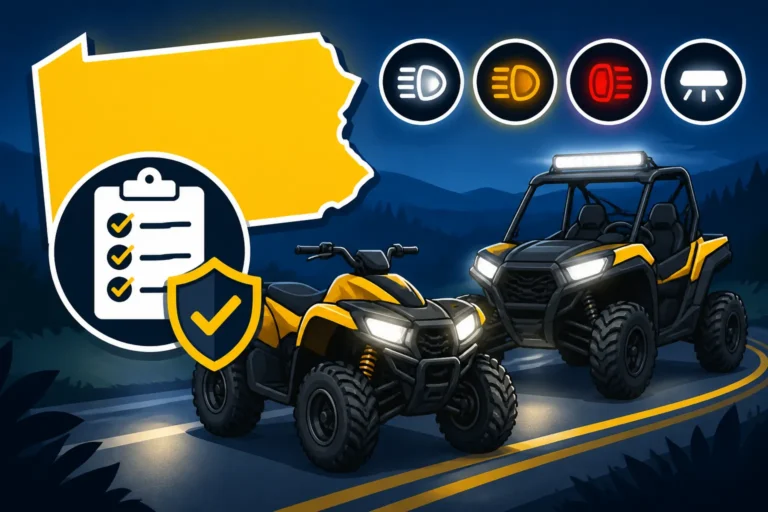
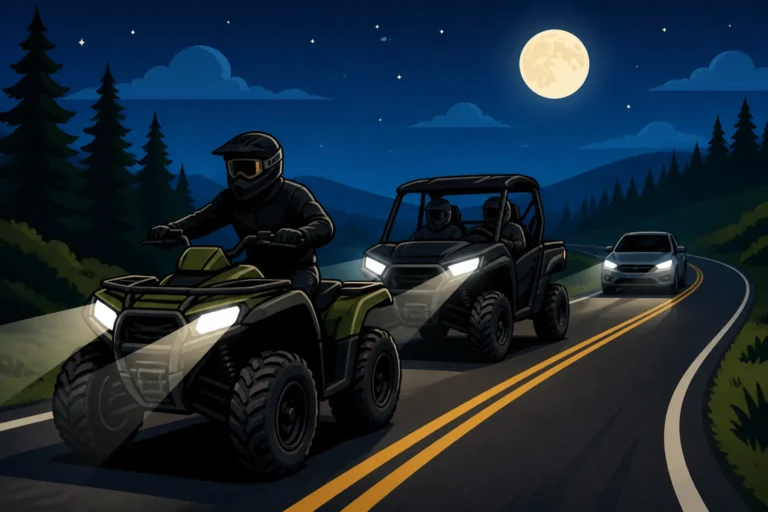
Riding on any public road, even a designated one, means you need to be visible, especially if you're out after dark. Pennsylvania law requires ATVs to have working headlights and taillights if they are operated between sunset and sunrise, or at any time when visibility is limited. Your headlights should be bright enough to illuminate the road ahead, and your taillights must be clearly visible from the rear.
Beyond the basic requirements, it's a good idea to consider additional lighting for increased safety on designated roads. While not always legally mandated for ATVs, things like amber turn signals (even if just temporary stick-on ones) and brake lights, which are standard on cars, make your intentions clearer to other drivers. Reflective tape on your machine or gear can also greatly enhance your visibility to others. [Pennsylvania Lighting Rules for Road Use] apply stringently to night operation.
Pennsylvania Muffler and Spark Arrester Requirements
Noise pollution and fire prevention are also important considerations. All ATVs operating in Pennsylvania, including on designated roads, must be equipped with an effective muffler system in good working order. This means no excessively loud aftermarket exhausts that remove baffles or catalytic converters. The muffler must reduce engine noise to reasonable levels as specified by law. Loud pipes might sound cool on the trail, but they can be a nuisance and a violation on public roads, drawing unwanted attention from law enforcement.
Additionally, your ATV must have a U.S. Forest Service-approved spark arrester. This device prevents hot carbon particles from escaping your exhaust system and potentially igniting dry leaves, grass, or other flammable materials, especially in wooded areas common around designated roads. These are critical for preventing wildfires, particularly in dry conditions. Many stock ATVs come with spark arresters from the factory, but if you've modified your exhaust, double-check that this crucial safety feature is still in place. [Pennsylvania Muffler Requirements for ATVs] ensures that riders are mindful of both noise and fire hazards.
Crossing Public Highways and Divided Roads
Even though you can't cruise down a major highway on your ATV, there are specific, highly regulated situations where you might need to cross one. This is typically done to connect two sections of a designated trail or to access a specific point on the other side of a state route. These crossings are not to be taken lightly and require extreme caution and adherence to strict rules.
Crossing at Ninety Degrees in Pennsylvania
If you encounter a public road that is not designated for ATV use but you need to cross it to continue on a legal trail or reach a designated road, the law is very specific: You must cross the highway at approximately a 90-degree angle. This means driving straight across the road, minimizing your time spent in the flow of traffic. You cannot drive along the road for any distance, even a short one. The goal is to get from one side to the other as quickly and safely as possible.
This rule is designed to reduce the risk of collisions by making your path predictable to other drivers. It also ensures you're not engaging in illegal "road riding" under the guise of crossing. Always choose the safest possible point to cross, ensuring maximum visibility for yourself and oncoming traffic.
Stopping Before a Pennsylvania Crossing
Before you attempt any crossing of a non-designated public road, you must come to a complete stop and yield to all oncoming traffic. Treat it exactly like stopping at a stop sign or pulling out of a private driveway onto a busy street. This means looking both ways, listening for approaching vehicles, and waiting for a clear, safe gap in traffic before proceeding.
Never assume that traffic will stop or slow for you. Highway vehicles often travel at high speeds, and their drivers may not anticipate an ATV entering the roadway. Patience is absolutely crucial here. Rushing a crossing is one of the quickest ways to put yourself in a dangerous situation. Think of it as a pedestrian crossing a busy street; you wouldn't just dart out. [Stopping Before a Pennsylvania Crossing] is a critical safety step.
Divided Highways and Intersection Crossings
Crossing a divided highway presents an even greater challenge and is often explicitly prohibited or only permitted at specific, marked intersections. If you do encounter a divided highway that you need to cross (and it's legally permissible at that point), the rule is typically that you must cross at an intersection. You cannot cross the median or drive along the divided highway.
At an intersection, you would treat each section of the divided highway as a separate crossing, stopping at the median and yielding to traffic before proceeding across the second section. This is often the rule when [Crossing SR 144 Near Snow Shoe] or other major state routes that might split for a short distance. Again, always prioritize safety and visibility. If there's any doubt about the legality or safety of a crossing, find an alternative route, even if it means a longer ride. It's better to be safe than sorry, as a citation for an illegal crossing can be costly, let alone the potential for an accident. [Crossing a Highway on an ATV in Pennsylvania] rules are very strict for a good reason.
UTVs, Golf Carts, and Low-Speed Vehicles: Different Rules Apply
It's common to lump all off-road vehicles into one category, but Pennsylvania law makes clear distinctions between ATVs, UTVs, golf carts, and Low-Speed Vehicles (LSVs). While an ATV has very limited road access, UTVs, golf carts, and LSVs operate under different regulations that can sometimes allow for more (but still limited) street use. Understanding these differences is crucial, especially as side-by-sides (UTVs) grow in popularity.
Pennsylvania Rules for a UTV on a Road
UTVs, or side-by-sides, often look more like small cars than traditional ATVs, which leads many owners to assume they have more road privileges. However, in Pennsylvania, UTVs generally fall under the same DCNR registration and off-road use rules as ATVs. This means, like ATVs, they are not street legal for general highway use and can only be operated on designated ATV trails and designated joint-use roads.
While some UTVs might come equipped with features like turn signals, seatbelts, and even windshields, these additions do not automatically confer street-legal status in Pennsylvania. The core classification remains an off-road vehicle. Some states have specific laws allowing UTVs on certain roads, but Pennsylvania has not widely adopted such provisions. Therefore, if you own a UTV and plan to ride in Pennsylvania, expect it to be treated legally as an ATV in terms of road access. You'll need to follow the same DCNR registration, age, helmet, and insurance rules. Many SuperATV accessories can enhance safety and trail performance for UTVs, but they won't make a UTV street legal for general road use in PA. [Pennsylvania Rules for a UTV on a Road] are quite restrictive.
Golf Carts and Low-Speed Vehicles in Pennsylvania
This is where things get interesting, as these vehicle types do have some specific, albeit limited, on-road privileges that ATVs and UTVs do not.
-
Golf Carts: Golf carts are primarily designed for use on golf courses. While they are generally not permitted on public streets and highways in Pennsylvania, there are exceptions for specific local ordinances. Some municipalities, often in retirement communities or very small towns, may pass ordinances to allow golf cart use on certain low-speed roads during daylight hours. This is highly localized and not a statewide rule. If you're considering driving a golf cart on public roads, you absolutely must check with the specific township or borough for their local laws and requirements, which often include specific safety equipment like lights, mirrors, and slow-moving vehicle signs. [Golf Carts and Low-Speed Vehicles in Pennsylvania] delves into these nuances.
-
Low-Speed Vehicles (LSVs): An LSV is a street-legal class of vehicle that is distinct from a golf cart. To be classified as an LSV in Pennsylvania, a vehicle must meet specific federal safety standards and be registered and titled with PennDOT. They are typically small, electric vehicles, often resembling glorified golf carts, but they are built to a higher safety standard. LSVs are restricted to roads with a posted speed limit of 35 mph or less and cannot operate on highways or interstates. They must have headlights, taillights, stop lights, turn signals, reflective devices, mirrors, a parking brake, a VIN, and seatbelts. Because they are PennDOT-registered, they have more road privileges than an ATV or UTV, but they are very different vehicles designed for slow, urban environments. You won't be taking an LSV off-roading like you would an ATV.
The key takeaway here is to never assume that a vehicle's appearance or features dictate its legal status on Pennsylvania roads. Always refer to the specific legal definitions and regulations for ATVs, UTVs, golf carts, and LSVs before planning any road use.
Consequences of Riding an ATV Illegally on Pennsylvania Roads
Operating an ATV on a public road in Pennsylvania where it's not explicitly permitted is not just frowned upon; it's a direct violation of state law. The consequences can range from costly fines to serious legal trouble, vehicle impoundment, and even criminal charges, especially if an accident occurs. It's simply not worth the risk.
Pennsylvania Fines for Riding Illegally
If you're caught riding your ATV on an undesignated road, you're likely to receive a citation. Pennsylvania fines for riding an ATV illegally can be substantial. The base fine for operating an unregistered or illegally operated ATV on a public road typically starts around $300 for a first offense. This isn't a minor parking ticket; it's a significant financial penalty that can quickly add up.
Beyond the initial fine, you could also face additional citations for other violations, such as not wearing a helmet, not having insurance, or operating with an expired DCNR registration. Each of these can carry its own separate penalty, quickly turning a single encounter with law enforcement into a multi-hundred-dollar headache. [Pennsylvania Fines for Riding Illegally] can be a harsh reality check. Law enforcement, whether DCNR rangers or local police, are generally well-versed in these regulations and will not hesitate to enforce them.
Does a Pennsylvania ATV Ticket Hit Your Driving Record?
This is a common concern for riders, and the answer is generally reassuring: A citation for an ATV violation in Pennsylvania typically does not go on your regular driving record. Because ATVs are not PennDOT-registered highway vehicles and do not require a standard driver's license for operation (though you do need a valid driver's license to operate on designated roads if over 16), the fines are usually treated as summary offenses, similar to a minor traffic infraction or parking ticket.
However, this doesn't mean there are no consequences. While it might not affect your car insurance rates or add points to your driver's license, the citation itself is a legal record. Repeated offenses could lead to more severe penalties, including increased fines, mandatory court appearances, or even the impoundment of your ATV. More importantly, if the illegal operation of your ATV contributes to an accident, the legal repercussions could be far more serious than a simple summary offense, potentially involving civil lawsuits or criminal charges depending on the severity of the incident. [Does a Pennsylvania ATV Ticket Hit Your Driving Record?] addresses these specific concerns.
Cost of Prosecution on Top of a Fine
When you receive a citation for an ATV violation, the amount listed as the "fine" is often just one part of the total cost. In Pennsylvania, almost all summary offenses, including ATV tickets, come with additional "costs of prosecution" that are added on top of the base fine. These costs cover administrative fees, court expenses, and other charges associated with processing your citation through the legal system.
These costs of prosecution can easily add another $100 or more to your bill, sometimes even exceeding the original fine amount. So, what might look like a $300 fine can quickly become a $400 or $500 total payment. This unexpected expense catches many riders off guard. It's a stark reminder that even seemingly minor violations can have significant financial implications once the full legal process is factored in. Paying these promptly is important, as unpaid fines and costs can lead to further legal issues, including warrants or suspension of other privileges. [Cost of Prosecution on Top of a Fine] can be a rude awakening for those not expecting it.
Navigating the System: Asking for More Open Roads
While the current state of ATV road legality in Pennsylvania might seem restrictive, it doesn't mean the situation is entirely static. Local communities and advocacy groups can and do work to expand legal riding opportunities. It's a challenging process, but understanding how it works can empower riders to become advocates for responsible expansion.
Asking a Township to Open a Road
If you believe a particular road in your township or borough would be a logical and safe route for ATV access – perhaps it connects two existing trail sections, provides essential access to local businesses, or leads to a popular staging area – you can absolutely approach your local municipal government. This isn't a guaranteed path to success, but it's where change starts.
The process typically involves attending township or borough meetings, presenting your case to the supervisors or council members, and gathering support from other community members and riders. You'll need to articulate why opening the road is beneficial (e.g., boosting local tourism, providing safer access than illegal riding, connecting communities) and how it can be done safely (e.g., specific signage, speed limits, enforcement plans). Be prepared to address concerns about noise, safety, road damage, and property values. Providing solutions and demonstrating a commitment to responsible riding will be key. This often leads to a [How a Pennsylvania Township Designates a Road].
Who Votes to Open a Road and Why Most Roads Stay Closed
Ultimately, the decision to open a road to ATV traffic rests with the elected officials of the local municipality – typically the township supervisors or borough council members. They will consider various factors, including public safety, budgetary implications (for signage, enforcement, and potential road maintenance), public input (both pro and con), and the overall impact on the community.
The reality is that most roads stay closed to ATVs due to a combination of factors. There's often strong opposition from residents concerned about noise, dust, safety, and potential damage to roads or property. Municipalities also face liability concerns; they don't want to create new risks for their residents or open themselves up to lawsuits. Furthermore, the cost of proper signage, increased law enforcement presence, and potential road improvements to handle ATV traffic can be a significant burden on small municipal budgets. [Why Most Roads Stay Closed] is a complex issue with many moving parts.
While there's certainly a desire among riders for more freedom, the balance between recreational access and community concerns means that opening new roads for ATVs is a slow, difficult process that requires persistent, organized, and responsible advocacy. It's a testament to the fact that while riding on public roads might be convenient, it comes with a host of regulatory and social challenges that are deeply embedded in Pennsylvania law and community values.
Here's a quick comparison of vehicle types and their road legality in Pennsylvania:
| Vehicle Type | PennDOT Registered? | DCNR Registered? | General Street Legal? | Designated Road Legal? | Primary Purpose | Common Examples |
|---|---|---|---|---|---|---|
| ATV | No | Yes | No | Yes (Limited) | Off-road recreation | Honda Foreman, Polaris Sportsman |
| UTV (Side-by-Side) | No | Yes | No | Yes (Limited) | Off-road recreation | Polaris RZR, Can-Am Maverick |
| Golf Cart | No | No | No (Generally) | Yes (Local Ordinance) | Golf course/Low speed | Yamaha Drive, EZGO Express |
| Low-Speed Vehicle (LSV) | Yes | No | Yes (Limited) | Yes (Limited) | Local street travel | Polaris GEM, Club Car LSV |
Disclaimer
This article is for general informational purposes only and does not constitute professional advice. Laws, prices and regulations vary by location and change over time. Consult a qualified professional for guidance on your specific situation.