Golf Carts and Low-Speed Vehicles in Pennsylvania
It’s easy to get tangled up in the legal jargon surrounding off-road vehicles and their road-going cousins here in Pennsylvania. Many of us look at a utility task vehicle (UTV) or even some souped-up golf carts and wonder why our beloved ATVs and side-by-sides can’t enjoy the same freedom on public roads. This guide aims to clear up the confusion, explain the distinct categories of golf carts and low-speed vehicles (LSVs) in the Commonwealth, and detail why they are fundamentally different from your ATV or UTV in the eyes of the law.
Unpacking the Legal Distinctions: Why Your ATV Isn't an LSV
Pennsylvania's laws regarding vehicles, especially those that aren't traditional cars or trucks, can feel like a maze. There's a persistent hope among ATV and UTV enthusiasts that there's a loophole, a modification, or a secret handshake that can make their machines "street legal." Unfortunately, when it comes to golf carts and Low-Speed Vehicles (LSVs), the distinctions from ATVs and UTVs are not just minor differences; they are rooted in entirely separate sections of the vehicle code, with different authorities governing them. This fundamental legal separation is often the biggest hurdle and source of frustration for riders.
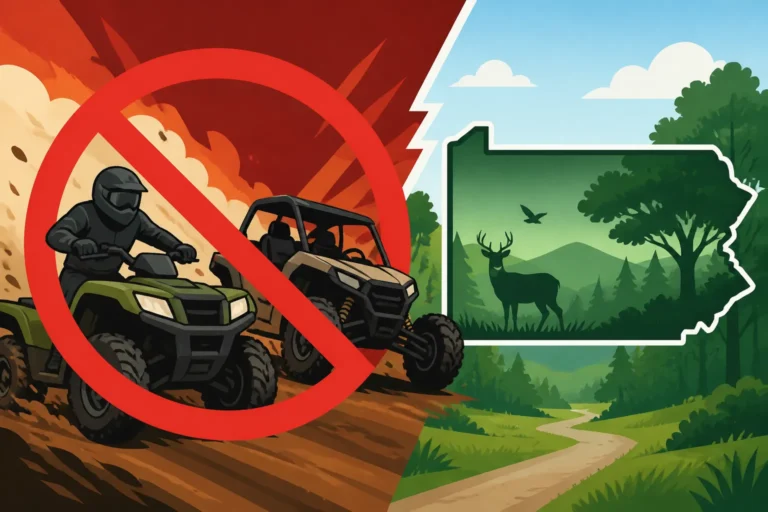
Imagine buying a powerful side-by-side, maybe one that looks every bit as capable as a small car, with turn signals, a horn, and a windshield. You might think, "Surely this is just a few parts away from being road-ready." The truth is, the law doesn't care as much about what it looks like or what accessories you've added (even quality ones from brands like SuperATV) as it does about how the vehicle was originally manufactured and classified. Your ATV, by its very design and definition, is an off-highway vehicle (OHV) regulated by the Department of Conservation and Natural Resources (DCNR), not PennDOT, which handles on-road vehicles. This means it's already on a different legal track from the moment it leaves the factory.
The DCNR issues registrations and manages trails for ATVs and UTVs because they are primarily intended for off-road recreational use, agriculture, or business on private property. [Why DCNR Registers Pennsylvania ATVs] They are not designed, certified, or titled for general public road use under Pennsylvania’s motor vehicle code. This is a critical point of separation. While golf carts and LSVs may share some characteristics, their legal genesis is entirely different, setting them on distinct paths for regulation, permissible use, and the authorities that oversee them.
What Constitutes a Golf Cart in Pennsylvania?
When you think of a golf cart, you probably picture someone cruising leisurely around a golf course or maybe a gated community. In Pennsylvania, that image is pretty accurate for how the law views and regulates these machines. They are in a class of their own, designed for very specific, low-speed applications.
Defining a Golf Cart by Law
Pennsylvania law defines a "golf cart" quite narrowly. Generally, it's considered a self-propelled vehicle that's designed and manufactured for carrying no more than four persons, their golf clubs, and incidental golf course equipment at speeds not exceeding 20 miles per hour. Crucially, they are primarily intended for use on golf courses. This specific definition is key because it immediately separates them from more powerful and versatile machines like ATVs and UTVs, which are built for rough terrain and higher speeds.
Because of this narrow definition and intended use, golf carts usually escape many of the regulations that apply to other vehicles. They typically don't require titling, registration with PennDOT, or a conventional driver's license to operate on private property. Their regulatory burden is significantly lighter than almost any other motorized vehicle, reflecting their limited scope of operation.
Where You Can (and Can't) Ride a Golf Cart
This is where the distinction becomes really important for riders thinking about road access. In Pennsylvania, golf carts are generally allowed on private property, like the golf courses they were named for, or within private communities. The moment you consider taking one onto a public road, the rules change dramatically.
For a golf cart to be legally operated on a public road in Pennsylvania, that road must be specifically designated for such use by a local municipality (borough or township) through an ordinance. These ordinances are relatively rare and usually apply to very specific, low-traffic areas, often connecting parts of a community or providing access to a golf course. Even on these designated roads, there might be restrictions on times of day, speed limits, or specific routes. You won't see golf carts zipping down state routes or major highways, ever. They are strictly limited to these hyper-local, specially approved zones. [Township Roads Open to Pennsylvania ATVs] (Note: This link is relevant here because townships can open roads, but the process is different and typically applies only to golf carts, not ATVs/UTVs).
It’s easy to misunderstand this: just because a golf cart is sometimes allowed on a public road in a very specific context doesn't mean your ATV or UTV gets the same privilege. The legal framework permitting that golf cart use is a local exception for a specific type of vehicle, not a blanket allowance for all off-highway machines.
Demystifying Low-Speed Vehicles (LSVs) in Pennsylvania
If golf carts are the casual cruisers of private property, then Low-Speed Vehicles (LSVs) are their slightly more sophisticated, road-legal cousins. LSVs are a distinct category of motor vehicle, designed and manufactured specifically to meet federal safety standards for limited road use. They bridge the gap between golf carts and traditional automobiles, but they are not the same as ATVs or UTVs.
What Makes an LSV an LSV?
Pennsylvania law, aligning with federal regulations, defines a Low-Speed Vehicle as a four-wheeled motor vehicle with a gross vehicle weight rating of less than 3,000 pounds, and a top speed of more than 20 miles per hour but not more than 25 miles per hour. This speed range is critical. If it goes slower than 20 mph, it might be a golf cart (or not even a vehicle). If it goes faster than 25 mph, it's generally considered a conventional motor vehicle and subject to more stringent regulations.
Beyond speed, LSVs are required to have specific safety equipment that golf carts often lack and that ATVs/UTVs, even heavily modified ones, don't typically come with from the factory. This includes headlamps, tail lamps, stop lamps, turn signal lamps, reflex reflectors, an exterior mirror on the driver's side and either an exterior mirror on the passenger's side or an interior rearview mirror, a parking brake, a VIN, and seat belts. These aren't optional add-ons; they are federal safety requirements that the manufacturer must certify the vehicle meets for it to be legally sold as an LSV. Companies like SuperATV offer excellent aftermarket parts, but adding lights or mirrors to an ATV doesn't magically reclassify it as an LSV if it wasn't manufactured as one from the start.
Titling, Registration, and Road Use for LSVs
Unlike golf carts, LSVs are recognized as motor vehicles by PennDOT. This means they must be titled and registered, just like a car or truck, and they require a valid driver's license to operate. They will receive a proper license plate and often undergo an inspection process to ensure they meet the necessary safety standards. This is a huge departure from the DCNR registration system for ATVs and UTVs, which doesn't grant any public road access. [Why PennDOT Does Not Register Pennsylvania ATVs]
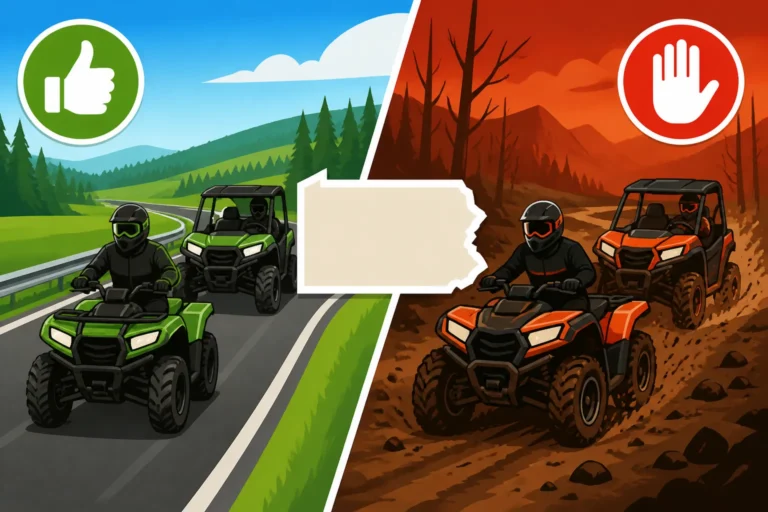
Once properly titled and registered, an LSV can generally be operated on public roads where the posted speed limit is 35 miles per hour or less. This is a significant advantage over ATVs, which are [Are ATVs Street Legal in Pennsylvania: The Short Answer] and limited to very specific [Pennsylvania's Designated ATV Roads]. However, LSVs are explicitly prohibited from operating on state highways, interstates, or any road where the speed limit exceeds 35 mph. They are designed for local, low-speed travel within communities.
The crucial takeaway here is that an LSV is a street-legal vehicle by design and certification. You cannot take an ATV or UTV, bolt on some lights and mirrors, and expect it to qualify as an LSV in Pennsylvania. The state does not provide a conversion path for off-highway vehicles to become on-highway LSVs. The manufacturer's original intent and certification are paramount. [Why There Is No Conversion Path in Pennsylvania]
Comparing ATVs/UTVs to Golf Carts and LSVs in Pennsylvania
It's clear that these three categories of vehicles—ATVs/UTVs, golf carts, and LSVs—are treated very differently under Pennsylvania law. While they might all share the commonality of being smaller, motorized vehicles, their intended purpose, legal classification, and permissible use diverge significantly. Understanding these differences is crucial for any rider to avoid fines and stay safe.
To help clear up the confusion, let's break down the key characteristics of each type of vehicle in a straightforward comparison. This isn't just about semantics; these are the legal realities that dictate where and how you can ride.
| Feature | ATV/UTV (Off-Highway Vehicle) | Golf Cart | Low-Speed Vehicle (LSV) |
|---|---|---|---|
| Primary Purpose | Off-road recreation, utility, agriculture | Golf courses, private communities | Local short-distance on-road travel (neighborhoods) |
| Governing Authority | DCNR (Department of Conservation and Natural Resources) | Local ordinances (if on public roads), generally unregulated on private land | PennDOT (Pennsylvania Department of Transportation) |
| Titling Required? | Yes, via DCNR | No (typically) | Yes, via PennDOT |
| Registration Required? | Yes, via DCNR (for state land/public access) | No (typically) | Yes, via PennDOT |
| License Plate? | Yes, DCNR-issued ATV plate | No (typically) | Yes, standard PennDOT license plate |
| Max Speed | Varies widely, generally much higher than 25 mph | Up to 20 mph | 20-25 mph (by definition) |
| Public Road Use? | Highly restricted, only on designated ATV roads | Only on specifically designated local roads (by ordinance) | Roads with posted speed limits of 35 mph or less |
| Highway Use? | No | No | No (prohibited on highways, interstates, over 35 mph roads) |
| Required Equipment | Helmet (unless agricultural exception), spark arrester | Basic operation equipment | Head/tail/stop lamps, turn signals, mirrors, seatbelts, VIN |
| Conversion Path? | No legal path to become street-legal in PA | No legal path to become an LSV (different class) | Manufactured as LSV, no conversion from other vehicle types |
This table vividly illustrates the separate legal universes these vehicles inhabit. You can see why efforts to make a UTV "street legal" in Pennsylvania by simply adding accessories, even high-quality ones from companies like SuperATV, are usually a dead end. The issue isn't a lack of equipment; it's a fundamental difference in classification and manufacturing standards.
Real-World Implications for Pennsylvania Riders
Understanding these distinctions isn't just about legal theory; it has very real, practical consequences for riders in Pennsylvania. Ignoring these differences can lead to significant headaches, financial penalties, and even safety risks. For anyone who owns an ATV or UTV, the desire to expand their riding opportunities is understandable, but the reality of Pennsylvania law needs to be respected.
Fines and Enforcement for Misuse
One of the most immediate implications of confusing these vehicle types is the risk of fines and legal trouble. If you operate an unregistered ATV on a public road, or if you try to use your UTV on a street where only LSVs or specifically permitted golf carts are allowed, you could face hefty penalties. Pennsylvania has clear laws regarding the illegal operation of off-highway vehicles on public roads, and enforcement is a reality, especially in areas adjacent to popular riding spots. [Pennsylvania Fines for Riding Illegally]
Law enforcement officers, including DCNR rangers and local police, are trained to identify these distinctions. They understand that an ATV, even one equipped with street tires and lights, is not a street-legal vehicle in Pennsylvania. They're not looking at your cool custom build from SuperATV; they're looking at the vehicle's inherent legal classification. Citations for operating an unregistered or illegal vehicle on a public road can include significant fines, court costs, and potentially even impoundment of your machine. It’s far better to know the rules and stick to designated trails and private property.
Insurance and Liability Considerations
Another critical area affected by these legal categories is insurance. Your ATV or UTV insurance policy is specifically designed for off-road use. It covers you and your machine while riding on trails or private property, and it often includes liability for incidents that occur in those contexts. [Pennsylvania ATV Insurance Requirement]
However, if you operate your ATV or UTV illegally on a public road and are involved in an accident, your off-road insurance policy may not cover the damages or liability. Insurers write policies based on the legal classification and intended use of the vehicle. If the vehicle is being used outside its legal bounds, you could find yourself personally liable for significant costs, including property damage, medical bills, and legal fees. This risk alone should be a major deterrent to attempting to use an ATV or UTV on a public road where it's not explicitly permitted. Golf carts and LSVs, when properly registered and operated, would fall under different insurance frameworks more akin to automobile policies, tailored for their specific road-going status.
The Role of Local Ordinances
While state law is clear, it's worth noting that some local municipalities have indeed passed ordinances concerning golf carts. These ordinances might allow golf cart use on specific, low-speed roads within their jurisdiction. However, it's crucial to understand that these are almost exclusively for golf carts as defined by state law, and rarely, if ever, extend to ATVs or UTVs. A township that opens a few roads for golf carts is not giving a green light for your side-by-side to cruise through town.
Always check with local authorities directly if you're unsure about specific road allowances for any vehicle type. Don't rely on assumptions or what you see others doing, as local rules can vary wildly, and what applies to a golf cart rarely applies to an ATV or UTV.
Understanding the "No Conversion Path" for ATVs and UTVs
The desire to make an ATV or UTV street legal is one of the most common questions and frustrations among riders in Pennsylvania. Many look at the rigorous federal standards for LSVs, see all the safety features available as aftermarket add-ons, and think, "Why can't I just equip my side-by-side with these and get a license plate?" Unfortunately, Pennsylvania law, like that in many other states, does not offer a conversion path.
The Myth of Making an ATV Street Legal
I totally get why you'd look at a powerful UTV and think, "This should be street legal!" Modern side-by-sides are incredibly capable and often come with features like headlights, turn signals, and even rearview mirrors from the factory. Aftermarket companies, including industry leaders like SuperATV, offer fantastic kits that can add even more road-oriented equipment: DOT-approved windshields, mirrors, horns, and robust lighting packages. It seems logical that if you add all the required components for an LSV, your UTV should qualify, right?
The answer, definitively, is no. The core issue isn't about the presence of safety features; it's about the vehicle's original certification and designation by the manufacturer. For a vehicle to be an LSV, it must be manufactured and certified by the OEM (Original Equipment Manufacturer) to meet all federal motor vehicle safety standards (FMVSS) for low-speed vehicles. It's a classification made at the point of manufacture, not an upgrade you can achieve through aftermarket modifications.
Why Pennsylvania Stands Firm
Pennsylvania's vehicle code is structured to classify vehicles from their inception. An ATV or UTV is categorized as an "off-highway vehicle" by its manufacturer and subsequently registered with the DCNR. An LSV, on the other hand, is manufactured and certified as a "low-speed vehicle" and registered with PennDOT. These are two distinct legal classes, and there's no provision in Pennsylvania law to transition an off-highway vehicle into an on-highway vehicle, even if you equip it with every imaginable street-legal accessory. [Can You Plate a UTV in Pennsylvania?]
The state views them as fundamentally different machines serving different purposes. Attempting to register an ATV or UTV as an LSV with PennDOT would be futile because it wasn't manufactured to LSV standards and doesn't have the necessary OEM certification. You might install a full kit from SuperATV that includes turn signals, a horn, and a rearview mirror, but it still won't change the vehicle's underlying legal designation in Pennsylvania.
This can be incredibly frustrating for riders who see the potential in their machines and the convenience that street legality would offer. However, the Commonwealth's stance is firm: if it wasn't built and certified as a street-legal vehicle (like an LSV or a traditional automobile) from the factory, it won't be made street legal in Pennsylvania. This reinforces the need for riders to stick to designated ATV trails and private property for their off-road adventures.
Disclaimer
This article is for general informational purposes only and does not constitute professional advice. Laws, prices and regulations vary by location and change over time. Consult a qualified professional for guidance on your specific situation.