Pennsylvania Rules for Riding a Borough Street
It's a common daydream, isn't it? You've just finished a fantastic ride out on the trails, and you think, "Man, it would be so much easier if I could just hop on my quad and ride it down Main Street to grab a bite." Or maybe you want to connect your private property directly to a nearby trail system without having to trailer your machine for a mere few blocks. Unfortunately, when it comes to riding your ATV or UTV on the streets of a Pennsylvania borough, the reality often clashes quite hard with that desire. This guide is going to break down the rules, the frustrations, and the very few exceptions to help you understand exactly why that borough street often remains off-limits.
The Basic Reality: Why Most Borough Streets Are Closed to ATVs
Let's cut right to the chase: Pennsylvania generally doesn't allow ATVs or UTVs on public roads, and that includes the streets winding through your local borough. It's one of the biggest points of confusion and, frankly, irritation for many riders. You see these machines everywhere, performing farm tasks, moving around private property, or tearing up designated trails, and it feels natural to assume they could also navigate the paved roads for short distances. But the law sees things differently.
The Law's Stance on "Street Legal" ATVs in Pennsylvania
The term "street legal" is something that gets thrown around a lot in the off-road community, and it often leads to a lot of misinformation. In Pennsylvania, for all intents and purposes, there simply isn't a legal pathway to make your ATV or UTV truly "street legal" in the same way you would register a car or motorcycle with PennDOT. The Pennsylvania Department of Conservation and Natural Resources (DCNR) handles ATV registration, not PennDOT, precisely because these are considered off-highway vehicles. [Why PennDOT Does Not Register Pennsylvania ATVs]
The general prohibition means that if a road is maintained by the state, county, or a municipality (like a borough), it's typically closed to ATV and UTV use. This isn't just some arbitrary rule; it's deeply rooted in the state's vehicle code which was designed with cars, trucks, and motorcycles in mind. ATVs and UTVs, by their very nature and design—things like solid rear axles, often no turn signals, different braking systems, and no specific crash protection for road use—just don't fit the safety and operational criteria for general highway use. So, while you might find fantastic aftermarket accessories from a company like SuperATV to enhance your machine's performance and safety off-road, like robust skid plates or powerful LED light bars, these modifications won't grant you legal passage on a paved borough street.
This can be incredibly frustrating, especially if you live in a rural area where a borough street might be the most direct route between your property and an approved trail system. It feels like an unnecessary hurdle, forcing you to load up a trailer and haul your machine just to cover a short distance. Many riders wish for more flexibility, but the state's position remains clear: these are off-road machines, and public roads are generally not their domain. [Street Legal ATVs in Pennsylvania: The Short Answer]
Who Makes the Rules for Local Roads?
Understanding who has the authority over road use is key to understanding why borough streets are typically closed. While DCNR is responsible for registering ATVs and managing state-owned trails, the power to open or close local roads to off-highway vehicles rests with the specific municipalities themselves—the boroughs, townships, and cities.
Here's the crucial part: roads are presumed closed to ATVs unless a municipality takes specific action to open them. It's not that they're open by default and then closed; it's the other way around. A borough council or board of supervisors would need to pass a specific ordinance to designate certain streets or sections of streets for ATV use. This isn't a simple rubber-stamp process; it often involves public hearings, debates over safety, noise concerns from residents, and discussions about potential wear and tear on roads not designed for such traffic.
Without a specific ordinance explicitly opening a street to ATVs, riding on it is considered illegal. This local control means that the rules can vary from one borough to the next, though the general trend is overwhelmingly towards keeping streets closed. Don't assume that because you saw an ATV on a street in one borough, it's permissible in another. Always check the specific ordinances for the borough you intend to ride in, though your starting assumption should always be that it's closed. This is a primary reason why you won't find a universal list of "ATV-friendly" borough streets across Pennsylvania; it’s handled case-by-case at the hyper-local level.
How a Borough Could Open a Street (and Why It's Rare)
While the default position is that borough streets are closed to ATVs, the law does provide a mechanism for municipalities to open them. However, it's a process fraught with challenges and is rarely pursued for general recreational riding.
The Process for Opening a Local Road
For a borough to open a street to ATV use, the municipal government—usually the borough council—must pass an ordinance. This isn't just a casual decision; it's a formal legislative process that typically involves several steps. First, there might be a proposal from residents or a council member, perhaps driven by a desire to connect a residential area to a nearby trail system. Then, the council would likely conduct research, consulting with their solicitor, police department, and public works department to understand the implications.
Next comes the public hearing stage, which is critical. Residents on the affected streets or those concerned about noise, safety, or property values would have the opportunity to voice their opinions, both for and against. This can often become a contentious issue, pitting riders against non-riders or property owners. If the council decides to proceed, they would draft an ordinance specifying which streets, during what hours, and under what conditions ATVs would be allowed. This ordinance would then need to be officially voted on and passed.
Even after passing, the borough would be responsible for properly marking any open roads. This means installing specific signage, often the distinctive green signs that indicate an approved ATV route. [The Green Sign on a Pennsylvania Township Road] Without these signs, even if an ordinance exists, it can be difficult for riders and law enforcement alike to know what's permitted. The administrative burden, the potential for public outcry, and the ongoing responsibility make this a significant undertaking for any borough. It's why initiatives like [Windber Borough's Mixed Use Program] are noteworthy precisely because they are exceptions to the norm.
The Practical Hurdles and Safety Concerns
Beyond the legislative process, boroughs face significant practical hurdles and safety concerns that make opening streets to ATVs a rare occurrence. One of the primary worries is safety. ATVs and UTVs handle differently than street-legal vehicles. They have a higher center of gravity, different braking characteristics, and are generally less visible to other motorists. Introducing them onto streets shared with cars, trucks, pedestrians, and cyclists significantly increases the risk of accidents.
Boroughs also grapple with issues like noise. Many ATVs, especially those with aftermarket exhausts (even if not from SuperATV or another performance brand, though quality exhaust systems are popular off-road), can be considerably louder than street vehicles. This can lead to complaints from residents, particularly in quiet residential areas. Dust and road wear are other considerations; ATVs, especially on gravel or less-maintained roads, can kick up dust and contribute to rutting or damage, which then falls to the borough to repair.
Finally, there's the question of liability. If a borough opens a street to ATVs and an accident occurs, the municipality could potentially face legal challenges. While insurance can mitigate some risk, the added exposure can be a deterrent. For these reasons, most borough councils, even when faced with passionate requests from local riders, often err on the side of caution, choosing to maintain the default position of keeping their streets closed to off-highway vehicles. [Why Most Roads Stay Closed] They recognize the desire, but the balancing act of public safety, quality of life for all residents, and potential legal ramifications is a heavy one.
Limited Exceptions and What to Watch For
While the general rule is "no ATVs on borough streets," there are very specific and limited circumstances where you might encounter ATV use, or where the rules allow for minimal interaction with paved roads. It's crucial to understand these distinctions.
Designated Connector Routes and Joint-Use Roads
In some unique situations, a borough might have designated very specific, short sections of road as part of a larger trail network or as a connector between two approved trail systems. These are usually referred to as "joint-use roads" or "designated ATV roads." [Pennsylvania's Designated ATV Roads] Such routes are almost always clearly marked with special signage, indicating that ATV use is permitted. They are often short stretches, perhaps a block or two, designed solely to link larger off-road areas.
For example, a borough might have a connector road that allows riders to travel from a staging area to an entry point for a state forest trail, or link two segments of a multi-county trail system. Even in these cases, the rules for riding on such a road can be strict: speed limits, specific hours of operation, and requirements for lights or helmets might apply. These aren't blanket permissions to ride anywhere in the borough; they are surgically precise exceptions. You won't find these everywhere, and they are typically the result of extensive planning and coordination between the municipality and DCNR or local ATV clubs. [Pennsylvania's Joint-Use Roads] It's also important to remember that these are distinct from the general concept of [Pennsylvania's Sixteen-Year-Old Road Rule], which refers to age limits for riding on any public road where it is allowed, regardless of the vehicle type.
Always look for the official signage. If there's no sign explicitly stating ATV use is permitted, assume it is not. Relying on "I saw someone else doing it" or "it looks like a connector" is a recipe for a fine. If you're planning a ride and believe a borough street might be part of a designated route, always consult official DCNR maps or the borough's website for concrete proof and specific regulations.
Crossing Roads vs. Riding On Them
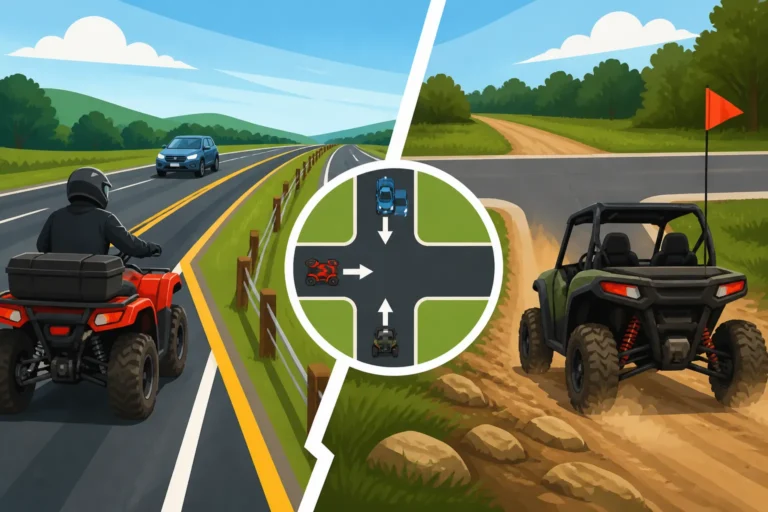
There's a significant legal and practical difference between using a borough street as a travel route and merely crossing it to get to another trail or private property. Pennsylvania law generally permits ATVs to cross public roads, including borough streets, under very specific conditions, even if riding on that street is prohibited.
The rules for crossing are designed to minimize risk and ensure safety. You must cross at an angle of approximately 90 degrees to the roadway. Before crossing, you must bring your ATV to a complete stop, look both ways, and yield to all oncoming traffic. You are only permitted to cross the road; you cannot ride along the shoulder or use the road to travel any distance. [Crossing a Highway on an ATV in Pennsylvania] This allowance is critical for riders whose properties or intended trails are bisected by a public road.
| Feature | Riding On a Borough Street | Crossing a Borough Street |
|---|---|---|
| Legality | Generally illegal unless explicitly opened by ordinance. | Generally permitted under strict conditions. |
| Purpose | Travel along the street, connection to other areas. | Moving directly from one side of the road to the other. |
| Duration | Continuous travel along the road. | Brief, momentary passage over the road. |
| Signage | Requires specific "ATV Route" or joint-use signs. | No specific "crossing permitted" signs needed. |
| Vehicle Design | Designed for off-road, not general street travel. | Same off-road design, temporary on-road interaction. |
| Required Action | N/A (assuming it's illegal to ride on it) | Stop, look both ways, yield, cross at 90 degrees. |
| Consequences | Fines, potential citations for unregistered use, etc. | Safe crossing is legal; unsafe crossing leads to fines. |
It's vital not to confuse the permission to cross with permission to ride on the road. A brief, controlled crossing is very different from traveling a quarter-mile down a borough street, even if you are just heading to the gas station. Law enforcement officers are well aware of this distinction and will ticket riders who try to stretch the "crossing" rule into an excuse for street riding.
Consequences of Illegal Street Riding
Riding your ATV or UTV illegally on a borough street in Pennsylvania isn't just a minor infraction; it can lead to significant financial penalties, legal headaches, and potentially dangerous situations. It's simply not worth the risk.
Pennsylvania Fines and Penalties
The most immediate consequence of illegal street riding is a citation and a fine. The fines for operating an ATV or UTV illegally on a public road can vary, but they are generally not trivial. One of the most common and expensive citations is for operating an unregistered ATV on a public highway or road. If your machine is unregistered and you're caught riding it on a borough street, you could be facing an automatic $300 fine. [Pennsylvania Fines for an Unregistered ATV] This fine is substantial and is specifically designed to deter illegal operation.
Beyond the registration issue, you could also be cited for other violations, such as reckless driving, disturbing the peace (due to excessive noise), or operating a vehicle in a manner that endangers others. Each of these can come with its own set of fines and administrative fees. In some cases, repeated offenses could lead to more severe penalties, including impoundment of your machine. It's a quick way to turn what you thought would be a convenient shortcut into a very costly mistake, easily draining your wallet of hundreds of dollars that could have gone towards trail passes or even a new set of tires from SuperATV for your legal trail adventures.
Law enforcement officers, whether local police or DCNR rangers, take illegal street riding seriously because of the safety risks involved. They are usually quite vigilant, especially in areas where there have been complaints from residents about ATV noise or dangerous operation. A quick ride "just down the street" can very quickly become an expensive lesson. [Pennsylvania Fines for Riding Illegally]
Insurance, Safety, and Legal Liability
The financial penalties are just one aspect; there are also significant insurance, safety, and legal liability concerns when riding illegally on a borough street. Your ATV insurance policy, which is mandatory to ride off your own property in Pennsylvania, typically has exclusions for illegal operation. [Pennsylvania ATV Insurance Requirement] If you're involved in an accident while riding on a public street where ATVs are prohibited, your insurance company may deny coverage.
This means that if you hit a car, injure a pedestrian, or damage property, you could be personally liable for all damages, medical bills, and legal fees. This financial burden could be catastrophic. Imagine a scenario where you, trying to connect two points, clip a parked car or, worse, get into a collision with a moving vehicle. Without insurance coverage, you'd be on the hook for thousands, if not tens of thousands, of dollars in repairs and medical expenses.
From a safety standpoint, borough streets are simply not designed for ATV traffic. Other drivers don't expect to see ATVs, especially not in residential areas. This lack of expectation dramatically increases the risk of accidents. ATVs are also much less protected than cars; even a low-speed collision can result in severe injuries to the rider or passenger. You might be wearing a helmet and other protective gear, but the inherent risks of mixing an off-road machine with road traffic are immense.
Ultimately, the desire for convenience is understandable, but the risks and consequences of riding an ATV or UTV on a Pennsylvania borough street are far too high. It's always best to stick to designated trails, private property with permission, or legally designated joint-use roads. If you're unsure, err on the side of caution and trailer your machine.
Disclaimer
This article is for general informational purposes only and does not constitute professional advice. Laws, prices and regulations vary by location and change over time. Consult a qualified professional for guidance on your specific situation.