Divided Highways and Intersection Crossings
It’s a scenario many of us riders face: you're out on the trails, having a blast, and suddenly, you need to get from one section of public land to another. Often, that means encountering a public road, and sometimes, it's not just a quiet country lane, but a busy intersection or even a divided highway. This guide is here to walk you through the very specific, and often frustrating, rules Pennsylvania has in place for safely and legally navigating these tricky crossings with your ATV or UTV, helping you avoid fines and stay safe.
The Core Challenge of ATV/UTV Road Crossings in Pennsylvania
Let’s be honest, the moment you have to touch pavement with your off-road machine, a little knot forms in your stomach. It feels wrong, and it certainly comes with a different set of rules and anxieties than tearing through mud or climbing a rocky trail. Pennsylvania’s approach to ATV and UTV use on public roads is extremely cautious, and for good reason—these machines are simply not designed for the same kind of traffic and speeds as highway vehicles.
Why Road Use is Restricted for Off-Road Vehicles
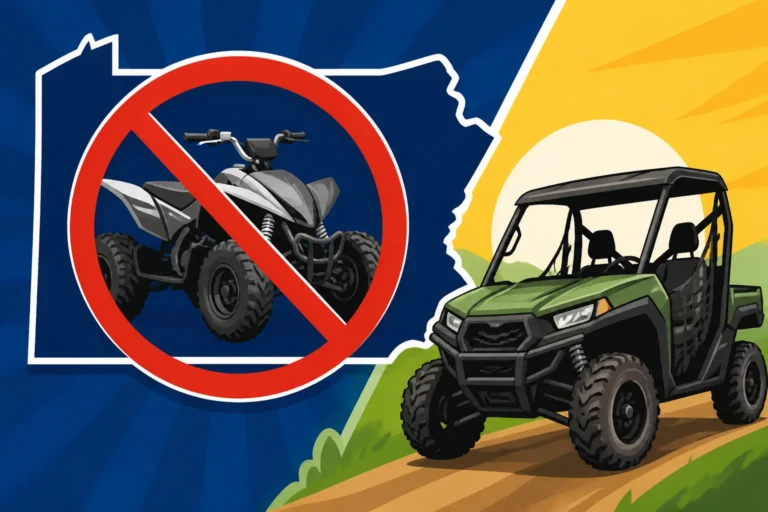
The fundamental truth about ATVs and UTVs in Pennsylvania is that they are off-road vehicles. They are built for dirt, rocks, mud, and uneven terrain, not smooth asphalt. Their tires, suspension, steering, and even their braking systems are optimized for different conditions than those found on public roads. This difference in design is the primary reason why there’s such a strict separation between off-road recreation and on-road travel. You'll often hear the question, "[Street Legal ATVs in Pennsylvania: The Short Answer]", and the short answer is almost always no, with very narrow exceptions.
Beyond design, there's the critical issue of safety. ATVs and UTVs lack many of the safety features standard automobiles have, like airbags, crumple zones, and fully enclosed cabins (though many UTVs from companies like SuperATV do offer robust roll cages and windshields, they are still not designed for highway speeds and impacts). Their visibility to other drivers can be limited, especially in dense traffic or at higher speeds, and their handling characteristics are dramatically different. The state’s Department of Conservation and Natural Resources (DCNR) manages ATV registration and trail systems, while PennDOT handles highway vehicle registration, clearly delineating their roles and the intended use of each type of machine. This separation is crucial for public safety.
The Legal Framework for Permitted Crossings
While Pennsylvania generally prohibits ATVs and UTVs from operating on public roads, the law does recognize the practical necessity of crossing them to connect trails or access certain areas. However, these aren't free-for-all allowances; they are very specific, tightly regulated exceptions. It's not about giving ATVs general road access, but about providing a controlled way to traverse a road from one side to the other.
This legal framework is built around the idea of designated crossings or very limited access to connect trail systems. You won't find widespread "designated ATV roads" in the same way you find them for snowmobiles in certain areas. Instead, the focus is on enabling a quick, safe transition across a road. Understanding these regulations is key to avoiding penalties. The state has gone to great lengths to define what constitutes a legal crossing versus illegal road operation, distinguishing between a brief, necessary transit and actually riding on the road. Knowing the difference can save you from a hefty fine, as operating outside these narrow allowances can quickly lead to citations.
Understanding Divided Highways and Their Unique Risks
When we talk about road crossings, it’s not all equal. A quiet, two-lane rural road presents a different challenge than a multi-lane, high-speed divided highway. The latter introduces layers of complexity and risk that demand even greater caution and adherence to rules.
What Constitutes a Divided Highway in Pennsylvania
In Pennsylvania, a divided highway is essentially any roadway where opposing directions of traffic are separated by a physical barrier or a median strip. This isn't just a painted line; it's a distinct, physical separation, whether it's a grassy median, a concrete barrier, or even a wide stretch of unpaved land. Think of major state routes or interstate bypasses—these are quintessential divided highways. They typically feature multiple lanes of traffic flowing in each direction, higher speed limits, and significantly increased traffic volume compared to single-lane roads.
The presence of this median creates a distinct two-stage crossing scenario. You don't just cross one stream of traffic; you cross one, pause (if the median is wide enough and safe), and then cross another. This fundamental design difference is what makes them inherently more challenging and dangerous for off-road vehicles. The speeds of approaching vehicles are much higher, and the sheer volume of cars and trucks means smaller windows of opportunity to cross safely. It’s not just about looking left and right once; it's about evaluating two independent traffic flows.
Why Crossing a Divided Highway is More Complex
The complexity of crossing a divided highway stems directly from its design and the nature of the traffic it carries. Unlike a simple two-lane road where you might have a clear view and a quick dash across, a divided highway often involves:
- Multiple Lanes: You’re not just crossing one lane, but potentially two, three, or even more lanes in a single direction. This significantly increases the distance you need to cover and the number of vehicles you need to clear.
- Higher Speeds: Vehicles on divided highways are typically traveling at much higher speeds. This dramatically reduces your reaction time and the time available for a safe crossing. What looks like plenty of time on a country road can be mere seconds on a highway.
- Increased Traffic Volume: More vehicles mean fewer safe gaps in traffic. You might find yourself waiting much longer for a truly clear opportunity, and when it comes, it might be fleeting.
- Two-Stage Crossing: The median, while offering a potential safe haven between traffic flows, also forces a two-part decision. You must assess traffic for the first half, cross, then re-assess for the second half. This requires sustained focus and quick decision-making under pressure. It's not uncommon for ATVs and UTVs to struggle with acceleration that matches highway traffic, making these crossings particularly precarious.
Misjudging any of these factors can lead to a dangerous situation. It's not an exaggeration to say that crossing a divided highway on an ATV or UTV is one of the riskiest maneuvers an off-road rider can attempt on public roadways, which is why Pennsylvania's rules are so strict. Riders must exercise extreme caution and always prioritize safety over convenience.
Pennsylvania's Specific Rules for Crossing Roads
Pennsylvania has very explicit regulations governing how ATVs and UTVs are permitted to cross public roads. These aren't suggestions; they are laws designed to protect you and other motorists. Deviating from them can lead to serious consequences, not just legally but physically.
The Ninety-Degree Crossing Mandate
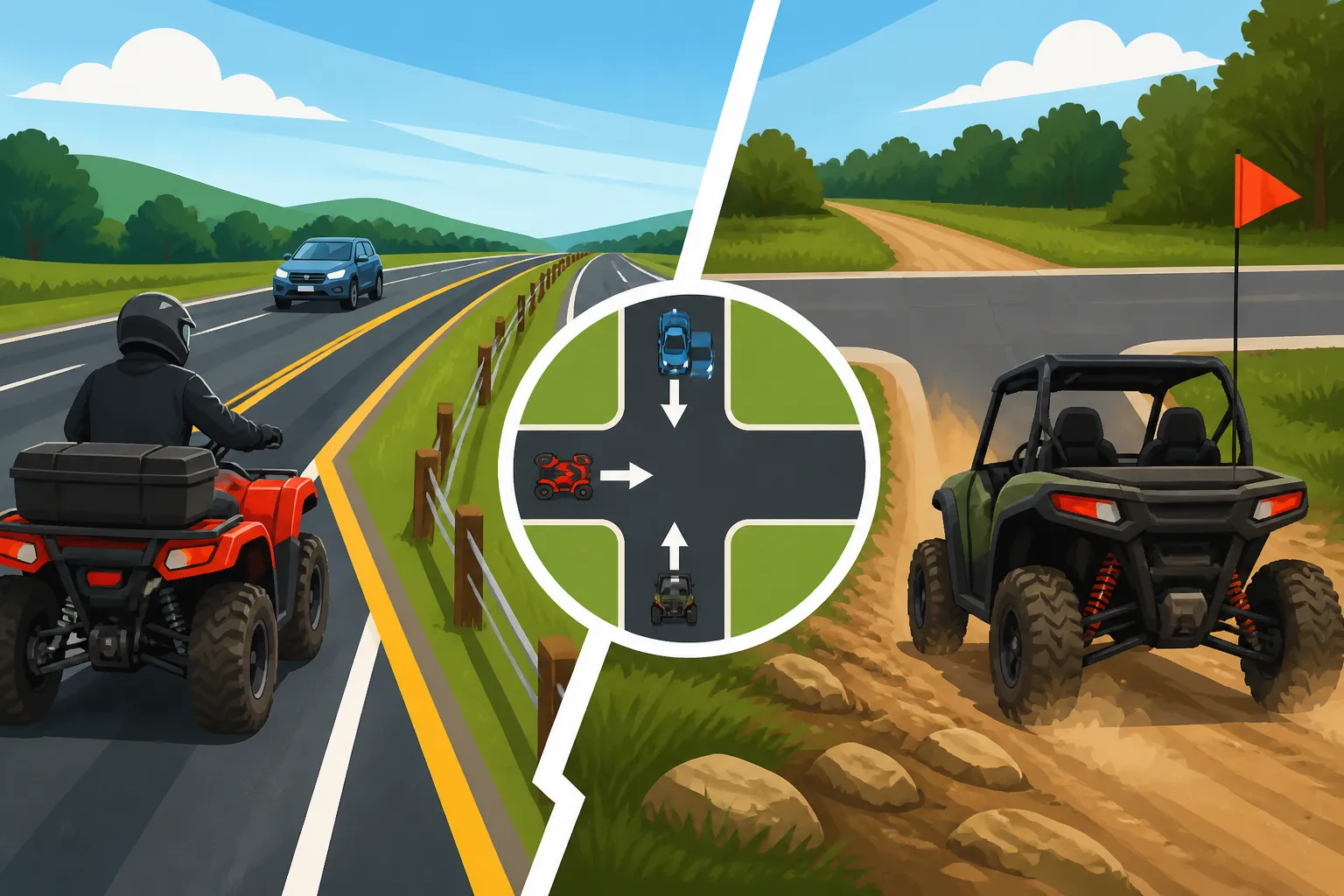
One of the most crucial rules is that an ATV or UTV must cross a public highway or street "at or near a ninety-degree angle" to the road. This isn't some arbitrary bureaucratic detail; it's a safety measure. Imagine trying to merge onto a busy road at an acute angle on your quad—you'd be exposed to traffic for a longer period, and other drivers might not anticipate your slow speed or unusual angle.
By requiring a ninety-degree crossing, the state aims to:
- Minimize Exposure: You're on the roadway for the shortest possible duration. You're effectively taking the quickest path across.
- Maximize Visibility: Your machine is presented broadside to oncoming traffic, making it easier for drivers to see you clearly as a distinct object crossing their path, rather than trying to interpret a vehicle attempting to ride on the road.
- Promote Predictability: Other drivers are used to vehicles moving with the flow of traffic. A ninety-degree crossing is a clear, unambiguous action that signifies you are traversing, not traveling, the road. This reduces confusion and the likelihood of unexpected maneuvers from other drivers.
This rule applies whether you're crossing a small township road or a larger state highway. It's fundamental to safe operation when you "[Crossing a Highway on an ATV in Pennsylvania]". You should approach the edge of the roadway, ensure a clear path, and proceed directly across, minimizing any travel along the road itself.
Stopping Before a Pennsylvania Crossing
Another non-negotiable rule is the requirement to stop completely before entering any public roadway. This isn't a suggestion; it's a must. Just like a car at a stop sign, you must come to a full and complete stop at the edge of the pavement, or at least where you can see oncoming traffic without entering the traffic lane.
This full stop serves several vital purposes:
- Full Situational Awareness: It forces you to pause, take a breath, and thoroughly scan for traffic in all directions. A rolling stop, or trying to judge traffic while still moving, significantly compromises your ability to accurately assess the speed and distance of approaching vehicles.
- Yielding Right-of-Way: The law is clear: you must yield the right-of-way to all vehicular traffic on the public road. Stopping completely ensures you have the opportunity to do this safely, waiting until there's a clear and ample gap in traffic before proceeding.
- Preventing Impulsive Crossings: The urge to get across quickly can be strong, especially if you're holding up other riders. But stopping makes you consciously commit to a safe crossing, rather than rushing into a dangerous situation.
Never assume traffic will stop for you. Even if it looks like a vehicle is slowing, always assume it will maintain its speed unless given clear indications otherwise. Only proceed when you are absolutely certain it is safe to do so, leaving plenty of margin for error.
Crossing at Intersections and Designated Points
While the ninety-degree rule and the full stop are critical, where you cross is just as important. Pennsylvania law generally expects these crossings to occur at legal intersections or at points specifically designated for ATV/UTV crossings. You can't just pick any random spot on a busy highway to cross.
Crossing at an intersection provides a few advantages:
- Defined Traffic Flow: Intersections are designed for vehicles to enter and exit, and other drivers are generally more alert to activity at these points. Traffic often slows, and there may be traffic control devices like stop signs or traffic lights to assist.
- Improved Sightlines: Intersections are typically designed with clearer sightlines than random points along a road, allowing you to see oncoming traffic and for other drivers to see you.
- Legal Precedence: Using designated crossing points or intersections aligns with the intent of the law. Attempting to cross a road outside of these areas, especially where visibility is poor or traffic is fast, could be seen as an illegal operation of the ATV/UTV on the roadway, even if you’re trying to cross at a ninety-degree angle.
Always look for the safest, most clearly marked, and most legally appropriate place to cross. Sometimes, this might mean traveling a short distance off-trail to reach a safer intersection or official crossing point. Being smart about your crossing location is a huge part of being a responsible rider. For example, some townships might have specific "[Pennsylvania Rules for Riding a Township Road]" that include designated crossing points, or a borough might have specific "[Pennsylvania Rules for Riding a Borough Street]" allowing limited movement to an official crossing.
Navigating Intersections with Your ATV/UTV
Intersections can be nerve-wracking places for any vehicle, let alone an off-road machine that doesn't belong on the asphalt. However, when you must cross at an intersection, understanding traffic laws and practicing extreme caution are paramount.
Right-of-Way and Traffic Signals
When crossing at an intersection, you are subject to the same traffic laws as any other vehicle on the road. This means:
- Obeying Stop Signs and Traffic Lights: If there's a stop sign, you stop completely. If there's a traffic light, you obey its signals. Do not run a red light or blow through a stop sign on your ATV. This is not only illegal but incredibly dangerous.
- Yielding Right-of-Way: Just as when you stop before crossing any road, at an intersection, you must yield to any vehicle that has the right-of-way. This includes vehicles already in the intersection, those approaching on a through street, or those with a green light. Never assume another driver sees you or will yield to you. Your ATV or UTV is small compared to cars and trucks, and you might be in their blind spots.
- Predictable Behavior: Use hand signals if necessary to indicate your intentions, even for a short crossing. Make eye contact with drivers if possible. The more predictable you are, the safer the crossing will be for everyone.
Think of yourself as a very slow-moving, exposed bicycle in this scenario. You need to take extra precautions and rely on the full attention of other drivers. Always give yourself plenty of time and space, and if in doubt, wait.
Safe Practices for Multi-Lane Intersections
Multi-lane intersections, particularly those on divided highways, present heightened challenges. Here’s how to approach them with maximum safety:
- Wait for a Clear Break: Do not attempt to cross a multi-lane intersection unless you have a completely clear view and an undeniable gap in traffic. This means waiting for all lanes to be clear in the direction you’re crossing, or for a sufficient interval that allows you to cross one direction of travel and then the next, if there's a median you can safely stop in.
- Be Seen, Be Bright: Ensure all your lights are working—headlights and taillights—even during the day. Consider adding auxiliary lights for better visibility, a common upgrade for UTVs with products from SuperATV. Wear brightly colored gear, and if your machine allows, fly a safety flag. The goal is to make yourself as conspicuous as possible to drivers who might not be expecting an off-road vehicle. [Pennsylvania Lighting Rules for Night Riding] details specific lighting requirements that are helpful to consider even during the day.
- Use the Median Wisely (if available): If you're crossing a divided highway with a sufficiently wide and safe median, treat it as two separate crossings. Cross the first set of lanes when clear, stop in the median (ensuring your machine is fully out of any traffic lanes), and then wait for a clear break to cross the second set of lanes. Never assume the median is a permanent waiting area; it’s a temporary refuge.
- Assess All Angles: At a multi-lane intersection, you might have traffic turning, merging, or coming from multiple directions. Stay alert to all possibilities and don't fixate on just one direction of traffic. This includes being aware of vehicles turning into the cross-street you are coming from.
A table can help visualize the difference in approach between different road types:
| Feature | Two-Lane Road Crossing (e.g., Township Road) | Divided Highway / Multi-Lane Intersection Crossing |
|---|---|---|
| Traffic Volume | Generally lower, fewer vehicles | High, many vehicles at higher speeds |
| Complexity | Simpler, often one stream of traffic at a time | Highly complex, multiple streams, two-stage crossing |
| Decision Time | More forgiving, larger gaps typically | Very short, precise timing required |
| Visibility | Often good, but can vary with terrain | Critical to maximize your machine's visibility |
| Safe Haven | Minimal; crossing should be continuous | Median can provide temporary safety (if wide/safe) |
| Risk Level | Moderate, but still requires vigilance | High, demands extreme caution and patience |
Remember, the goal is always to get across safely. If you feel uncomfortable, or if traffic is too dense, it's always better to find an alternate route or simply wait until conditions improve.
Essential Safety Gear and Practices for Road Crossings
While adhering to traffic laws is critical, your personal safety gear and the condition of your machine also play a massive role in mitigating risks during road crossings. Being visible and protected can make all the difference.
Visibility and Lighting Requirements
Imagine you're in a car, speeding down a highway, and suddenly, a small, dark object darts across. That's the scenario you want to avoid. Your ATV or UTV needs to be as visible as possible to other drivers.
- Functioning Lights are Non-Negotiable: Pennsylvania law requires your ATV or UTV to have at least one headlight and one taillight, both operational, whenever you’re operating after dark or when visibility is low. For any road crossing, even during the day, having your lights on dramatically increases your visibility. Don’t just rely on daylight; turn your lights on. Check them before every ride. [Pennsylvania Rules for Night Riding] emphasizes these points.
- Reflectors: Ensure your machine has appropriate reflectors, especially on the rear. These catch headlights from approaching vehicles and can make your machine noticeable even if your taillights fail.
- Bright Clothing and Flags: Wear high-visibility clothing—neon greens, oranges, or yellows. A bright helmet is also a good idea. Consider attaching a tall, brightly colored safety flag to your machine, especially if you ride a UTV or are in an area with rolling terrain that might obscure your vehicle. This is especially true if you ride a larger UTV where your presence might be unexpected on a crossing. Products like SuperATV's various accessories often include options for flags or improved lighting systems to enhance visibility.
The goal here isn't just to meet the minimum legal requirement, but to go above and beyond to ensure you are seen by every driver. It could genuinely save your life.
Helmets, Eye Protection, and Other Gear
Personal protective equipment (PPE) is your first line of defense, especially when there's any interaction with public roadways.
- Helmets are Law: Pennsylvania mandates helmet use for all ATV operators and passengers when riding off their own land. This absolutely extends to any road crossings. A DOT-approved helmet is essential. Ensure it fits properly and is securely fastened. [Pennsylvania Helmet Law for ATV Riders] details these requirements thoroughly. Helmets significantly reduce the risk of head injuries in the event of a collision, a risk that dramatically increases when on or near a public road.
- Eye Protection: Goggles or a helmet with a face shield are critical. Dust, debris, or even insects can impair your vision at the worst possible moment, leading to a loss of control or a missed observation of traffic. Clear vision is non-negotiable for safe crossing.
- Protective Clothing: While not specifically mandated for road crossings, wearing long sleeves, long pants, gloves, and sturdy over-the-ankle boots provides crucial protection against abrasions and impacts. While a UTV from SuperATV offers a more enclosed cab, a roll cage, and sometimes doors, this doesn't negate the need for proper attire. Any impact on a road at speed can be devastating, and layers of protection are always a good idea. For UTV riders, a strong roll cage, often enhanced by aftermarket options from companies like SuperATV, offers a degree of structural protection that an open-air ATV simply cannot. Additionally, a windshield can protect against road debris thrown up by other vehicles, improving visibility and safety.
Don't ever get complacent with your gear. Every time you throw a leg over your ATV or buckle into your UTV, especially when you know you'll be interacting with public roads, ensure you are fully protected.
Consequences of Illegal Road Use and Crossings
The temptation to take a shortcut, or perhaps a moment of impatience, can lead to operating your ATV or UTV illegally on a public road. However, the consequences in Pennsylvania are significant, ranging from hefty fines to potential liability in an accident. It's simply not worth the risk.
Penalties for Improper Road Crossings
Pennsylvania takes illegal ATV/UTV road use very seriously. Operating an unregistered ATV, or an ATV on a public road where it's not permitted, can result in substantial fines. For example, riding an unregistered ATV can lead to an automatic $300 fine. When you factor in court costs and other fees, that number can climb even higher.
Beyond just the registration, any violation of the specific crossing rules—such as failing to stop, not crossing at a ninety-degree angle, or operating on a section of road that isn't designated for crossing—can result in citations. Law enforcement, including DCNR rangers and state police, are vigilant about enforcing these rules, especially in areas connecting popular trail systems. A ranger at a trailhead like Bloody Skillet or Whiskey Springs might check for proper registration and compliance with road rules. [Pennsylvania Fines for Riding Illegally] can be a harsh lesson if you're caught.
Moreover, if you are involved in an accident while operating illegally on a public road, the legal ramifications can escalate dramatically. You could face charges for reckless endangerment, property damage, or even more serious offenses depending on the circumstances. The costs associated with legal fees, damages, and fines could quickly outweigh the momentary convenience of an illegal road shortcut.
Insurance and Liability Concerns
Perhaps one of the most significant, and often overlooked, consequences of illegal road use is the impact on your insurance and personal liability. Most ATV and UTV insurance policies are written specifically for off-road use. If you have an accident while operating your machine illegally on a public road, your insurance company might deny coverage.
Think about it:
- Policy Exclusions: Many policies have clauses that exclude coverage for accidents occurring during illegal operation or on surfaces not intended for the vehicle (i.e., public roads when not expressly permitted). This means you could be personally responsible for all damages, including medical expenses for yourself or others, and property damage to other vehicles or infrastructure. [Pennsylvania ATV Insurance Requirement] is critical, but it only covers you if you're riding legally.
- Personal Liability: Without insurance coverage, you become personally liable for any damages or injuries resulting from an accident. This could lead to significant financial ruin. Imagine causing damage to a car, or worse, injuring someone while making an illegal crossing. The costs could be astronomical and follow you for years.
- Legal Defense: Even if your insurance does cover some aspects, fighting a liability claim or defending against legal charges can be incredibly expensive and time-consuming.
Always check with your insurance provider to understand the exact terms of your policy regarding road use and crossings. Never assume you're covered if you're breaking the law. The financial and legal risks associated with improper road crossings far outweigh any perceived benefit. Riding legally and safely is not just about avoiding tickets; it's about protecting your financial future and ensuring your continued ability to enjoy the sport.
Disclaimer
This article is for general informational purposes only and does not constitute professional advice. Laws, prices and regulations vary by location and change over time. Consult a qualified professional for guidance on your specific situation.