Pennsylvania Rules for Riding a Campground Road
Heading out to a Pennsylvania campground with your ATV or UTV can feel like a bit of a gray area, right? You've got your machine, you want to enjoy the outdoors, but the thought of getting in trouble for riding on campground roads can be a real buzzkill. It’s frustrating trying to figure out which rules apply where, especially since state laws often contradict what you think should be allowed on private property. This guide is here to cut through that confusion, giving you a realistic look at the rules for riding your quad or side-by-side within a Pennsylvania campground, how to stay safe, and how to avoid any unwanted surprises.
Understanding Pennsylvania's General ATV Road Rules And Why Campgrounds Are Different
Let's face it, one of the biggest headaches for ATV and UTV owners in Pennsylvania is figuring out where you can actually ride. The state has some pretty strict rules about operating these machines on public roads, and understanding those foundational regulations is key to grasping why campgrounds operate under a different set of expectations.
Why Most Public Roads Are Off-Limits
Generally speaking, Pennsylvania law considers ATVs and UTVs to be off-highway vehicles. This means they are not designed for, nor are they typically permitted on, public streets, roads, or highways. It's a common point of frustration for riders who just want to get from Point A to Point B, or even just cross a road. You see cars, trucks, and motorcycles everywhere, but your perfectly capable off-road machine is often confined. This is because the Pennsylvania Department of Conservation and Natural Resources (DCNR) handles ATV and UTV registration, not PennDOT. PennDOT is responsible for highway vehicles, and ATVs just don't fit that mold in the eyes of the law. You can dive deeper into this distinction by checking out [Why PennDOT Does Not Register Pennsylvania ATVs].
There are, of course, exceptions to this general rule. Pennsylvania does have designated ATV roads and joint-use roads, which are specific routes that have been officially opened for ATV and UTV traffic, often to connect trail systems or provide access to specific areas. However, these are clearly marked and few and far between when you consider the vast network of roads across the state. These designated roads are the exception, not the norm, and they definitely don't include your average township or borough street. The intent of state law is generally to keep ATVs and UTVs off the blacktop where they can interfere with or pose a risk to traditional vehicle traffic.
The "Private Property" Loophole
This is where campgrounds start to diverge from the general state rules. A vast majority of campgrounds, RV parks, and private resorts in Pennsylvania operate on private property. And the beauty of private property, within certain legal limits, is that the owner gets to set the rules. This "private property loophole" is what allows for different operational guidelines for ATVs and UTVs compared to public roads.
Think about it: when you're on a friend's farm or your own hunting land, the state's public road laws don't typically apply to your riding activity on that private land. As long as you're not operating unsafely, causing a nuisance that leads to complaints, or doing something illegal that would draw law enforcement (like a DUI), you're largely beholden to the landowner's wishes. Campgrounds are no different. They are essentially managed private communities, and while they might be open to the public for a fee, the land itself is not public domain. This means that the state's blanket prohibition on ATVs on public roads doesn't automatically extend to the internal roads within a privately owned campground. We'll explore the specifics of [Pennsylvania Rules for Riding Private Land] in more detail soon, but for now, just remember that the "private" aspect is crucial here.
Navigating Campground-Specific ATV/UTV Rules in Pennsylvania
So, you've arrived at your Pennsylvania campground, your ATV or UTV is off the trailer, and you're ready to use it. But what now? The biggest mistake you can make is assuming that because it's private property, anything goes. Trust me, that's a quick path to a very unpleasant conversation with management, or worse, an early departure from your vacation.
Always Check With Campground Management First
This cannot be stressed enough: your absolute first step upon arrival at any Pennsylvania campground should be to inquire directly about their ATV/UTV policy. Do not assume. Do not rely on what you read online from a few years ago. Do not just look around to see what others are doing. Go to the office, speak to the staff, and get the official word. Every campground is its own little kingdom, and their rules can vary wildly.
Some campgrounds might have a blanket "no ATVs or UTVs allowed" policy, even if they see utility vehicles in use by staff. Others might be very welcoming, perhaps even having a small, designated riding area or allowing travel to and from your campsite. Still others might permit utility-focused use only, such as hauling firewood or moving your boat, but prohibit any recreational joyriding. Management sets these specific regulations based on their insurance policies, noise concerns, safety for other guests (especially kids and pets), and the overall vibe they want to maintain. Failing to check means you're flying blind, and that's a gamble you don't want to take with your weekend getaway.
Common Campground Restrictions and Expectations
While every campground is unique, there are some very common themes you'll encounter regarding ATV and UTV use on their grounds. Knowing these ahead of time can help you prepare and avoid any misunderstandings.
- Speed Limits: Expect extremely low speed limits, often as low as 5 or 10 mph. Campgrounds are places where people relax, walk their dogs, and kids ride bikes. High speeds are absolutely not tolerated and are often the quickest way to get a stern warning or worse.
- Noise Restrictions: This is a big one. Campgrounds are generally quiet places, especially in the evenings. Machines with loud exhausts are almost universally frowned upon. Some campgrounds might even appreciate if you've got a quieter exhaust, which, while not always an explicit rule, is just good neighbor practice (and a decent aftermarket muffler from a place like SuperATV can help with that, too). Being considerate of noise is paramount. Take a look at [Pennsylvania Muffler Requirements for ATVs] for general guidance, but always remember campground rules can be stricter.
- Designated Riding Areas or Routes: Many campgrounds that permit ATVs/UTVs will specify where you can ride. This might mean only on the main access roads, or perhaps a small, enclosed riding loop, or strictly for travel between your site and a boat launch. Recreational riding through loops of campsites is rarely permitted.
- Insurance and Registration: Even though you're on private property and state registration might not be legally required for that specific use, some campgrounds, for their own liability purposes, might ask to see proof of your machine's registration and insurance. It's always a good idea to have your [Pennsylvania ATV Registration and Insurance Proof] handy, just in case.
- Helmets for Minors (and Sometimes Adults): Safety is a huge concern in family-oriented campgrounds. Even if state law might have exceptions for private property, many campgrounds will mandate helmet use for all riders, particularly minors. It's smart to pack helmets for everyone, just to be safe. You can learn more about general state requirements in [Pennsylvania Helmet Law for ATV Riders].
- Passenger Rules: If your machine is designed for a passenger, ensure they are seated properly. If it's a single-rider ATV, don't try to squeeze a second person on. Campgrounds will often enforce strict adherence to manufacturer seating limits. [Pennsylvania Rules for a Passenger on a Quad] provides the state's view, but again, campgrounds can add their own layers of caution.
- "No Recreational Riding" Policies: This is common. You might be allowed to use your UTV to haul firewood, move a pop-up camper, or transport fishing gear to the lake, but not simply ride laps around the park for fun. This often applies to larger machines like side-by-sides where the line between utility and recreation can blur. You might even be using your UTV to haul firewood or camping gear, perhaps with some handy cargo solutions from companies like SuperATV.
- Age Restrictions: Even if a minor meets Pennsylvania's minimum age to ride an ATV, a campground might impose higher age limits or stricter supervision requirements due to the mixed-use environment. For state-specific safety certification needs, see [Pennsylvania ATV Safety Certificate Requirements].
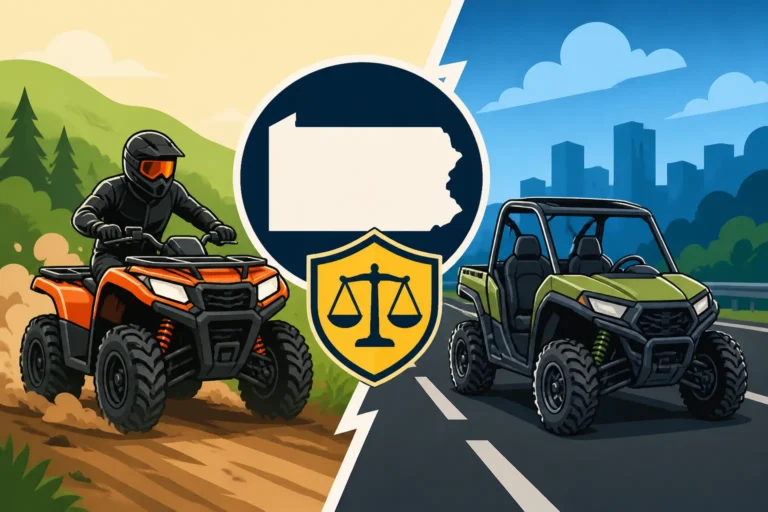
To help you understand the potential differences, here's a quick comparison table:
| Feature | Typical Public Road (PA) Rules | Typical Private Campground (PA) Rules |
|---|---|---|
| Legal Status | Generally Prohibited (off-highway vehicles) | Permitted if campground allows; owner sets rules |
| Registration | Mandatory for public land/trails via DCNR | Often requested, but not always legally required for private use |
| Insurance | Mandatory for public land/trails | Often requested by management for liability reasons |
| Speed Limit | Varies by designated road; often 25 mph or more | Very low (e.g., 5-10 mph); strict enforcement |
| Helmet Use | Mandatory for all riders 15 and under, recommended for all | Often mandatory for all riders, especially minors |
| Noise Levels | State-mandated muffler requirements | Often stricter than state law; quiet operation expected |
| Designated Area | Only on officially opened ATV roads and trails | Limited to specific routes, often just access to sites/amenities |
| Enforcement | DCNR Rangers, State Police, Local Law Enforcement | Campground Management, potentially local law enforcement |
Safety and Etiquette for Riding Your ATV/UTV in a Campground
Even if a campground allows ATVs or UTVs, it's not a free-for-all. You're sharing space with families, kids, and people trying to relax. Responsible operation, courtesy, and safety aren't just polite; they're often mandated by campground rules and are essential for everyone's enjoyment.
Prioritizing Pedestrian Safety
This is the absolute top priority. Campgrounds are incredibly pedestrian-heavy environments. There are kids on bikes, toddlers learning to walk, people walking their dogs, and groups strolling to the shower house or playground. Your ATV or UTV, while fun and useful, can be intimidating and dangerous in such a setting if not operated with extreme caution.
Always drive as if there's a child about to run out from behind every RV or tent. Maintain walking speeds, constantly scan for movement, and be prepared to stop instantly. Yield to absolutely everyone – pedestrians, bicyclists, golf carts, and other vehicles. Make eye contact if possible. Remember that your machine, with its engine noise and size, might startle someone, especially children or pets. Being a good steward of the trails and roads means prioritizing the safety and comfort of others above all else. The perception of ATVs and UTVs can already be a bit negative among some non-riders; don't give them more reason to complain.
Keeping the Peace (Noise and Dust Control)
Nobody wants their camping experience ruined by excessive noise or a constant cloud of dust. Even if your machine is perfectly legal and has a proper muffler, operating it in a campground requires extra consideration for your neighbors.
- Noise: Avoid revving your engine, driving at high RPMs, or making unnecessary noise. Stick to the lowest possible gear to maintain your slow speed. Be especially mindful during "quiet hours," which most campgrounds strictly enforce, often in the evenings and early mornings. An aftermarket exhaust might be cool for the trails, but a quieter setup is definitely appreciated in a campground. You can refer to [Pennsylvania Rules for a Loud Exhaust] for general regulations, but apply an even stricter personal standard in a campground.
- Dust Control: Driving too fast on gravel campground roads will kick up significant dust, coating nearby tents, RVs, and outdoor gear. Keep your speed to an absolute minimum to avoid this. If the roads are particularly dry and dusty, consider whether your trip is truly necessary, or if you can walk instead. Being considerate about dust is a huge part of being a good neighbor in a camping environment.
Practical Tips for Campground Riding
Beyond the basic rules, a few practical considerations can make your campground ATV/UTV experience smoother and safer for everyone.
- Use Lights: Even if it's not fully dark, using your headlights and taillights can significantly increase your visibility to others, especially at dusk, dawn, or in shaded areas between large RVs. It's a simple safety measure. For general lighting rules, see [Pennsylvania Lighting Requirements for ATVs], but adapt for the specific context of a campground.
- Enhance Visibility: Consider adding turn signals or a horn to your machine for better communication with pedestrians and other vehicles. SuperATV offers great universal kits for these kinds of upgrades. While not legally required on private property, these can be invaluable tools for safety in a busy campground. Or maybe you've added some practical accessories, perhaps a windshield or a roof from SuperATV, which certainly makes cruising around a bit more comfortable.
- Secure Your Gear: If you're using your UTV to haul supplies, make sure everything is securely strapped down. You don't want a cooler or bag falling off on a bumpy campground road, especially with people around.
- Stay on Designated Paths: Do not, under any circumstances, cut across grass, empty campsites, or through wooded areas that aren't clearly marked as trails. This shows disrespect for the campground property and can damage landscaping or upset other campers. Stick strictly to the roads and any approved riding areas.
Consequences of Disregarding Campground Rules
It's tempting to think that because you're on private property, the rules are more relaxed. However, ignoring a campground's policies regarding your ATV or UTV can lead to a host of unpleasant consequences, ranging from a simple warning to serious legal trouble.
Internal Campground Penalties
Campground management has significant power over your stay. Their rules are usually part of the agreement you make when you reserve or check in. Breaching these rules can quickly escalate the situation:
- Warning: For minor infractions, you'll likely receive a verbal or written warning. This is your chance to correct your behavior immediately.
- Loss of Riding Privileges: If the behavior continues, management might tell you that your ATV or UTV must remain parked for the rest of your stay, or you'll be restricted to only essential utility use (e.g., driving straight to the dump station and back, not for recreational loops).
- Eviction from the Campground: This is the most severe internal penalty. If you repeatedly violate rules, operate unsafely, or cause a disturbance, management has every right to ask you to leave. And here's the kicker: you typically won't receive a refund for any unused portion of your reservation. You'll have to pack up, often on short notice, and find somewhere else to go.
- Banned from Future Visits: Beyond just being evicted, many campgrounds will place you on a "do not rent" list, meaning you won't be welcome back in the future. This can be particularly frustrating if it's a favorite spot for your family.
When Private Rules Cross Into Public Law
While you're on private property, it doesn't mean you're entirely immune from public laws. Campground management can, and often will, call local law enforcement if they feel public safety is at risk, or if illegal activities are taking place. This is where things can get much more serious.
- Reckless Endangerment/Disorderly Conduct: If you're driving an ATV or UTV recklessly, at excessive speeds, or in a way that truly endangers others (e.g., nearly hitting a child), law enforcement can absolutely get involved. These aren't just campground rule violations; they're potential criminal offenses that carry fines and could even lead to arrest.
- DUI on an ATV/UTV: This is a critical point. Operating an ATV or UTV while under the influence of alcohol or drugs is illegal everywhere in Pennsylvania, including on private property. Even if you're just "cruising slowly" around your campsite, if you're impaired, you can be charged with a DUI. These charges carry severe penalties, including hefty fines, license suspension, and even jail time. You can learn more about this serious issue by reading [Pennsylvania DUI Rules for ATV Riders].
- Noise Ordinances: While most noise complaints in a campground are handled internally, if your machine is excessively loud and causing a significant disturbance, especially after quiet hours, local law enforcement could issue citations for noise ordinance violations, even on private land.
- Other Violations: Depending on what you're doing, other public laws could apply. For example, if you're riding an unregistered machine and venture even a foot onto a public road adjacent to the campground, you could face significant [Pennsylvania ATV Registration Fines] or [Pennsylvania Fines for an Unregistered ATV]. While the goal is to respect private property, common sense and a general understanding of the law are always your best protection.
In summary, while campgrounds offer a unique setting for some ATV/UTV use, the golden rule is always to check with management, follow their specific rules to the letter, and prioritize the safety and enjoyment of everyone around you. Being a respectful and responsible rider ensures you have a great time and helps maintain a positive image for the ATV/UTV community.
Disclaimer
This article is for general informational purposes only and does not constitute professional advice. Laws, prices and regulations vary by location and change over time. Consult a qualified professional for guidance on your specific situation.