Riding Into Town on a Pennsylvania ATV
It's a common dream for many ATV and UTV enthusiasts here in Pennsylvania: finishing up a great ride on the trails, maybe out in Sproul State Forest, and then just hopping on your machine to cruise right into the nearest small town for a burger, a cold drink, or to fill up the tank. It sounds convenient, practical, and honestly, a little bit like the ultimate freedom of off-roading. But the reality is, Pennsylvania's laws around riding your ATV or UTV on public roads are incredibly strict, and misunderstanding them can quickly turn a fun day into a very expensive headache. This guide is going to break down exactly what the rules are for taking your quad or side-by-side into town in Pennsylvania, where you might find some legal exceptions, and what you absolutely need to know to avoid fines and frustration.
The Core Challenge: Why Riding an ATV "Into Town" Isn't Always Simple in Pennsylvania
Let's face it, the idea of being able to just run your ATV down the road to grab some gas or a sandwich sounds amazing. You're already on the machine, it's right there, and it just feels natural. But here in Pennsylvania, our laws are generally quite clear: ATVs and UTVs are primarily designed and legally intended for off-road use. This fundamental principle creates the biggest hurdle for anyone wanting to take their machine into a populated area, even for a short distance.
Pennsylvania's General Ban on Road Use for ATVs
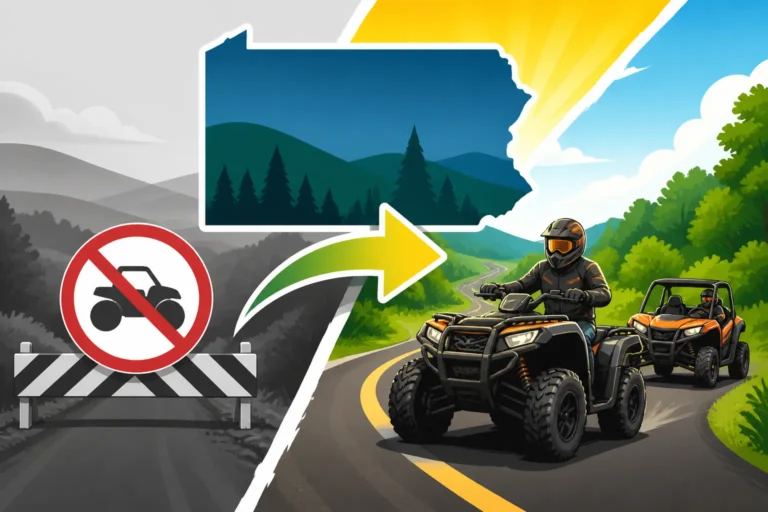
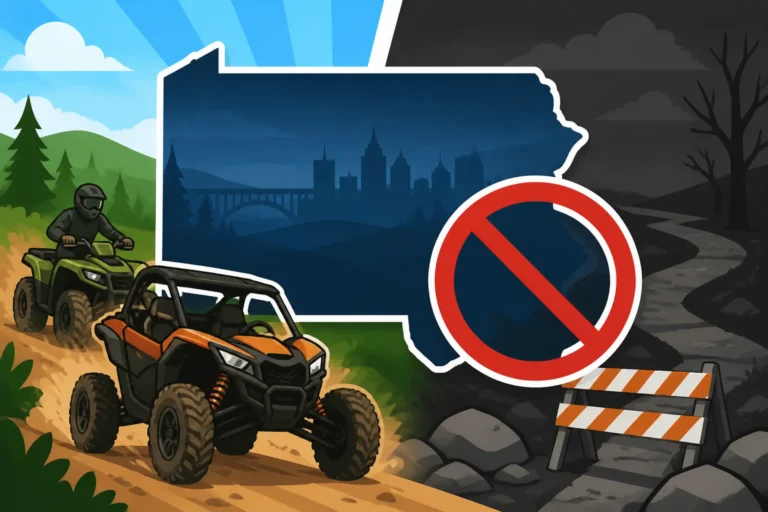
The default legal stance in the Commonwealth is that ATVs and UTVs are not permitted on public roads. This isn't just a suggestion; it's written into the law. These machines lack many of the safety features required for on-road vehicles, like turn signals, specific headlight brightness, and often, the stability on paved surfaces at higher speeds. The Pennsylvania Vehicle Code, specifically [17 Pennsylvania Code Chapter 51], lays out these regulations quite clearly. It treats ATVs as recreational off-highway vehicles, which means they belong on designated trails, private property with permission, or other approved off-road areas – not mixing with cars, trucks, and school buses on Main Street.
The reasoning behind this isn't to spoil your fun, but to ensure public safety. ATVs can be unstable on pavement, especially when braking or turning quickly. They're also often harder for motorists to see due to their smaller profile and different operating characteristics. Imagine trying to navigate downtown traffic on a machine designed for dirt and rocks; it's a recipe for potential disaster. This general prohibition means that if you pull out of a trail system onto an undesignated road and head towards a store, you're immediately in violation of the law.
What "Into Town" Actually Means for a Rider
When we talk about riding "into town," what exactly do we mean? For many riders, it's not about joyriding through residential streets or commuting to work. It's usually about convenience. You might be deep in the backcountry, realize your fuel tank is running low, and spot a gas station just a mile down the state route in the nearby village. Or perhaps after a long day of dusty riding, all you crave is a hot meal, and the local diner looks incredibly inviting from the edge of the woods.
The core intent is often to access services: fuel, food, lodging, or maybe even a small repair shop. Sometimes, it's also about connecting two sections of a trail system where a township road might provide the shortest link. However, the legal definition doesn't differentiate between "just a little bit" and "a long haul." Unless a specific exception applies, any travel on a public road in a municipal area, whether it's a small village or a bustling borough, is generally prohibited. This distinction is crucial because while crossing a road might be allowed under strict conditions, actually driving on it for any distance to reach a destination in town is a much bigger legal leap.
Designated ATV Roads and Joint-Use Routes: Your Legal Lifelines
While the general rule is "no ATVs on roads," Pennsylvania does offer some very specific, albeit limited, exceptions. These exceptions are typically found in designated areas and require you to be vigilant about identifying them. These aren't blanket permissions, but rather carefully carved-out routes where ATVs and UTVs are legally allowed to share the road with traditional vehicles.
Identifying Designated Township and Borough Roads
Some forward-thinking townships and boroughs across Pennsylvania have recognized the economic benefit of ATV tourism and have taken steps to open certain roads for off-highway vehicle access. This isn't a decision made lightly; it involves local government approval and careful consideration of safety and local impact. When a township or borough decides to open a road, they must explicitly designate it for ATV use. You won't find this everywhere, and it's certainly not the norm for every street in every town.
The key indicator you're looking for is a specific sign. As we explain in [The Green Sign on a Pennsylvania Township Road], these are typically green signs posted clearly at the beginning and end of the designated route. These signs indicate that the road is open for ATV use. It’s absolutely critical to understand that if you don't see this sign, the road is not open to ATVs, regardless of what local scuttlebutt might suggest. These designated roads are usually connectors to trail systems or provide limited access to nearby services. A notable example of a municipality that has implemented such a program is [Windber Borough's Mixed Use Program], which publishes its open and closed roads, giving riders clear guidance. Always check with local authorities or trail system maps for these specific designations, as they can change and are often very localized.
Understanding Pennsylvania's Joint-Use Roads
Beyond municipal designations, Pennsylvania also has what are known as "joint-use roads." These are typically found within state forests and are roads that are shared by motor vehicles, including cars and trucks, and ATVs or UTVs. Unlike designated township roads, these are usually rural routes, often gravel or dirt, winding through vast stretches of forest land. Their primary purpose is often to provide access within the forest itself, acting as crucial links between different sections of trail systems. [Pennsylvania Joint-Use Roads and Who Shares Them] covers this in more detail.
These roads are vital for accessing trailheads, connecting different segments of larger trail networks, or reaching remote campsites. However, it's important to set expectations: while they allow ATV use, these joint-use roads are generally not going to lead you "into town" in the sense of a populated commercial area. They connect you to other wild areas or possibly very small, isolated communities. Think of them as connecting [Riding From Westport to Kettle Creek] rather than taking you to a grocery store. When riding on joint-use roads, you must obey all traffic laws, including speed limits, yielding to oncoming traffic, and staying to the right. While they offer legal road riding, it’s not the solution for most urban-access needs.
The "Crossing" Exception: Navigating Intersections and State Routes
Even when riding exclusively on trails or private property, you'll inevitably encounter situations where you need to cross a public road. This is often the case when a trail system continues on the other side of a highway, or when you need to get from one section of a property to another. Pennsylvania law does provide a very specific, limited exception for these scenarios, but it's crucial to understand that "crossing" is not the same as "riding."
Rules for Crossing a Highway or State Route
If your trail or private land necessitates crossing a public highway or state route, Pennsylvania law allows this under extremely strict conditions. The most important rule is the "90-degree rule," as covered in [Crossing a Highway on an ATV in Pennsylvania]. This means you must cross the road as directly as possible, at an angle as close to 90 degrees to the roadway as you can manage. You are not permitted to ride along the road, even for a very short distance, to find a more convenient crossing point. It must be a straight shot across.
Before attempting any crossing, you must come to a complete stop, look both ways, and yield to all oncoming traffic. Treat it exactly as you would crossing a railroad track – extreme caution is paramount. This brief traversal is not intended to get you anywhere "in town" but simply to move your machine from one legal riding area to another. Any deviation from these rules, such as riding parallel to the road for even a few yards, immediately puts you in violation and at risk of a citation.
Divided Highways and Intersection Crossings
Crossing a divided highway presents an even greater challenge and requires additional vigilance. For these types of roads, you must cross each section of the highway separately, treating the median as an intermediate stop or staging area if it's wide enough and safe to do so. [Divided Highways and Intersection Crossings] provides more context on this. You still adhere to the 90-degree rule for each lane of travel. The intent here remains solely to traverse the road, not to use it as a pathway to a destination.
Similarly, crossing at intersections comes with its own set of considerations. While intersections might seem safer due to traffic signals or stop signs, the core principle of a direct, 90-degree crossing still applies. You're not allowed to use the intersection to make a turn onto the road or to ride around a corner "into town." The act is solely one of crossing from point A to point B. This distinction between a brief, direct crossing and actual travel on the road for any distance is vital for avoiding legal trouble and ensuring your safety.
Navigating the Practicalities: What You'll Need (Beyond Just a Legal Road)
Let's say you've found one of those rare, legally designated township roads that actually does lead into a small town for services. Or perhaps you're on a joint-use road within a state forest. Even in these specific, legal scenarios, your ATV or UTV isn't just a free-for-all. There are specific machine requirements, as well as personal documentation you must have in order. Neglecting these details can quickly negate the legality of your road use and lead to fines.
Essential Gear and Machine Requirements for Road Use
When your ATV or UTV is on any public road, even a legally designated one, it needs to be equipped to be seen and heard safely. First and foremost, working headlights, taillights, and brake lights are absolutely essential. If you're riding after dusk, or even during the day in low visibility, these lights ensure that other motorists can see you. You'll also need reflectors on your machine to enhance visibility, especially from the sides. [Pennsylvania Lighting Rules for Road Use] details these requirements. Many aftermarket suppliers, like SuperATV, offer excellent lighting kits and accessories that can significantly improve your machine's visibility and help you meet these safety standards.
Beyond lighting, your machine must be equipped with a muffler in good working order to keep noise levels reasonable. Nobody wants excessively loud machines disrupting peaceful rural communities. A spark arrester is also mandatory to prevent stray sparks from igniting dry vegetation, especially crucial in forested areas. [Pennsylvania Muffler Requirements for ATVs] and [Pennsylvania Spark Arrester Requirement] are specific about these. And of course, for your own safety, a properly fitting helmet is mandatory for all ATV and UTV riders and passengers in Pennsylvania, regardless of where you're riding. [Helmet Rules for Pennsylvania Riders] are strictly enforced.
Age, Registration, and Insurance: Your Paperwork Check
Even if you're on a legally designated road, the driver and the machine itself must meet certain legal criteria. First, the operator must be at least 16 years old to ride an ATV on any public road. This isn't just a suggestion; it's a hard and fast rule in Pennsylvania. [Pennsylvania's Sixteen-Year-Old Road Rule] is very clear about this. A younger rider, even if they're permitted on a trail system, cannot legally operate an ATV on a public road, even for a short distance.
Second, your ATV or UTV must be properly registered with the Pennsylvania DCNR. This involves obtaining a title for your machine, paying the necessary fees, and displaying your registration plate and sticker. [Registering an ATV in Pennsylvania] is a comprehensive guide to this process. Riding an unregistered machine on any public road, designated or not, will lead to a significant fine.
Finally, and critically, you must carry proof of liability insurance. [Pennsylvania's Mandatory Insurance Off Your Own Land] clearly states that if you're riding off your own private property, whether on a trail, a designated road, or crossing a highway, you need to be insured. This protects you and others in case of an accident. You should always have your proof of insurance with you, perhaps in a waterproof wallet card holder. [Carrying Proof of Insurance in Pennsylvania] is not just a good idea; it's a legal requirement. An officer checking your documents will expect to see this, along with your registration and a valid safety certificate if applicable.
Common Misconceptions and Serious Consequences
Despite the clear laws, many riders still harbor misconceptions about what's permissible, often based on what they've "always done" or what they see others doing. This can lead to serious legal trouble and financial penalties that can quickly sour any recreational ride. It's vital to separate fact from fiction when it comes to road use in Pennsylvania.
The Myth of the "Short Ride to the Store"
One of the most persistent myths is that it's okay to ride your ATV on the road for "just a short distance" to get to a store, a restaurant, or a friend's house. The thinking goes: "It's only a quarter-mile," or "I'll be quick," or "There's no police out here." This line of reasoning, while understandable from a convenience standpoint, is dangerous and illegal. Pennsylvania law doesn't have a "short distance" loophole for undesignated roads. If the road isn't specifically marked as open for ATV use by the township or borough, or if it's not a DCNR-designated joint-use road, then it's off-limits. Period.
The temptation is certainly there, especially when services seem so close. You might see a gas station sign from the trail and think it's worth the risk. But that risk is significant. What feels like an innocent shortcut to you is a violation of traffic laws and could put you and other motorists in harm's way. An officer on patrol isn't going to care if you were "just going for milk"; they'll see an unregistered (for road use), uninsured, and potentially unsafe vehicle operating illegally on a public road.
Fines, Penalties, and Machine Impoundment
The consequences of riding an ATV illegally on a public road in Pennsylvania are not minor. The most common and immediate penalty is a hefty fine. For riding an unregistered machine, which includes an ATV without proper DCNR registration for road use, the automatic fine can be $300, as explained in [Pennsylvania Fines for an Unregistered ATV]. This isn't a maximum; it's a base amount that can be compounded by other violations.
Beyond the registration issue, you can face additional citations for:
- No Helmet: If you're not wearing a helmet.
- No Insurance: A separate fine for not carrying the required liability insurance.
- Underage Operation: If the operator is under 16 years old.
- Reckless Endangerment/Driving: If your manner of operation is deemed unsafe.
On top of these fines, you'll also be responsible for the "cost of prosecution," which can add substantially to the total amount you owe. [Cost of Prosecution on Top of a Fine] means administrative fees and court costs can stack up quickly. In severe cases, particularly for repeat offenders or dangerous operation, your machine could even be impounded. Having your ATV towed and stored comes with its own set of fees, adding insult to injury. Don't let a moment of convenience turn into hundreds, or even thousands, of dollars in fines and fees.
Finding Fuel, Food, and Lodging Near Pennsylvania Trails
Given the strict regulations against riding ATVs on most public roads, especially into towns, planning ahead becomes absolutely essential. You can still enjoy the convenience of accessing services, but it often requires a different approach than simply riding your machine directly there. The key is to leverage existing resources and focus on trail-friendly communities that cater to riders.
Planning Ahead: Researching Trailhead Amenities
Before you even load up your ATV for a trip, take some time to research the trail system and the surrounding area. DCNR provides excellent resources, including detailed [Pennsylvania Trail Maps From DCNR], which often indicate staging areas, parking lots, and nearby facilities. Look for trail systems that have services directly adjacent to designated staging areas or those that have established partnerships with local businesses.
For example, many trail systems are strategically located near small towns, but the access is often designed for tow vehicles and trailers. You'll drive your truck and trailer to the trailhead, unload your ATV for riding, and then, when you need gas or food, you'll load your ATV back onto the trailer and drive your truck into town. This might seem like an extra step, but it keeps you legal and safe. Some trail systems, like the AOAA or Rock Run Recreation, are private parks and are often set up with amenities or very close access to them, sometimes even having fuel on site. Always check the specific rules and maps for the area you plan to ride.
Trail-Friendly Communities and Local Businesses
Some communities in Pennsylvania actively embrace ATV tourism and make it easy for riders to access their towns, even if not directly by ATV. These "trail-friendly" towns might have large staging lots where you can leave your truck and trailer, and then have shuttle services or even designate specific roads for limited ATV access (as discussed earlier with the green signs). They understand that catering to riders brings economic benefits. Look for towns that advertise themselves as such.
When you're planning your trip, identify these communities. Many local tourism bureaus or chambers of commerce will have information specifically for ATV riders, listing gas stations, restaurants, and lodging that are accustomed to off-road visitors. You might find a local outfitter or gear shop, like a place that sells SuperATV accessories, that has specific advice on where to fuel up or grab a bite without breaking the law. These businesses often understand the specific needs and challenges of ATV riders. Sometimes, even though you can't ride your ATV directly to the burger joint, the gas station next to the trailhead might have a food truck on weekends, or the local general store might offer a pickup service for orders. It's all about proactive planning and leveraging the resources that are legally available to you.
Summary of Pennsylvania ATV Road Use Rules
To help clarify the various scenarios and requirements for riding your ATV or UTV in and around Pennsylvania towns and roads, here's a quick summary:
| Scenario | Legal Status | Key Requirements | Consequences of Violation |
|---|---|---|---|
| Riding on Undesignated Public Roads (e.g., Main St. in a town) | Generally ILLEGAL | NONE (No legal way to do this) | Automatic $300 fine, potential impoundment, other citations for no insurance/helmet/etc. |
| Crossing a Public Road (90-degree rule) | LEGAL (Under strict conditions) | Stop, yield, 90-degree crossing, valid registration, insurance, helmet, age 16+ | Fine for not following crossing rules, other citations if lacking required items |
| Riding on Designated Township/Borough Roads | LEGAL (If explicitly signed "Open to ATVs") | Green "ATV OPEN" signs, valid registration, insurance, helmet, age 16+, all traffic laws obeyed | Fine if lacking required items or violating traffic laws on designated roads |
| Riding on DCNR Joint-Use State Forest Roads | LEGAL (Specific rural forest roads) | Valid registration, insurance, helmet, age 16+, all traffic laws obeyed, often requires trail permit | Fine if lacking required items or violating traffic laws on joint-use roads |
| Riding on Private Property (with permission) | LEGAL | Landowner permission, helmet (recommended for safety, not legally mandated by DCNR on private land), age restrictions still apply (under 16 requires supervision) | Trespassing charges if no permission |
Disclaimer
This article is for general informational purposes only and does not constitute professional advice. Laws, prices and regulations vary by location and change over time. Consult a qualified professional for guidance on your specific situation.