How a Pennsylvania Road Gets Opened to ATVs
It's incredibly frustrating, isn't it? You love riding your ATV, but the moment you think about connecting trails, accessing a store, or even just getting from your hunting camp to a public trail, you hit a brick wall. Pennsylvania's rules on riding ATVs on public roads can feel like a maze, leaving many riders wondering if any roads are truly open, and if so, how in the world they became that way. This guide is here to demystify the process, explaining exactly how a local road in Pennsylvania can potentially be opened for ATV use and what that actually means for riders like you.
The Tough Reality of ATV Road Access in Pennsylvania
Let's face it, Pennsylvania isn't exactly known as an ATV-friendly state when it comes to road access. For the most part, ATVs are considered off-highway vehicles, and that means they're generally banned from public roads, streets, and highways. This isn't just a DCNR rule; it's deeply embedded in state law, specifically 17 Pennsylvania Code Chapter 51. The frustration among riders is palpable because while you might see other states with robust shared-use road systems, Pennsylvania has taken a much more restrictive stance. This can make simple acts, like getting from one section of a trail to another without trailering, feel like an impossible quest.
The core reason for this blanket restriction is safety, perceived impact on road infrastructure, and often, public sentiment. There's a long-standing view that ATVs don't mix well with traditional vehicle traffic. While many riders would argue that with proper lighting, registration, and insurance, they could safely navigate certain low-traffic roads, the legal framework hasn't caught up to that sentiment on a widespread basis. This is why you often hear about riders getting tickets for merely crossing a road, let alone riding down one. Understanding [Why Pennsylvania Will Not Plate a Quad] for street use is crucial here; the state simply doesn't recognize ATVs as on-road vehicles.
The General Prohibition and Its Exceptions
The default position in Pennsylvania is clear: no ATVs on public roads. However, there are very limited exceptions, and they are exceptions that prove the rule, not common allowances. You can generally cross a highway at a ninety-degree angle after coming to a complete stop, ensuring the path is clear. This is typically meant for getting from one private property to another, or from a private property to a legal trail. But actually riding along a public road for any distance? That's where things get extremely tricky, and usually, illegal.
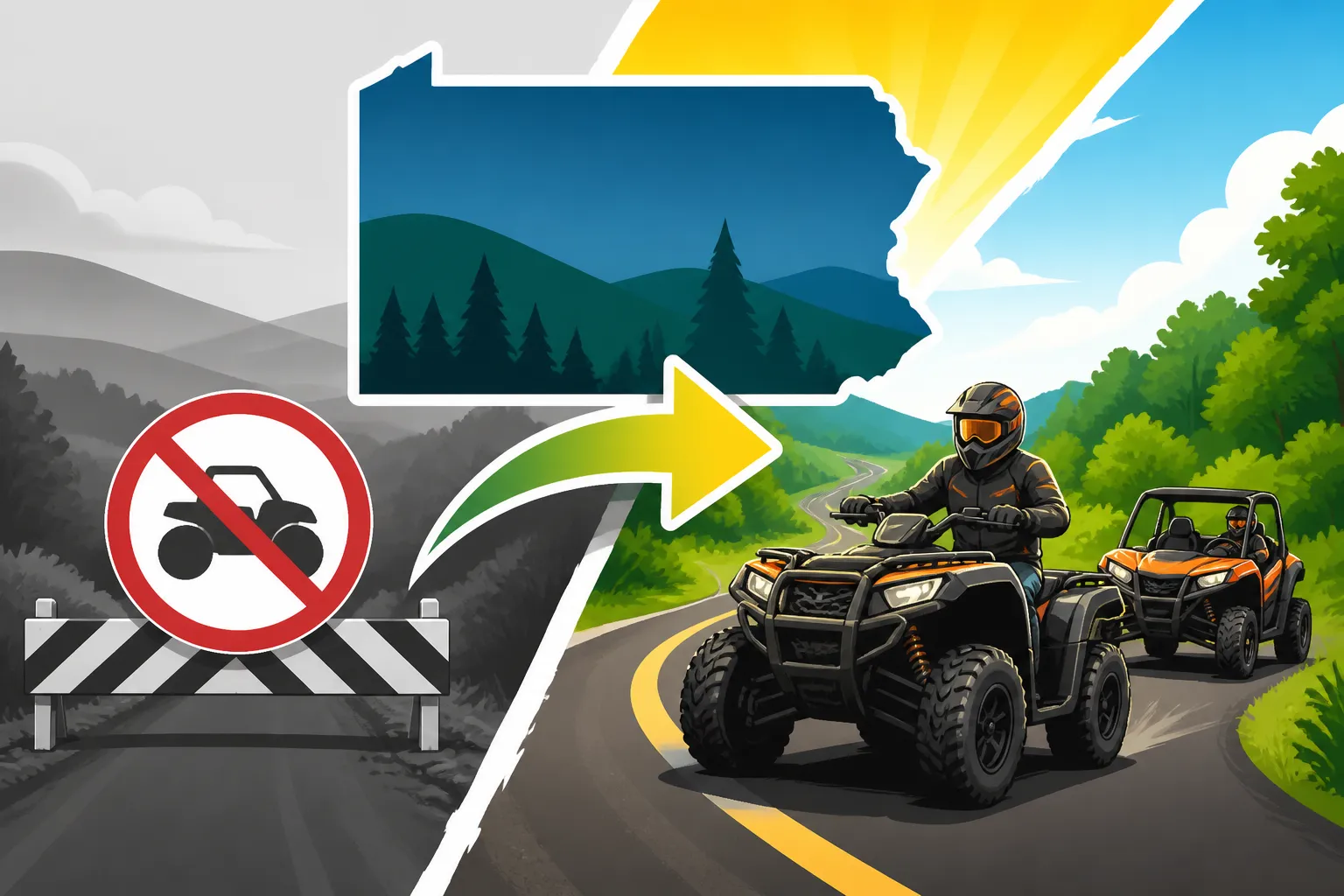
The exceptions typically involve specially designated routes. These aren't widespread, and they don't pop up overnight. They are the result of specific, deliberate actions by local governments to designate a road as open to ATVs. These are not state-level initiatives that magically open all township roads. Instead, they are hyper-local decisions, often driven by community needs, economic development efforts tied to tourism, or specific access requirements. For example, some municipal areas might designate a short connector road to allow access to a major trail system or allow riders to reach fuel and food services, but these are often the result of significant effort and a clear vision from the local community.
The Path to Opening a Township or Borough Road for ATVs
So, if the default is "no," how does a road get opened? It's not a simple wave of a wand. In Pennsylvania, the authority to open or close local roads to ATVs primarily rests with local municipal governments – townships and boroughs. These local bodies have the power to enact ordinances that designate specific roads or sections of roads for ATV use, usually under very strict conditions. It's a localized, political process that requires significant community input, official action, and often, a lot of patience.
Understanding the Municipal Role
Townships and boroughs are the key players in this process. They are empowered by state law to make decisions regarding the use of roads under their jurisdiction. This means a county commissioner or state representative usually won't be able to unilaterally open a local road. It has to come from the ground up, from the local elected officials who oversee those specific roads. This can be a double-edged sword: on one hand, it allows for hyper-local solutions tailored to specific communities. On the other, it means fragmented efforts, and a single road in one township might be open, while the identical road right across the border in another township remains closed.
When a township or borough considers opening a road, they typically look at several factors:
- Safety Concerns: Is the road suitable for mixed use? What are the speed limits, traffic volumes, sight lines, and pedestrian activity?
- Infrastructure Impact: Will ATV use damage the road surface, especially unpaved roads?
- Public Opinion: What do residents, both ATV riders and non-riders, think about the proposal? Noise and dust are common concerns.
- Economic Benefit: Could opening a road boost local tourism, attract riders to businesses, or connect existing trail systems?
- Connectivity: Does the road provide a vital link between otherwise disconnected legal riding areas?
These considerations aren't taken lightly. Local officials often have to balance the desires of the riding community with the concerns of other residents.
The Formal Process: From Proposal to Ordinance
Getting a road officially opened typically follows a structured, public process:
- Initial Proposal/Request: This usually starts with local ATV clubs, concerned residents, or local businesses approaching the township supervisors or borough council. They present their case, highlighting the benefits and addressing potential concerns. This is where organizations like [Pennsylvania's DCNR Snowmobile and ATV Section] might offer guidance on best practices, but they don't dictate local road usage.
- Research and Feasibility Study: The local government might conduct its own research. This could involve looking at existing road conditions, traffic counts, potential costs for signage, and consulting with law enforcement about enforcement challenges.
- Public Hearings: This is a crucial step. The local government must publicly announce their intent to consider an ordinance and hold one or more public hearings. This provides a platform for residents, both pro and con, to voice their opinions. Rider advocacy is vital here, showing up to these meetings and presenting a united, responsible front.
- Drafting the Ordinance: If there's enough support and the feasibility looks good, the local government will draft an ordinance. This document will specify exactly which roads or sections are open, under what conditions (e.g., specific hours, speed limits, required equipment like lighting and mirrors), and any penalties for non-compliance. It will likely reference state law regarding ATV operations, such as [Pennsylvania's Minimum Age of Sixteen on Roads] for operators.
- Voting and Enactment: The township supervisors or borough council will then vote on the proposed ordinance. If it passes, it becomes law within that municipality.
- Signage and Enforcement: Once enacted, the municipality is responsible for clearly marking the designated roads. You'll often see [The Green Sign on a Pennsylvania Township Road] indicating that ATVs are permitted. Local police or DCNR rangers will then enforce the ordinance.
This process can be lengthy, taking months or even years. It requires persistent, organized effort from the riding community. Many times, the process might stall due to lack of public support, budget constraints for signage and enforcement, or perceived safety risks.
| Stage of Road Opening | Key Actions | Involved Parties | Typical Timeline |
|---|---|---|---|
| Initiation | Rider groups or businesses propose idea, contact officials | Local ATV clubs, businesses, residents | Varies, can be ongoing |
| Investigation | Feasibility studies, traffic analysis, safety review | Township/Borough officials, local police | Weeks to a few months |
| Public Input | Public hearings, community meetings, feedback collection | Local residents, ATV riders, property owners | Multiple meetings over several weeks |
| Drafting | Legal department prepares official ordinance document | Township/Borough solicitor, elected officials | Weeks |
| Enactment | Official vote by local council/supervisors | Elected officials | Single meeting |
| Implementation | Installation of signage, notification of law enforcement | Public works, local police, DCNR | Weeks to months post-enactment |
The Role of Local Government and Rider Advocacy
The success of opening any road hinges on a collaborative effort between the local government and the riding community. Neither can achieve this goal effectively without the other. Riders often feel like the system is against them, but being proactive and responsible can shift perceptions.
How Riders Can Be Effective Advocates
If you're passionate about seeing more designated ATV roads, you have a vital role to play. Sitting back and hoping someone else will do it rarely yields results.
- Join or Form a Local ATV Club: There is strength in numbers. A recognized club has more credibility than individual riders. Clubs can organize meetings, gather petitions, and present a unified voice to local officials. They also often partner with brands like SuperATV for group discounts on parts or gear.
- Attend Local Government Meetings: Show up at township supervisor or borough council meetings. Don't just show up to complain; show up to listen, learn, and respectfully present your case. This demonstrates engagement and a willingness to be part of the solution. Learning [Who Votes to Open a Road] is the first step to influencing that vote.
- Educate and Inform: Many non-riders have misconceptions about ATVs. Share information about safety courses, responsible riding, and the economic benefits that ATV tourism can bring to an area. Highlight how new parts from SuperATV, like enhanced lighting or mirrors, can contribute to safer riding, even if they don't make the machine street legal.
- Be a Responsible Rider: If you advocate for more road access, you must also model responsible behavior. This means adhering to all existing laws, respecting private property, keeping noise down, and staying on designated trails. One rider's poor behavior can derail years of advocacy efforts. [Pennsylvania ATV Registration Fines] for unregistered machines or [Pennsylvania Fines for an Unregistered ATV] are not just costly for the individual, they tarnish the image of all riders.
- Focus on Specific, Achievable Goals: Instead of asking for every road to be open, identify specific, low-traffic connector roads that would genuinely improve access to legal trails or essential services. A clear, well-reasoned proposal for a single road is more likely to succeed than a broad, undefined demand.
The Challenges Local Governments Face
It's important to understand that local governments aren't always resistant just to be difficult. They face genuine challenges when considering opening roads to ATVs:
- Public Safety and Liability: Their primary concern is the safety of all residents – drivers, pedestrians, and riders. They also worry about potential liability if an accident occurs on a designated road.
- Enforcement: Opening a road requires enforcement. Local police departments, especially in rural areas, may have limited resources to patrol newly opened ATV routes and ensure compliance with speed limits, age restrictions, and other rules.
- Nuisance Complaints: Noise, dust, and environmental impact are common complaints from residents who live near proposed ATV routes. These concerns often dominate public hearings and can sway officials.
- Cost: While DCNR manages state forest trails, local governments might incur costs for signage, road maintenance, or even increased law enforcement presence for designated local roads.
This is where collaborative solutions come in. Can local clubs help with signage or offer to patrol designated routes? Can they commit to maintaining the integrity of the road? These types of proposals can ease the burden on local governments.
Navigating Designated ATV Roads: Rules and Responsibilities
If a road in a Pennsylvania township or borough does get officially opened for ATV use, it comes with a strict set of rules and significant responsibilities for riders. This isn't a free-for-all; it's a privilege that can be revoked if abused. You won't find many of these, but where they exist, you must know the rules.
Understanding Designated Road Limitations
Even on a designated road, you're not driving a car. These are typically "joint-use" roads, meaning traditional vehicles share them with ATVs. This requires extra caution and adherence to specific rules that will be outlined in the local ordinance and often posted on signage.
- Specific Roads and Hours: The ordinance will usually list the exact roads or sections of roads that are open. There might also be specific hours of operation (e.g., no night riding).
- Speed Limits: You'll be expected to follow all posted speed limits, which are often lower than typical road speeds due to the nature of the vehicles.
- Required Equipment: Designated roads often require specific equipment beyond what's needed for pure trail riding. This might include mirrors, working headlights and taillights, turn signals, and sometimes even a horn. Always check the specific ordinance. Many riders may consider robust upgrades from SuperATV for visibility, like improved lighting systems, for enhanced safety on any shared routes.
- Age and License Requirements: Operators must typically be at least 16 years old and possess a valid driver's license to operate an ATV on any designated public road, consistent with [Pennsylvania's Sixteen-Year-Old Road Rule].
- Registration and Insurance: Your ATV must be properly registered with DCNR, and you must carry proof of liability insurance, just as you would on state trails. [Pennsylvania ATV Registration and Insurance Proof] is mandatory.
- Helmets: Helmets are almost universally required for all operators and passengers on designated roads, regardless of age, mirroring state trail rules. [Pennsylvania Helmet Law for ATV Riders] applies.
The "Green Sign" and What It Means
You might occasionally spot a green sign on a township road that indicates ATV use is permitted. This sign, often featuring an ATV symbol, is your visual confirmation that the local municipality has designated that specific section for ATV use. Without such a sign or a clear, official ordinance from the local government, assume the road is closed to ATV traffic. Never rely on hearsay or the assumption that "everyone else does it." Rely instead on clear, official signage and a copy of the actual local ordinance if you can find one. This is exactly [What the Green Sign on a Township Road Means].
It’s crucial to remember that these signs only apply to the jurisdiction that posted them. A green sign in Windber Borough, for example, doesn't mean the entire county is open. Always be aware of your location and the specific rules of that municipality.
What Happens If You Break the Rules?
Riding an ATV on a closed road or violating the rules of a designated road can lead to significant penalties. These can include:
- Fines: Monetary fines, which can be substantial, especially for repeat offenses.
- Citation and Court Costs: You might also face court costs and other administrative fees.
- ATV Impoundment: In some cases, your ATV could be impounded, adding towing and storage fees to your troubles.
- Damage to Rider Reputation: Most importantly, violations by a few riders can jeopardize the hard-won privilege of road access for the entire riding community, potentially leading to the closure of designated routes.
Always ride responsibly, respect the rules, and be an ambassador for the sport. The ability to ride an ATV on a specific Pennsylvania road is a rare and hard-earned privilege, not an inherent right.
Disclaimer
This article is for general informational purposes only and does not constitute professional advice. Laws, prices and regulations vary by location and change over time. Consult a qualified professional for guidance on your specific situation.