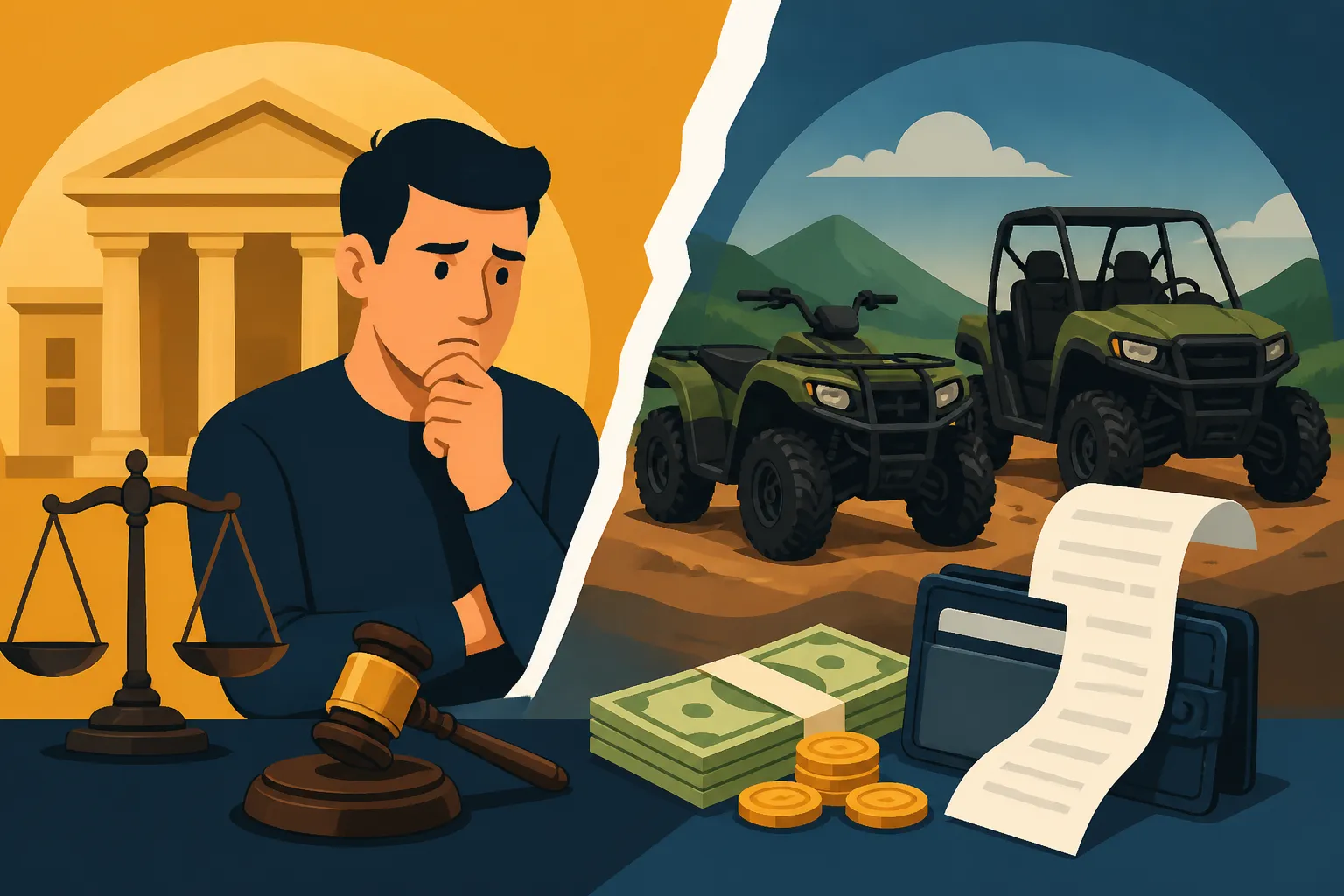
What Cost of Prosecution Means
When you receive a citation for an ATV or UTV violation in Pennsylvania, it's easy to fixate on the dollar amount written on the ticket. But many riders are blindsided by an additional charge that can sometimes double or even triple the initial fine: the "cost of prosecution." This guide will unravel what this mysterious phrase actually means, why it exists, and how these added fees can quickly escalate the financial impact of what might seem like a minor infraction.
Understanding the Basics of ATV/UTV Fines in Pennsylvania
Let's face it, nobody wants a ticket. You're out there on the trails or designated roads, enjoying the freedom that your ATV or UTV offers, and then, suddenly, you're flagged down. Whether it's a DCNR ranger, a local police officer, or a state trooper, receiving a citation is a real buzzkill. The immediate reaction is to look at the fine amount, sigh, and start thinking about how to pay it. But that initial number is rarely the full story.
More Than Just the Base Fine
Pennsylvania's system for handling ATV and UTV violations, much like other traffic or summary offenses, operates on the principle that there are costs associated with processing these infractions. It's not just about penalizing the rider; it's about covering the administrative and judicial expenses involved in upholding the law. So, while you might see a $50 fine for a specific violation, the total bill you receive could easily be $150 or more once everything is tallied. This can be a huge shock if you're not expecting it, turning a seemingly minor slip-up into a significant hit to your wallet. You can learn more about [Pennsylvania ATV Registration Fines] to get a general idea of the penalties.
The Role of the Magisterial District Judge
In Pennsylvania, most ATV and UTV citations for summary offenses – which includes things like riding unregistered, riding without a helmet (where required), or riding on a closed trail – are handled by the Magisterial District Courts. These are your local courts, often found in small towns and boroughs across the state. When you get a ticket, you'll see information about where to pay or how to respond. If you choose to plead guilty, you'll often just pay the fine and the associated costs. If you plead not guilty, you'll have a hearing before a Magisterial District Judge. Even if you win your case, there can still be administrative fees involved if the process has been initiated. Understanding the local court system is crucial, as this is where the "cost of prosecution" originates and is applied. It's part of the standard operating procedure for every case that passes through their doors.
Deconstructing "Cost of Prosecution"
So, what exactly is this "cost of prosecution" that gets tacked onto your ATV or UTV fine? It's not a single, monolithic charge but rather a collection of fees that are designed to reimburse the state, county, or local municipality for the resources expended in enforcing the law and administering justice. Think of it as the price tag for the justice system's time and effort.
What Constitutes the Costs
The actual breakdown of costs can vary slightly by jurisdiction, but generally, the "cost of prosecution" can include a range of items. These might encompass:
- Court Costs: This is often the largest component, covering the general overhead of the court system itself. This includes the judge's time, the court clerk's processing, and the maintenance of the courthouse.
- Administrative Fees: These are specific fees for processing paperwork, maintaining records, and ensuring that all legal procedures are followed correctly.
- Mailing and Notification Fees: If the court has to send you notices, reminders, or other correspondence, they will charge for postage and handling. This is particularly true if you don't respond promptly to the initial citation.
- Judicial Computer System (JCS) Fees: Pennsylvania has a statewide computer system for tracking court cases, and a portion of the costs goes towards maintaining this infrastructure.
- Constable or Sheriff Service Fees: If a warrant needs to be served, or if someone needs to be officially notified in person, the costs associated with that service will be passed on.
- Witness Fees: In some cases, if a law enforcement officer or another witness has to appear in court, there might be a nominal fee associated with their time or travel, though this is less common for simple summary offenses unless contested.
- Surcharges for Specific Funds: Sometimes, a small portion of the fees goes to specific state funds, such as a victim's compensation fund or a judicial education fund.
These various components add up quickly, sometimes dwarfing the actual penalty for the violation itself. It really highlights how [Cost of Prosecution on Top of a Fine] can make a ticket much more expensive than you initially expect.
Why These Costs Exist
The primary reason these costs exist is quite practical: to fund the justice system. Court systems, administrative staff, and law enforcement agencies require significant resources to operate. If every citation only covered the direct fine for the offense, the system itself would quickly become financially unsustainable. The "cost of prosecution" ensures that the state and local governments can recoup some of their expenditures related to investigation, adjudication, and record-keeping.
It's a way for the burden of these operational costs to be shared by those who interact with the system due to a violation, rather than falling entirely on general taxpayers. This system is designed to be self-sustaining to a degree, ensuring that the legal framework for enforcing rules – like those governing ATVs and UTVs – can continue to function effectively across the Commonwealth.
Real-World Impact and Avoiding These Costs
Let's be honest, nobody plans to get a ticket. But when it happens, the surprise of the "cost of prosecution" can turn a minor annoyance into a major headache. It's crucial for riders to understand the full financial picture so they can make informed decisions, both before and after receiving a citation.
The Financial Burden Beyond the Ticket
Imagine you're cited for [Riding Unregistered Brings an Automatic $300 Fine] in Pennsylvania. That $300 sounds steep enough, right? Now, add the various costs of prosecution. Depending on the county and the specific court, that $300 fine could easily swell to $450, $500, or even more. suddenly, what was a significant fine becomes an even bigger chunk of your budget. For many, this can be the difference between paying it off comfortably and having to scramble. This hidden layer of fees is why even a seemingly small violation can have a disproportionately large financial impact.
It’s not just the money, either. Dealing with a citation takes time – time to research, time to perhaps call the court, and time to make arrangements. If you ignore it, those costs can compound with late fees and potential legal action, leading to even greater expenses and stress down the line. That's why being aware of things like [Pennsylvania Fines for an Unregistered ATV] is just the first step; knowing the full financial hit is the second.
Navigating the System or Preventing the Issue
The best way to avoid the cost of prosecution is, naturally, to avoid getting a citation in the first place! This means being incredibly diligent about understanding and following all Pennsylvania ATV and UTV laws.
- Registration: Always ensure your machine is properly registered with DCNR. This includes having a current plate mounted correctly and the necessary stickers. Check out [Registering an ATV in Pennsylvania] for a full breakdown.
- Safety Certificates: If you have younger riders, ensure they have their [Pennsylvania ATV Safety Certificate Requirements].
- Trail Rules: Know where you can and cannot ride. Stick to designated trails and pay attention to signage. Riding on a [Pennsylvania Rules for Riding a Closed Trail] is a surefire way to get a ticket.
- Equipment: Make sure your machine is properly equipped with functional lights, brakes, and spark arresters. Many trail parks will perform checks, and law enforcement can issue tickets for deficiencies. Products from reputable brands like SuperATV can help ensure your machine meets these standards, especially when it comes to lighting or protective gear.
- Insurance: Off your own land, insurance is generally required. Always carry proof. [Pennsylvania ATV Insurance Requirements] will give you the full details.
If you do receive a citation, address it promptly. Often, paying the fine and associated costs within the designated timeframe can prevent additional fees (like late penalties or collection costs) from accruing. If you believe you were cited unfairly, you have the right to challenge it, but be prepared for the process, which will still incur some of these prosecution costs if the case goes forward, even if you are ultimately found not guilty. It's a system that has a cost, regardless of the outcome.
Case Studies and Common Scenarios
Let's walk through a couple of hypothetical, but all too common, scenarios to really illustrate how the "cost of prosecution" plays out for ATV and UTV riders in Pennsylvania. These examples help bring clarity to how a seemingly simple violation can lead to a more complex financial burden.
The Unregistered Machine
Imagine you bought a used ATV from a friend. You've been meaning to get it registered, but life got in the way. You take it out for a spin on a state forest trail, thinking you'll just do a quick loop. Suddenly, a DCNR ranger appears, checks your machine, and finds it's unregistered. You're issued a citation for [Being Cited for No Registration].
The base fine for riding an unregistered ATV in Pennsylvania is typically around $300. You're probably thinking, "Okay, $300, I'll pay that." But then, when the official notice arrives from the Magisterial District Judge's office, the total due is closer to $450 or even $500.
Here's a simplified look at how those costs might break down:
| Item | Base Fine / Fee Type | Example Cost (Illustrative) |
|---|---|---|
| Base Fine | Unregistered ATV | $300.00 |
| Court Costs (State) | Cost of Prosecution | $50.00 |
| Magisterial District Judge Fee | Cost of Prosecution | $25.00 |
| Judicial Computer System (JCS) | Cost of Prosecution | $10.00 |
| Administration Fee | Cost of Prosecution | $15.00 |
| Mailing/Processing Fee | Cost of Prosecution | $5.00 |
| Total Payment Due | ~$405.00 |
(Note: These are illustrative figures. Actual costs will vary by court and specific circumstances, but this shows the typical components.)
As you can see, that additional $100-$200 isn't an extra penalty for the violation itself; it's the cost of processing your case through the court system. This is why it's so critical to ensure all your paperwork is in order, from registration to your [Pennsylvania ATV Registration Paperwork Checklist], before you ever hit the trails. Even something like having proper mirrors or a quality horn from a brand like SuperATV can help prevent other types of citations, though not registration itself.
The Trail Violation
Let's consider another scenario. You're riding with a group, and someone suggests taking a shortcut on a clearly marked "closed" trail. You hesitate but go along with the group. A DCNR ranger is doing patrols and catches your whole group riding where you shouldn't be. You each receive a citation for riding on a closed or restricted trail.
The base fine for such a violation might be, say, $75 or $100. Again, your initial thought is that it's not too bad. However, once the "cost of prosecution" is added, that $75 fine could easily become $175 or more.
Here's how those additional fees might stack up:
| Item | Base Fine / Fee Type | Example Cost (Illustrative) |
|---|---|---|
| Base Fine | Closed Trail Violation | $75.00 |
| Court Costs (State) | Cost of Prosecution | $50.00 |
| Magisterial District Judge Fee | Cost of Prosecution | $25.00 |
| Judicial Computer System (JCS) | Cost of Prosecution | $10.00 |
| Administration Fee | Cost of Prosecution | $15.00 |
| Mailing/Processing Fee | Cost of Prosecution | $5.00 |
| Total Payment Due | ~$180.00 |
In this scenario, the costs of prosecution significantly outweigh the actual fine for the violation. It's a stark reminder that even what seems like a minor infraction, or "just following the leader," can have substantial financial consequences. Always check for [Pennsylvania Trail Closures to Check First] and adhere to all posted rules. Investing in reliable navigation tools or even quality storage from SuperATV for your paper maps can help you stay on the right path and avoid these costly detours.
Disclaimer
This article is for general informational purposes only and does not constitute professional advice. Laws, prices and regulations vary by location and change over time. Consult a qualified professional for guidance on your specific situation.