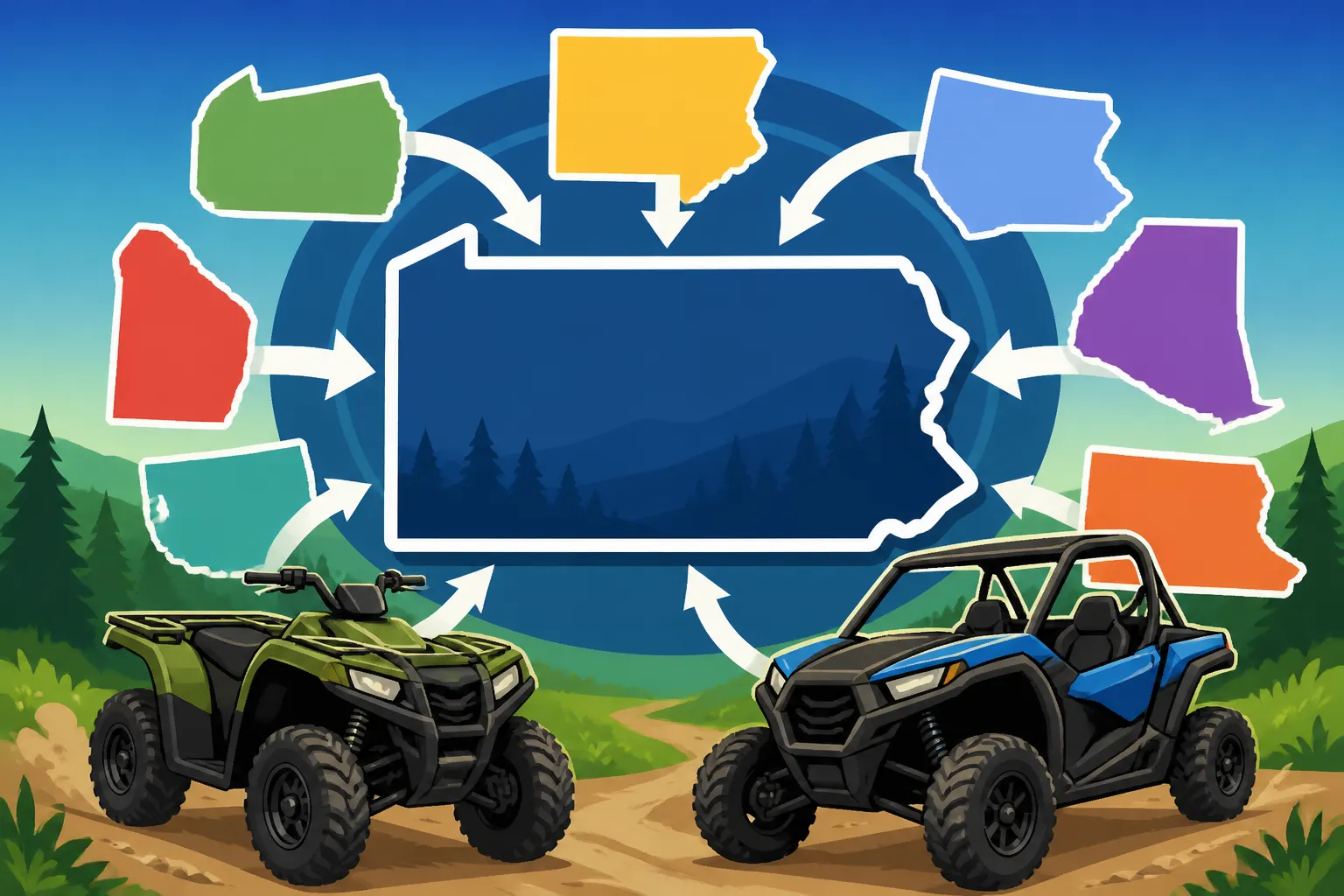
Pennsylvania ATV Reciprocity With Other States
Pennsylvania ATV reciprocity can be confusing because an out-of-state registration may satisfy one requirement without giving you access to every trail or road. The practical question is not just whether Pennsylvania recognizes your home-state plate. You also need to know where you plan to ride, whether a separate trail permit applies, and what documents to carry.
What Reciprocity Means for Pennsylvania ATV Riders
Reciprocity is an agreement or rule under which Pennsylvania recognizes an ATV registration issued by another state. It can let a visitor ride in Pennsylvania without first obtaining a Pennsylvania registration, provided the visitor’s machine is properly registered at home and the relevant conditions are met.
The key word is conditions. Reciprocity is not a universal pass for every machine, every kind of land, or every riding activity. It also does not turn a registered ATV into a street-legal vehicle or automatically cover a Pennsylvania trail permit.
A visitor should think about the rules in three layers:
- Registration: Is the ATV registered in its home state, and does Pennsylvania recognize that registration?
- Land access: Does the riding area require a separate permit, club membership, or landowner permission?
- Rider and machine rules: Do age, safety, insurance, equipment, and route restrictions apply?
Those questions are separate. An out-of-state plate may satisfy the registration layer while the rider still needs a permit for a particular trail system. Conversely, a permit does not replace registration when registration is required.
Pennsylvania’s reciprocity approach is conditional, not a simple statement that every state’s registration is accepted everywhere. The state’s treatment of a visitor can depend on whether the visitor’s home state recognizes Pennsylvania registrations under comparable circumstances. That makes your state of residence relevant, as well as the type and status of your ATV registration.
Before a trip, check the current Pennsylvania guidance for your home state and confirm the rules for the specific riding area. If you cannot establish that your home registration qualifies, do not assume it does. Find out whether you need Pennsylvania registration before unloading the machine.
For a broader overview of registration categories and how Pennsylvania handles them, see Pennsylvania’s Limited and General Registrations. The details of those Pennsylvania registrations matter most when a visitor is told that home-state registration is not enough.
Reciprocity is not a riding permit
A state registration generally identifies the machine and shows it has met that state’s registration requirements. A trail permit or access permit serves a different purpose: it authorizes use of a particular trail system or area under that system’s conditions.
Pennsylvania has areas where a separate permit may apply even when the ATV is registered. Some trail systems are managed by the state, some by a national forest, and others by clubs or private operators. Their access requirements can differ. A home-state registration does not necessarily substitute for a trail permit, and a permit for one area does not necessarily allow riding somewhere else.
This distinction is especially important for visitors planning to ride state forest trails or trails in the Allegheny National Forest. Check the specific system’s current requirements rather than relying on a general answer about reciprocity. Pennsylvania ATV Reciprocity With Other States addresses registration recognition; Pennsylvania ATV Trail Permits Explained explains why trail access is a separate question.
How to Check Whether Pennsylvania Recognizes Your State Registration
The most reliable approach is to check the current rule for your state of residence before travelling. Reciprocity can change, and a list remembered from a previous season—or advice from someone who rides a different state’s trails—may not settle your situation.
Use this process:
- Identify your home state and the exact registration status of the ATV. Confirm the registration is current, applies to the machine you will bring, and is issued to the appropriate owner.
- Check Pennsylvania’s current reciprocity information. Look for the rule that applies to your state, not a broad statement about out-of-state visitors.
- Check the riding destination separately. Ask the trail or land manager whether it requires a permit, proof of insurance, membership, or other documentation.
- Confirm any special facts. If the machine is not registered, is registered to someone else, has an unusual classification, or is being used for an organized event, ask how those details affect eligibility.
- Carry proof. Bring the registration document and any required permit or insurance evidence in a form you can show during a roadside or trailhead check.
If the written guidance is unclear, contact the appropriate Pennsylvania registration office or the manager of the riding area. Explain your home state, the machine type, whether its registration is current, and where you plan to ride. A precise question is more useful than asking only, “Does Pennsylvania have reciprocity?”
The question to ask is closer to this: “I live in this state, my ATV has this kind of current registration, and I plan to ride this specific area. Does Pennsylvania recognize the registration there, and what additional documents or permits do I need?”
That framing helps separate registration recognition from local access requirements. It can also uncover a mismatch—for example, a state registration that is valid for use at home but is not the type Pennsylvania recognizes for the planned activity.
Check the current rule, not just the plate
A visible plate or decal is useful, but it may not prove every detail an officer or trail manager needs to verify. Keep the registration card or official document with the machine. Check that the identifying information matches the ATV and that the registration has not expired.
If the registration is electronic, make sure you can retrieve it without depending on a weak cell signal. A saved digital copy may help, but do not assume a screenshot replaces whatever proof the applicable rule requires. Carry an official document or other accepted evidence if the agency says it is needed.
For more on what visiting riders should carry, see Carrying Proof of an Out-of-State Registration. If you are unsure whether Pennsylvania accepts the particular document your state issues, confirm that point before leaving home.
Out-of-state safety certificates are a separate issue
Registration reciprocity does not automatically answer whether Pennsylvania accepts a safety certificate issued elsewhere. Rider age, training requirements, and land-specific rules may be handled separately from machine registration.
If a child or teenager is riding, check the Pennsylvania rules that apply to the rider’s age and the location. Ask whether an out-of-state certificate is accepted for that purpose, and whether the trail system imposes additional conditions. See Does Pennsylvania Accept an Out-of-State Safety Certificate? for the certificate question.
What Reciprocity Does—and Does Not—Allow
When Pennsylvania recognizes a visitor’s home-state registration, the recognition is about registration. It does not grant general permission to ride anywhere in Pennsylvania.
A visitor still needs legal access to the land. That could mean a trail permit, a club membership, written landowner permission, or compliance with a designated route’s specific rules. Some areas are closed to ATVs altogether, even if the machine is registered and the rider has insurance.
Reciprocity also does not change Pennsylvania’s rules for using roads. Pennsylvania generally limits ATV road use to routes and circumstances where it is specifically permitted. A home-state license plate or registration does not make an ATV legal on an ordinary public road in Pennsylvania. Read Street Legal ATVs in Pennsylvania: The Short Answer and check the route rules before planning any road connection.
The same principle applies to equipment and rider conduct. A recognized registration does not exempt a visitor from applicable helmet, insurance, age, passenger, lighting, noise, or trail-width rules. If a Pennsylvania rule applies to the ride, a visitor should expect to follow it unless a specific exception covers the situation.
| Question | What reciprocity may affect | What it does not automatically provide |
|---|---|---|
| Is the ATV registered? | Pennsylvania may recognize qualifying home-state registration | Permission to ride on every parcel or trail |
| Is a trail permit needed? | Usually a separate access question | A permit merely because the ATV has an out-of-state plate |
| Can the ATV use a road? | Registration alone does not establish road access | General street legality |
| Does the rider meet age or training rules? | Usually a separate rider requirement | An exemption based on the ATV’s home-state registration |
| Is insurance required? | A separate legal or land-manager requirement may apply | Automatic proof that the policy qualifies |
| Can the ATV ride on private or club land? | Registration may be one requirement among others | Landowner permission or club access |
Public roads and designated routes
Do not treat a state registration as a road permit. A road may be open to ATV use only if it has been designated or opened under the applicable rules. A route that appears suitable, or that connects two trails, is not necessarily legal to ride.
If your planned route uses a township road, borough street, or other public road, verify that the route is authorized and check the conditions attached to it. A visitor’s home-state plate does not override local closures or Pennsylvania road-use rules. Pennsylvania Designated ATV Road List can help with the route question, while Pennsylvania Joint-Use Road Rules explains that a designated road may have separate operating conditions.
Private land and organized events
Registration does not grant access to private property. Get permission from the landowner or the organization responsible for the trail. Do not assume that a trail visible on a map is open to the public, or that permission to ride one section covers adjacent land.
An organized ride can add another layer. The organizer may need to arrange access, insurance, permits, or route approval. Participants should ask what documents they must bring and whether the event’s arrangements cover their machine. For private-property rules, see Pennsylvania Landowner Permission Requirements.
Permits and Trail Access for Visitors
Once you have settled the registration question, identify the exact trail system you want to ride. Pennsylvania has different types of riding areas, and their access rules are not interchangeable.
A state forest trail, a national forest trail, a privately operated riding park, a club trail, and a local road route can each have different requirements. A permit for one system might not be valid in another. Some areas require a permit for each machine; others may use a different access arrangement. Check the terms directly with the land manager before you buy or travel.
State forest trails
Some Pennsylvania state forest trail access is tied to a regional permit system. The permit’s coverage is limited to the trails and counties described in that program. It does not give a rider permission to use every state forest road or trail.
Visitors should check whether the relevant permit is required, how it is issued, what registration or insurance evidence is needed to apply, and how the permit must be displayed. Do not assume that an out-of-state registration makes the permit unnecessary. See Pennsylvania’s Northcentral Regional Trail Permit and Do You Need a Permit for Pennsylvania State Forest Trails? for the permit’s scope and when it applies.
The same caution applies to state forest routes that are not part of a designated ATV trail system. A road open to highway vehicles, a gated road, and an ATV trail are not automatically interchangeable. Follow the signs and current land-manager information.
Allegheny National Forest
The Allegheny National Forest has its own access rules and permit requirements for ATV riding. Do not assume a state forest permit covers the national forest, or that a home-state registration alone provides access there. Confirm what the forest requires, including any registration, insurance, permit, or machine-eligibility conditions.
Start with Pennsylvania’s Allegheny National Forest Permit and confirm the current details with the forest before setting out. If you plan to ride a particular trail, verify that it is open to your type of machine and during your intended riding period.
Club trails, private parks, and local systems
Club and private systems set access terms for their own land. They may require membership, a day-use arrangement, a waiver, proof of insurance, or compliance with their equipment rules. An out-of-state registration does not replace those conditions.
Before loading up, check:
- Whether the system is open to nonmembers
- Whether you need to reserve or purchase access in advance
- Whether a permit is required for each ATV
- Whether the trail accepts your machine’s width and configuration
- Whether youth riders have age, supervision, or training conditions
- Whether proof of registration and insurance must be shown at check-in
- Whether there are temporary closures, weather restrictions, or seasonal limits
If you are renting a machine, ask whether the rental company has arranged the required registration and access documents, and what remains your responsibility as the rider. Rental arrangements do not necessarily include every permit needed for the place you intend to ride. What a Weekend Visitor Needs to Ride Pennsylvania is useful for assembling the requirements for a short trip.
What to Carry and How to Prepare
A visitor who has checked reciprocity and trail access should still prepare for a roadside or trailhead inspection. The easiest problems to prevent are missing documents, expired registration, and confusion about which permit applies.
Carry or have accessible:
- Current home-state registration documents for the ATV
- Any Pennsylvania permit required for the riding area
- Proof of insurance when required by law or the land manager
- Rider safety certificates or training documents if applicable
- Written permission, membership proof, or event information when relevant
- Contact information for the trail manager or permit issuer
Keep documents protected from rain, mud, and accidental loss. A small waterproof document holder can make it easier to keep registration and insurance papers together. Some riders use a wallet-style holder or storage pouch; if you buy one through Amazon, choose a product that keeps papers legible and secure rather than relying on a loose bag that can tear or fill with water. Make sure any holder is mounted or stored where it will not interfere with riding or become a hazard.
Do not leave your only proof in a vehicle parked far from the trail. If you use a digital copy, download it before travelling and test that it opens offline. A dead phone, poor signal, or wet screen can turn a simple check into an avoidable delay.
Verify the machine details
Before the trip, compare the registration document with the ATV itself. Check the vehicle identification number and any registration number or decal. If a number is hard to read, address that before riding. A mismatch can prompt questions even if the machine was properly registered.
Also confirm that the machine fits the trail system’s size and equipment rules. A valid out-of-state registration does not make an oversized machine eligible for a narrow trail. Check width, weight, passenger capacity, and any restrictions on side-by-sides. If your machine is close to a stated limit, measure it in the configuration in which you will ride, including accessories that affect overall width.
Keep a simple trip record
For a multi-day visit, keep a note of the areas you plan to ride and the permits each one requires. Save confirmation messages, permit receipts, and the contact details for the relevant managers. This is especially useful if you are crossing between systems or riding in a group where different machines may have different registration statuses.
A compact paper checklist can help:
- Home-state registration confirmed as current
- Pennsylvania reciprocity checked for your state
- Trail access and permit requirements confirmed
- Insurance and rider documents packed
- Machine dimensions and equipment checked
- Current route and closure information reviewed
If you use Amazon for a waterproof pouch, phone mount, or document case, treat the product as storage—not proof of compliance. The important part is carrying the correct documents and being able to show them.
Common Reciprocity Mistakes to Avoid
Assuming every state is treated the same
A friend from another state may be allowed to ride using home registration, but that does not prove your state has the same arrangement. Reciprocity is conditional. Check the rule for your residence and the registration category of your own ATV.
Confusing registration with a trail permit
A visitor can have valid registration and still be turned away from a trail that requires an additional permit or membership. Ask the trail manager what applies to that location. Do not buy access based on a general claim that Pennsylvania “honors out-of-state plates.”
Relying on an expired or incomplete document
A plate or decal may remain physically attached after its registration has expired. Carry current proof, and confirm that the document corresponds to the machine. If the ATV belongs to another person, ask whether the registration and proof of authorization are adequate for your situation.
Assuming a road connection is legal
A route between a trailhead and lodging may look short and quiet but still be closed to ATVs. Check the legal route, not just the map. A home-state registration does not authorize travel on an unposted or prohibited road.
Forgetting insurance
Registration and insurance are different matters. Pennsylvania may require insurance for certain ATV use away from the owner’s property, and a trail manager may impose its own proof requirements. Check both the legal rule and the destination’s conditions. See Pennsylvania ATV Registration and Insurance Proof and Insurance the State Requires for more detail.
Ask your insurer whether the policy covers the machine while riding in Pennsylvania and whether the planned activity is covered. A policy can have limits, exclusions, or conditions that are not obvious from the insurance card alone. Keep proof available while riding.
Assuming reciprocity covers an unusual machine
A standard ATV may be treated differently from a machine with an unusual classification, an incomplete registration, or a special use. Side-by-sides, homebuilt machines, youth machines, and machines registered under a particular state’s limited-use category can raise questions. If your machine is not a typical adult ATV with current registration, describe it accurately when asking Pennsylvania officials or the trail manager.
Treating old advice as current
Rules, reciprocal arrangements, trail permits, and seasonal access can change. A previous trip is useful background, not a guarantee that the same conditions apply now. Recheck the official information before each trip, especially if you have not ridden in Pennsylvania recently.
A Practical Plan for an Out-of-State Ride
The safest way to plan is to start with the destination and work backward. First decide where you want to ride, then identify the access requirements for that specific area. After that, verify that your home-state registration is accepted for your machine and trip.
Use this sequence:
- Choose the trail system or riding property. Avoid planning around a broad region when different systems have different rules.
- Read the land manager’s current access information. Confirm operating dates, closures, machine limits, and permit rules.
- Verify registration reciprocity. Check Pennsylvania’s current treatment of your state and registration type.
- Check insurance and rider requirements. Include age, training, helmet, passenger, and equipment rules.
- Confirm the route to the trailhead. Make sure any road riding is specifically allowed.
- Pack your proof. Carry current registration, required permits, insurance evidence, and any relevant rider documents.
- Recheck before departure. Look for temporary closures, weather impacts, or changes to access conditions.
If you are told that your home-state registration is not sufficient, ask what Pennsylvania registration or documentation is required and whether you can complete it before travelling. Do not assume that a park’s day-use access or a paid permit cures a registration problem.
For registration questions, use the appropriate state channel rather than relying only on a dealer, social media post, or a rider’s recollection. The Pennsylvania ATV Registration Help Line may be useful when the official written guidance does not resolve your specific case. Have your state of residence, registration document, machine details, and intended riding location in front of you when you ask.
For a visitor, the practical rule is straightforward: verify registration recognition, verify trail access separately, and carry proof of both. That small amount of preparation is much easier than sorting out a registration or permit problem at a trailhead.
Disclaimer
This article is for general informational purposes only and does not constitute professional advice. Laws, prices and regulations vary by location and change over time. Consult a qualified professional for guidance on your specific situation.