Game Lands Signs and What They Mean
A sign at a Pennsylvania State Game Lands entrance can look like an invitation to explore, but it does not automatically allow ATV or UTV riding. The key is to distinguish a boundary or access sign from clear authorization to drive a particular route. Here’s how to read common signs, avoid relying on assumptions, and check whether an exception applies.
What a Game Lands Sign Does and Does Not Tell You
Pennsylvania State Game Lands are managed for wildlife and public recreation, but they are not general-purpose ATV trail systems. A sign identifying State Game Lands tells you that you are entering or near land with its own rules. It does not, by itself, grant permission to ride a quad, side-by-side, or other off-road vehicle.
That distinction matters because a road, path, or cleared corridor may look rideable without being open to motorized use. A route could be intended for foot travel, forestry or game-management work, or authorized access only. A map line does not necessarily mean a public ATV route, either.
The safest rule is to look for specific authorization for motorized travel on that exact route. If a sign says vehicles are prohibited, the road is closed, or access is limited to authorized users, treat that as a restriction. If you see no sign permitting ATVs, do not assume that the absence of a prohibition means riding is allowed.
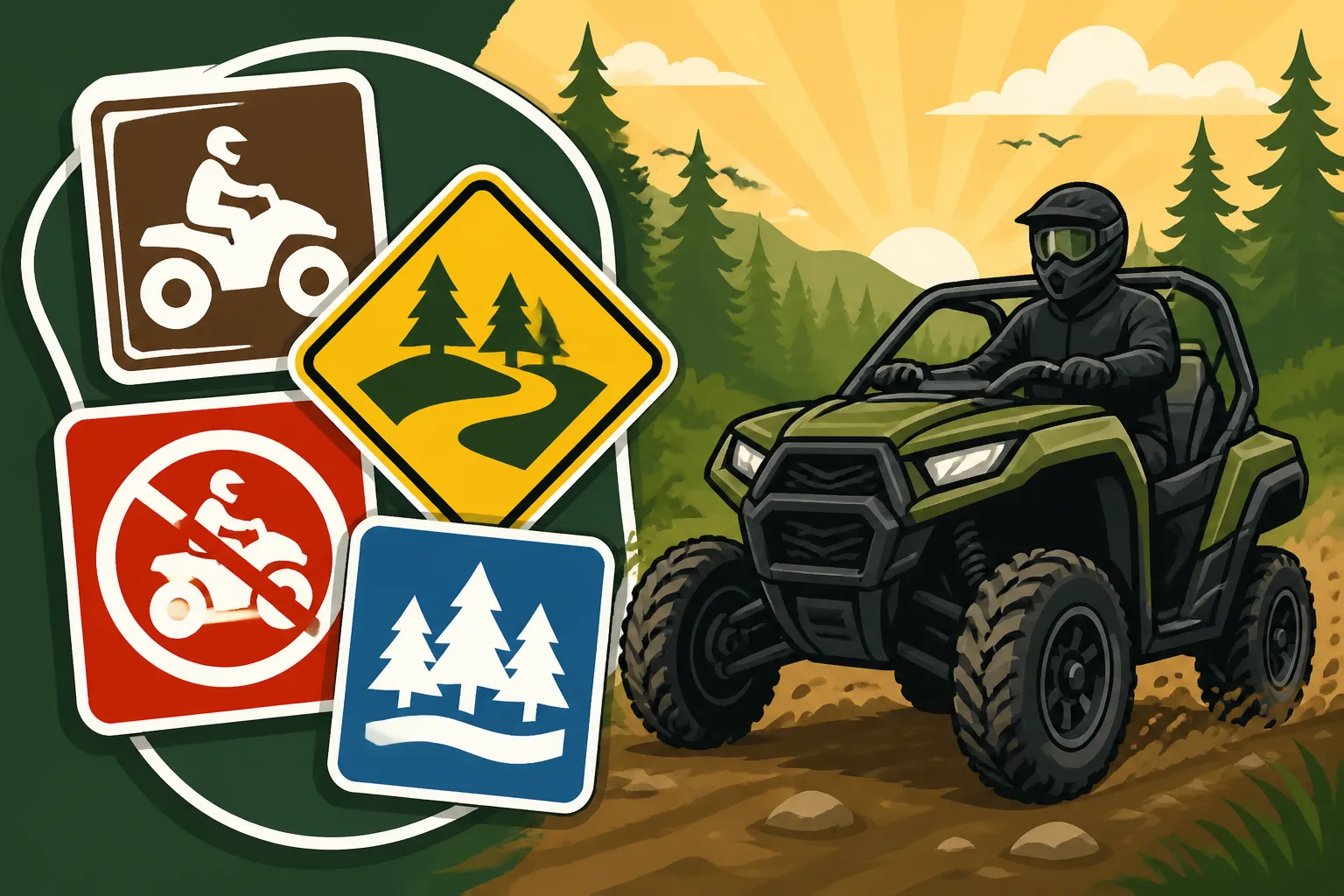
| Sign or feature | What it generally indicates | What to do as an ATV or UTV rider |
|---|---|---|
| State Game Lands identification sign | You are entering or approaching Game Lands | Check the rules for that property; the sign is not riding permission |
| No vehicles or no motorized vehicles | Motorized travel is restricted | Do not ride past the sign |
| Road closed or a closed-road barrier | The route is not open for ordinary travel | Do not go around, under, or beside the barrier |
| Authorized vehicles only | Access is limited to people or vehicles with permission | Ride only if your use is specifically authorized |
| A designated-route or permit notice | The notice may describe a limited access exception | Read the conditions and confirm they apply to your vehicle and trip |
| Trail blaze or route marker without motor-vehicle wording | A marked route exists, but its permitted use may be limited | Confirm that ATVs are allowed before entering |
Sign wording, placement, and the rules for a particular property can differ. A trail marker alone is not enough to establish that a route is open to ATVs. Similarly, seeing another rider, a tire track, or an unlocked gate does not establish permission. A route may be used by an authorized person, or it may simply be receiving unauthorized traffic.
For more background on the general restriction, see Pennsylvania State Game Lands and ATVs and Pennsylvania Rules on State Game Lands. The practical takeaway is simple: identify the land, identify the route, and verify that motorized access is allowed before riding.
How to Read Common Restrictions on the Ground
Signs are useful, but they are only one part of interpreting access. A posted notice, gate, barrier, or road surface can all signal that a route is restricted. Do not treat a gap in signage as permission to continue.
Boundary signs
A Game Lands boundary sign marks land managed by the Pennsylvania Game Commission. It is a cue to check the rules, not a recreational trail marker. If you cross that boundary, you may be subject to Game Lands restrictions even if the route started on a public road or another property.
Pay attention to where the boundary runs. A road may pass between public land and private property, or a route may enter Game Lands only for part of its length. Do not assume that permission for one segment carries over to the next. If the route crosses several land types, verify each section separately.
Road-closure signs and barriers
A closed-road sign, chain, gate, earth berm, or other barrier should be treated as a clear stop. Do not go around a gate on the shoulder or use a nearby track to bypass it. A barrier may protect wildlife habitat, prevent damage to a sensitive road, or enforce a seasonal closure.
A gate being open does not necessarily mean the road is open to recreational vehicles. It may be open for authorized work, emergency access, or another limited purpose. Likewise, a road that looks maintained is not automatically a public ATV route.
“Authorized vehicles only” notices
This wording does not mean that any registered ATV qualifies as an authorized vehicle. Authorization can depend on the person, purpose, vehicle, route, permit, or a combination of conditions. If you cannot tell whether your use is included, ask the managing agency before entering rather than trying to interpret the sign in the field.
Registration is also not the same as permission to use a particular property. A Pennsylvania registration, an out-of-state plate, or a trail permit for another riding area does not override a Game Lands restriction. Riding on Game Lands and What Happens explains why riding where access is not allowed can have consequences beyond simply turning around.
Markers that look like trail signs
Paint blazes, numbered posts, maps, and other route markers can indicate a maintained path without stating that ATVs are allowed. The route could be for hikers, hunters, or another permitted use. If the marker does not clearly establish motorized access, check the current property rules and route information.
Maps can be out of date, and online tracks may show where someone rode rather than where they were allowed to ride. Treat crowd-sourced routes and GPS tracks as navigation clues, not proof of permission.
When a Permit or Exception May Apply
Some access exceptions are limited and depend on eligibility and approval. One example is the disabled-access program for eligible users. A permit under that program does not make all Game Lands roads open to all riders; it applies only under the conditions and on the routes authorized for that use.
If you think an exception may apply, confirm the details before traveling. Check who may use it, which vehicle is covered, which routes are included, whether a specific permit or documentation is required, and whether any seasonal or property-specific restrictions remain in effect. Read the sign at the site as well: a permit should not be assumed to cancel a closure notice.
See How the Disabled Access Permit Works on Game Lands and 58 Pennsylvania Code and the Access Permit for information on the limited access process. If your situation does not clearly fit the stated conditions, contact the Pennsylvania Game Commission before riding. Do not rely on a general statement that a person has a disability or that a vehicle is needed for access; the program has its own eligibility and route requirements.
Keep separate rules for separate lands straight. A permit for a state forest trail or a private riding area does not grant access on State Game Lands. Likewise, an authorization for one Game Lands route does not automatically extend to neighboring property. Do You Need a Permit for Pennsylvania State Forest Trails? can help explain a different land system, but it is not a substitute for checking Game Lands rules.
A practical pre-ride checklist can prevent a costly misunderstanding:
- Identify the land manager. Confirm whether the route is on State Game Lands, state forest land, private land, or another property.
- Check the current access rules. Use official information for the specific property and route rather than relying only on an old map or a rider’s post.
- Read every notice at the entrance and along the route. A restriction farther down the road still applies even if the entrance was unmarked.
- Confirm any exception in advance. Make sure the authorization covers you, your vehicle, the route, and the purpose of the trip.
- Turn around if the status is unclear. Do not pass a barrier or continue because another vehicle has already gone through.
What to Do When a Sign Is Missing or Unclear
When signs conflict with a map, or a road appears open but has no clear motorized-use notice, pause before riding. A missing sign is not proof that a route is open. Nor is an online map, a friend’s recollection, or a tire track reliable evidence of current authorization.
Use the most specific and current official information available for that Game Lands property. If the public information does not answer the question, contact the Pennsylvania Game Commission and describe the location as precisely as possible. A property name, entrance, nearby road, or route marker can help staff identify the right area. Ask directly whether ATV or UTV travel is allowed on that particular route and whether the answer changes by season or permit status.
If a sign is damaged, obscured, or difficult to read, avoid treating the ambiguity as permission. Take note of its location and wording if you can do so safely, then report the issue to the managing agency. Do not move the sign or barrier, and do not ride around it to see where the road leads.
Prepare to check the rules before leaving home. Keep a map of the area available offline, note the official route information, and carry any required authorization. A waterproof map sleeve from an outdoor retailer or Amazon can help protect paper information from rain, but it cannot replace current access rules. On the ride, stay on a route only when you have confirmed that your use is permitted.
The best interpretation of a Game Lands sign is usually the cautious one: it tells you to check the rules for that place, not to infer permission from the road or trail in front of you. When specific ATV authorization is absent, choose a route that is clearly open for motorized riding instead. Pennsylvania Rules for Riding a Club Trail is a useful starting point if you are looking for an alternative on land where riding access is expressly arranged.
Disclaimer
This article is for general informational purposes only and does not constitute professional advice. Laws, prices and regulations vary by location and change over time. Consult a qualified professional for guidance on your specific situation.