Why PennDOT Does Not Register Pennsylvania ATVs
It can be incredibly confusing for new (or even seasoned!) ATV owners in Pennsylvania to figure out where exactly they need to go to get their machine legally registered. Many folks naturally assume that because it’s a vehicle, the Department of Transportation, or PennDOT, is the agency to handle it. However, that's not the case. This guide will clear up why PennDOT doesn't register ATVs in our state and direct you to the right place, ensuring you're ready for the trails without any frustrating detours.
Understanding Pennsylvania's Vehicle Registration Landscape
When you first get into owning an ATV or UTV in Pennsylvania, it's easy to think all vehicles are handled the same way. You buy a car, you go to PennDOT. You buy a motorcycle, you go to PennDOT. So, it's a perfectly logical leap to assume your new quad or side-by-side would follow suit. But the reality is, Pennsylvania has a very specific division of labor when it comes to vehicle registration, and understanding this division is key to avoiding a major headache and wasted time.
PennDOT's Domain: Roads and Highway Vehicles
Let’s talk about PennDOT for a moment. This agency is the big one most of us interact with regularly. PennDOT is responsible for all things related to highway travel and motor vehicles designed for public roads. Think about it: your car, your truck, your motorcycle, even your camper – if it’s street-legal and intended to share the road with other traffic, PennDOT is the agency that handles its titling, registration, and driver licensing. They are the gatekeepers for ensuring vehicles are safe for public highways and that drivers are properly licensed to operate them. Their entire framework, from inspections to license plates, is built around road-worthiness and the laws governing public thoroughfares. If your vehicle needs to meet specific emissions standards or have certain lighting for street use, PennDOT is the agency enforcing those rules.
DCNR's Role: Off-Road Recreation
Now, let's introduce the Pennsylvania Department of Conservation and Natural Resources (DCNR). This is the agency that might surprise some ATV owners. The DCNR is primarily focused on preserving and managing Pennsylvania's state parks and forests, promoting outdoor recreation, and protecting our natural resources. So, why would an environmental and recreation agency be in charge of vehicle registration? It all comes down to where ATVs and UTVs are primarily designed to be ridden: off-road. Because these machines are not considered highway vehicles and are used predominantly on designated trails within state parks and forests, or on private lands, the DCNR was deemed the appropriate body to oversee their registration. This allows the DCNR to manage the impact of these machines on the environment, track their usage, and fund trail maintenance and development directly through registration fees. It's a system designed to keep the funds generated by off-road riding within the off-road community and for the benefit of the natural lands they manage. [What Pennsylvania ATV Fees Pay For] is a great resource if you want to understand where your money goes.
The Legal Framework Behind ATV Registration
The separation of registration duties between PennDOT and DCNR isn't just a bureaucratic whim; it's rooted deeply in Pennsylvania's legal code. Understanding this distinction is crucial because it dictates everything from what type of paperwork you need to where you can legally ride your machine. Without this foundational understanding, you might find yourself wasting time at the wrong office or even facing a fine on the trail.
Pennsylvania's ATV Chapter 51
The specific laws governing ATVs in Pennsylvania are found in Title 17, Chapter 51 of the Pennsylvania Consolidated Statutes. This chapter, sometimes referred to as the "Snowmobile and All-Terrain Vehicle Law," defines what an ATV is, how it should be operated, and, most importantly for our discussion, how it must be registered. This isn't a short, simple piece of legislation. It's a comprehensive framework that addresses everything from rider age limits and safety course requirements to where these vehicles can be operated. The key takeaway from this chapter is that ATVs are explicitly categorized as "off-highway recreational vehicles" and are treated distinctly from "motor vehicles" that operate on public roads. This legal distinction is the bedrock of why DCNR, not PennDOT, is the registering authority. The legislature recognized that ATVs present unique challenges and opportunities related to recreation and conservation, making DCNR the logical choice for oversight. If you ever have questions, [Pennsylvania's DCNR Snowmobile and ATV Section] has extensive information.
The "Not for Highway Use" Distinction
The designation "not for highway use" is the lynchpin of the entire system. When you purchase an ATV or UTV, you'll often see this stamped right on the manufacturer’s certificate of origin or on the machine itself. This isn't just a suggestion; it's a legal classification that fundamentally separates ATVs from the vehicles PennDOT registers. Because ATVs are not designed, manufactured, or intended for operation on public highways, they don't fall under PennDOT's jurisdiction for registration. PennDOT's entire system is built around road safety, emissions, and features like turn signals, headlights, and brakes that comply with highway vehicle standards. ATVs simply don't meet these criteria.
This distinction also clarifies why [Street Legal ATVs in Pennsylvania: The Short Answer] is almost always "no." There is no conversion path in Pennsylvania to make an ATV street legal. You can't add a turn signal kit and suddenly expect PennDOT to give you a plate for road use. The machine's fundamental design and legal classification as an off-highway vehicle prevent this. This is a common point of confusion, especially for riders who might be coming from states with different regulations or who see modified machines elsewhere. In Pennsylvania, that "not for highway use" tag means exactly what it says for registration purposes.
Why This Distinction Matters for ATV Owners
Understanding this clear division between PennDOT and DCNR isn't just a matter of knowing your state agencies; it directly impacts your ability to legally and smoothly enjoy your ATV or UTV in Pennsylvania. Ignoring this distinction can lead to frustration, wasted time, and even legal trouble. It's about getting it right the first time so you can spend more time riding and less time in bureaucratic limbo.
Consequences of Misunderstanding the Agencies
Picture this: you've just bought your dream quad, saved up for months, and now you're eager to get it registered and hit the trails. You head down to your local PennDOT agent, full of enthusiasm, only to be met with a blank stare or a polite but firm redirection. You've just spent valuable time and maybe even a trip across town for absolutely nothing. At best, it's an inconvenience. At worst, if you assume your PennDOT visit was sufficient and try to ride without proper DCNR registration, you could face significant fines. [Pennsylvania Fines for an Unregistered ATV] can be substantial, and ignorance of the law is rarely an excuse.
Beyond the initial headache, misunderstanding the agencies can also create issues with titling, which is a separate but related process. While DCNR handles registration, the initial titling process often has touchpoints with the sales tax collection, which does involve forms that look PennDOT-esque. It’s a subtle but critical difference that can trip up even the most diligent new owner. Knowing which agency handles what paperwork from the start saves you from trying to submit a [What Pennsylvania Asks on Form DCNR-43] to a PennDOT office or vice-versa.
The Importance of Correct Registration Paths
Getting your ATV registered through the DCNR is not just about avoiding fines; it's about being a responsible off-road enthusiast. Your DCNR registration plate and sticker are your passport to legal riding on state-managed trails and lands where registration is required. Without it, you’re not only breaking the law but also missing out on contributing to the very trails you want to ride. The fees collected by DCNR go directly back into the [What Pennsylvania ATV Fees Pay For] to improve and maintain the trail system, ensuring there are more places for you and other riders to enjoy.
Furthermore, correct registration can save you hassle during a sale or transfer. If you ever decide to sell your ATV, having all the correct DCNR paperwork in order, including proof of proper registration and titling through the DCNR's process, makes the transaction much smoother for both you and the buyer. Imagine trying to sell a machine where the buyer can't verify its legal status because you went through the wrong channels. It's a headache no one wants. Properly registered machines also typically hold their value better, as there's no question about their legitimacy. You can find forms and guidance for these kinds of transactions, including a bill of sale, often through services like LawDepot, which provides templates that cover the necessary information for private sales, which then need to be submitted to DCNR for processing.
Navigating the DCNR Registration Process
So, now that we've firmly established that DCNR is your go-to for ATV registration in Pennsylvania, let's dive into what that process actually looks like. It's not overly complicated, but knowing the steps and what to expect can make it a breeze.
Required Paperwork and Information
When you're ready to register your ATV with the DCNR, you'll need to gather a few key pieces of documentation. The primary form you'll be working with is Form DCNR-43, the "Application for Certificate of Title/Registration." This isn't just a registration form; it covers both titling and registration in one go. You'll need information about yourself (the owner), details about the ATV itself (make, model, year, VIN), and crucially, proof of ownership. This proof typically comes in the form of a manufacturer’s certificate of origin (MCO) if it's a new machine, or a previously issued title if you bought it used.
If you purchased the ATV from a Pennsylvania dealer, they will typically handle a lot of this paperwork for you, submitting it to the DCNR on your behalf. They'll give you a temporary 45-day dealer sticker to ride while your official plate and registration come in the mail. If you purchased it privately, you’ll be responsible for submitting everything yourself, along with proof of sales tax payment (or an exemption). You might even need a physical inspection to verify the VIN. [Pennsylvania ATV Bill of Sale Requirements] are important here, as a properly filled out bill of sale can serve as crucial documentation. Websites like LawDepot offer customizable bill of sale templates that can help ensure all necessary details are included for a private sale, making the DCNR application smoother.
Registration Types: Limited vs. General
The DCNR offers two main types of ATV registration, and choosing the correct one depends entirely on where you plan to ride your machine:
-
Limited Registration: This type is for ATVs that will only be operated on private property owned or leased by the registrant. Think of a quad used exclusively on your own farm, hunting camp, or extensive private land. [Pennsylvania's Limited Registration for Your Own Land] is perfect for this. It's a free registration that never expires, meaning you only have to apply once. However, this registration absolutely does not permit you to ride on state-designated trails, public roads, or any other public land. It's strictly for your own domain. The plate you receive will reflect this limited use.
-
General Registration: If you plan to ride on any DCNR-designated ATV trails, participating private parks like the AOAA or Rock Run, or any public land where ATVs are permitted, you need [Pennsylvania's General Registration for Everywhere Else]. This is the more common type for recreational riders. General registration comes with a fee (check the DCNR website for current rates, but expect a modest cost) and is valid for two years. This registration type is your ticket to explore the vast network of trails across the state. It allows you the flexibility to travel to different riding areas and participate in organized events.
It’s important to decide upfront which type fits your needs. While you can switch from limited to general registration later, it involves another application process. [Pennsylvania's Limited and General Registrations] goes into more detail about the differences.
What DCNR Registration Provides
Once your application for [Registering an ATV in Pennsylvania] is processed by the DCNR, you won't get a typical vehicle registration card like you would from PennDOT. Instead, you'll receive a few specific items:
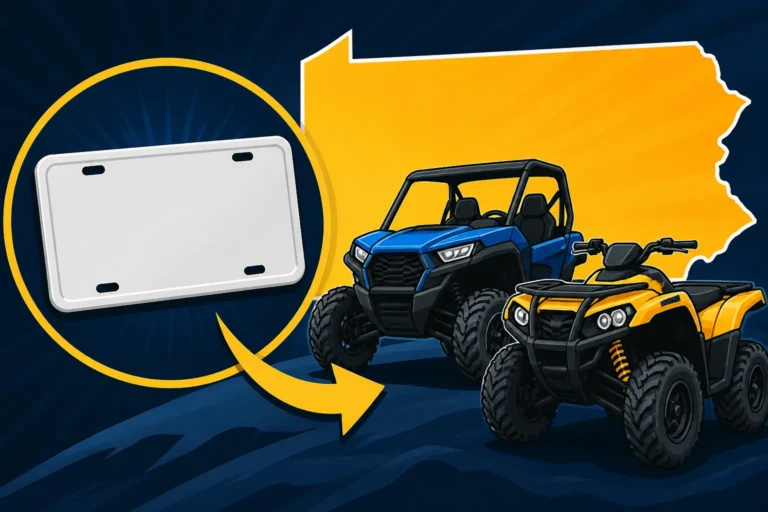
- Registration Plate: This is a small, typically orange or green (depending on the type of registration), rectangular metal plate with a unique registration number. [Pennsylvania ATV Plates and Where They Mount] explains exactly where this needs to be affixed to your machine – usually on the rear, in a spot that's easily visible and protected from debris.
- Validation Sticker: For general registrations, you'll also receive a small sticker that indicates the expiration year. This sticker goes on your registration plate. It's crucial to make sure this is current, as riding with an expired sticker is the same as riding unregistered. [Pennsylvania's Two-Year ATV Registration] means you’ll renew this every two years.
- Wallet Card: Perhaps one of the most practical items you'll receive is a small, durable plastic card, similar to a driver's license, that contains all your registration information. This "wallet card" is designed to be carried with you on your person while riding. It's much more convenient and waterproof than paper documents, making it easy to present to a DCNR ranger or law enforcement officer if requested. [Why Both Pennsylvania Registrations Include a Wallet Card] is all about having proof readily available.
These items collectively prove that your ATV is legally registered to operate in Pennsylvania according to DCNR regulations.
Common Misconceptions and Troubleshooting
Despite the clear legal distinctions and processes, many ATV owners still encounter confusion or have lingering questions. Let's tackle some of these common misconceptions head-on, so you're fully equipped with the knowledge to navigate the system without unnecessary stress.
"But My ATV Has a License Plate!"
This is a really common point of confusion. Some people might point to their ATV and say, "See? It has a plate, so it's registered just like a car!" While it's true that your ATV will receive a physical plate, it's critical to understand that this is a DCNR registration plate, not a PennDOT-issued license plate. They look distinctly different and serve different purposes. A PennDOT license plate is typically white or blue with state slogans and is designed for highway vehicles. A DCNR ATV plate is much smaller, often a solid color (orange for general, green for limited), and has a more basic numerical identifier.
The physical presence of a plate on your ATV does not mean PennDOT has anything to do with it, nor does it imply your ATV is street legal. It simply means you've completed the DCNR's registration process. Attempting to argue with law enforcement that your DCNR plate is equivalent to a PennDOT license plate for road use will not end well. The plates are distinct in appearance, the numbering schemes are different, and the issuing agencies are entirely separate entities with different legal mandates.
What Happens If You Go to PennDOT First
Let’s say you didn't read this guide and, in your eagerness, you first drive to a PennDOT Driver & Vehicle Services center or a third-party PennDOT agent. What will happen? In short, you'll be turned away. The staff at these locations are trained to handle highway vehicle registrations and driver's licenses. They simply do not have the forms, the system access, or the authority to process ATV registrations. They will politely (hopefully!) inform you that you need to contact the DCNR.
This can be incredibly frustrating. You’ve taken time out of your day, possibly driven a good distance, and waited in line, only to be told you're at the wrong place. This wasted effort is precisely why it's so important to clarify this distinction upfront. Save yourself the headache and go directly to the DCNR's online portal or mail in your forms. [Registering Online at Pennsylvania's DCNR Portal] is often the quickest and easiest way to handle the process.
When PennDOT Does Get Involved (Indirectly)
While PennDOT doesn't register ATVs, they aren't entirely out of the picture for ATV owners. Their indirect involvement primarily comes into play with sales tax. When you purchase an ATV in Pennsylvania, whether from a dealer or a private seller, you are generally subject to the state's sales tax. This tax is typically 6% of the purchase price, with an additional 1% in Allegheny County and 2% in Philadelphia. [Pennsylvania ATV Sales Tax on a Private Purchase] is an important consideration.
Even though DCNR handles the registration, they are also responsible for collecting this sales tax on behalf of the state. So, when you submit your DCNR-43 form and proof of purchase, you will pay the sales tax as part of that process. The funds collected by DCNR for sales tax are then transferred to the Pennsylvania Department of Revenue, which eventually routes them through state coffers, where PennDOT is also a major recipient of state funds for road infrastructure. So, in a roundabout way, the money you pay in sales tax on your ATV might eventually help fund some of PennDOT's highway projects. This is a crucial area where many private sale transactions go awry, as buyers sometimes overlook the sales tax obligation. Services like LawDepot can assist in creating a detailed bill of sale for private sales, which is essential for properly documenting the purchase price and sales tax liability when submitting to DCNR.
Comparing Registration Agencies
To summarize the key differences and ensure clarity, here's a quick comparison of the roles PennDOT and DCNR play in Pennsylvania vehicle and ATV administration:
| Feature | PennDOT (PA Department of Transportation) | DCNR (PA Department of Conservation and Natural Resources) |
|---|---|---|
| Primary Responsibility | Highway vehicle titling, registration, driver licensing | ATV/Snowmobile titling, registration, trail management, conservation |
| Vehicle Types | Cars, trucks, motorcycles, trailers, buses (highway-legal) | All-Terrain Vehicles (ATVs), Utility Task Vehicles (UTVs), snowmobiles |
| Registration Type | Public highway license plates and registration cards | Off-highway registration plates, stickers, and wallet cards |
| Funding Source | Fuel taxes, vehicle fees, state general fund | ATV/Snowmobile registration fees, state general fund, federal grants |
| Enforcement | State Police, local police, PennDOT enforcement officers | State Police, DCNR rangers, local law enforcement |
| Typical Term | 1 year (cars, trucks), 2 years (motorcycles) | 2 years (General Registration), Never expires (Limited Registration) |
| Permitted Use | Public roads, highways, streets | Designated ATV trails, private property (with permission) |
| Website for Info | dot.pa.gov | dcnr.pa.gov |
This table clearly illustrates why Why PennDOT Does Not Register Pennsylvania ATVs is such an important distinction. The agencies serve entirely different purposes and cater to different types of vehicles and uses.
By understanding that DCNR is the dedicated agency for ATV registration, you'll save yourself time, frustration, and ensure you're riding legally and responsibly across Pennsylvania's fantastic trail systems.
Disclaimer
This article is for general informational purposes only and does not constitute professional advice. Laws, prices and regulations vary by location and change over time. Consult a qualified professional for guidance on your specific situation.