Riding Lycoming County on the Permit
Riding Lycoming County on the Permit
Planning a ride in Lycoming County can get confusing when a permit, vehicle registration, insurance, and trail access are treated as if they were the same thing. They are not. The key is to confirm that your route is part of the Northcentral Regional ATV Trail, get the required permit, and check the current map and riding conditions before setting out.
What the Northcentral permit covers in Lycoming County
The Northcentral Regional ATV Trail includes parts of Lycoming County, but the county boundary is not a riding permission by itself. According to the Department of Conservation and Natural Resources (DCNR), the regional trail covers parts of Clinton, Lycoming, Potter, and Tioga counties, and riders need a yearly permit to use it. The permit is for access to the designated trail system—not blanket permission to ride any road, forest, private property, or track in those counties.
That distinction matters when planning a route. A trail or road may appear close to the regional system without being part of it, and a public road is not automatically open to ATVs. Use the current official trail map to identify the designated route and check for closures or changes before you travel. Pennsylvania Trail Maps From DCNR can help you understand what to look for on a map, while The Four Pennsylvania Counties the Permit Covers explains the regional footprint.
DCNR has approved Route 144 from Button Hollow Road for inclusion in the Northcentral Regional ATV Trail to establish a connection to Galeton. Treat that approval as a route detail to verify against the current map, not as a reason to assume every nearby road is open or that the connection is available in every riding season. The approved connection does not change the basic rule: stay on routes specifically designated for ATVs.
The permit also does not replace other requirements. Registration deals with the machine; the regional permit deals with access to this trail system. Insurance, age-related training rules, and safe operation are separate responsibilities. Pennsylvania ATV Registration and Trail Access explains why a registration alone does not answer every access question, and Do You Need a Permit for Pennsylvania State Forest Trails? covers the distinction between the Northcentral permit and other trail access rules.
| Before the ride | What to confirm |
|---|---|
| Route | The planned roads and trails appear on the current Northcentral Regional ATV Trail map and are open. |
| Permit | Each rider has the required permit for using the regional trail. |
| Registration | The ATV has the registration required for its circumstances, or qualifies for an exemption. |
| Insurance | Liability insurance is in force when required, and proof is with the rider. |
| Machine access | The ATV fits any route restrictions shown for the designated trail. |
| Season and conditions | The riding window is open and there are no closures or conditions that make the route unsuitable. |
Use the table as a planning check, not as a substitute for the official map or current trail notices. A valid permit does not make an undesignated route legal, and a route shown on a map may still be temporarily closed.
Permit season, cost, and what to check before buying
According to DCNR, the 2026 Northcentral Regional ATV Trail season opens on Friday, May 22, and closes on Sunday, September 27. These dates describe that season; confirm the applicable dates and current notices before planning a later trip. State forest trails elsewhere have their own access rules and season details, so do not assume every Pennsylvania trail follows the same schedule.
According to DCNR, the Northcentral permit costs $70 for a resident and $100 for a nonresident for the 2026 season, with those figures stated as of November 2026. The permit is yearly. For current application details and fees, check DCNR’s official information before buying. The permit is for the regional trail system; it does not serve as general permission to ride elsewhere in Lycoming County.
| Rider category | Northcentral permit for the 2026 season |
|---|---|
| Pennsylvania resident | $70 |
| Nonresident | $100 |
According to DCNR, every rider needs a yearly permit to use the Northcentral Regional ATV Trail. Do not assume that one rider’s permit covers everyone in a group, or that a permit attached to one machine automatically covers other riders. Confirm the current permit terms for how it must be carried or displayed and what information is required for each rider.
Also distinguish this regional permit from the permit for the Allegheny National Forest. The Allegheny National Forest has its own permit and trail system; a Northcentral permit should not be treated as an all-purpose Pennsylvania riding pass. Pennsylvania’s Northcentral Regional Trail Permit is the most relevant reference for understanding the regional system, and Pennsylvania’s $70 Resident Permit and Pennsylvania’s $100 Nonresident Permit cover the resident and nonresident permit categories.
Before you pay, check that the route you want is actually part of the Northcentral system, that the season is open, and that your machine is suitable for the listed route. If your trip crosses into another area, verify that area’s requirements separately. A low-effort planning check is often more useful than trying to sort out permit boundaries at the trail entrance.
Registration, insurance, and riding rules still apply
A trail permit and vehicle registration serve different purposes. According to DCNR, Pennsylvania ATVs generally must be registered and titled with DCNR, except for ATVs used solely for business or agricultural purposes. A nonresident ATV with valid out-of-state registration does not need Pennsylvania registration under the listed exemption. Those registration rules do not, by themselves, grant access to the Northcentral trail.
Registration choices also differ. According to DCNR, General Registration allows use off private property and provides a plate, expiration sticker, and wallet card. Limited Registration is free, never expires, and is for on-property use only; it provides a plate and card but no sticker. A rider planning to use a designated trail should not mistake Limited Registration for permission to ride away from the property covered by that registration. For a closer look at the difference, see Pennsylvania’s Limited and General Registrations.
According to DCNR, the registration plate belongs on the upper rear of the ATV, away from the tires and visible from behind, and the registration sticker belongs in the bottom corner of the plate area. Make sure the plate is not hidden by cargo, mud, or a mounting position that makes it hard to see. A permit does not replace a required registration plate or make an unreadable plate acceptable.
Liability insurance is another separate requirement. According to DCNR, a rider must carry liability insurance when operating an ATV on property they do not own or lease, and must carry proof of that insurance while riding. DCNR does not set minimum coverage standards for ATV liability insurance, so ask your insurer what the policy covers and whether it applies to the riding you plan to do. See Pennsylvania ATV Insurance Requirement for more on the insurance rule.
Keep the other basic operating rules in mind as well. According to DCNR, operators must wear a securely fastened helmet and eye protection, and carrying passengers on an ATV is prohibited. Riders must stay on trails specifically designated for ATVs. Riding under the influence of alcohol or other drugs is prohibited, and young or inexperienced riders need proper training and supervision.
For youth riders, age and certificate requirements can affect whether a trip is appropriate. According to DCNR, riders ages 8 to 15 must complete an ATV safety course and receive a certificate to ride on land other than their parents’ or guardians’ property. Riders who are 8 or 9 are restricted to ATVs with engines of 70cc or smaller, and children under 8 are not permitted to operate an ATV on state-owned property. DCNR says riders aged 16 or older must take its online ATV Safety Training course. Check Pennsylvania Safety Certificates for Ages 8 to 15 if a young rider is joining the trip.
A practical checklist for a Lycoming County ride
A smooth ride starts with the route rather than the gear. Confirm that the roads and trails you intend to use are on the current Northcentral map and are open. Then check that every rider has the required permit, each machine has the appropriate registration, and insurance proof is available where required. If any part of your plan involves a different trail system, verify that system’s access rules separately.
Before leaving, it helps to review these steps:
- Choose a designated route. Use the current DCNR map and notices to confirm that the route is part of the Northcentral system and open to riding. Do not use a county road, forest road, or private track simply because it connects two mapped locations.
- Check the season and conditions. Confirm the current season dates, closures, and any road or trail work that could affect access. Weather, maintenance, and local restrictions can change what is practical even when a trail is normally open.
- Confirm permit and registration separately. Make sure each rider has the regional permit required for the trail and that the ATV’s registration is appropriate for off-property riding. A permit does not replace registration.
- Carry required documents. Keep registration and insurance proof available while riding, and follow the current permit instructions for carrying or displaying the permit.
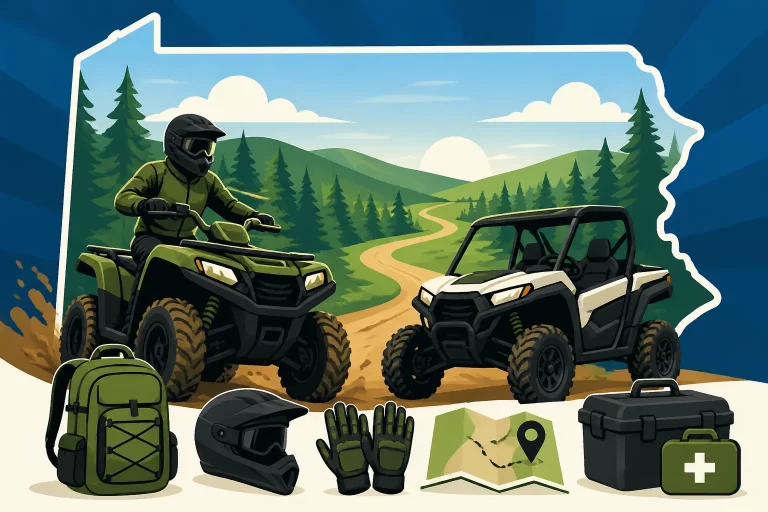
- Inspect the machine and safety gear. Check the helmet, eye protection, brakes, lights, tires, and fuel before starting. A small equipment issue can turn into a difficult problem once you are away from the staging area.
- Plan for a change of route. If a closure or unexpected condition means you cannot follow the planned route, stop and reassess. Do not improvise by using a trail or road that is not designated for ATV use.
A simple way to keep paperwork together is to use a securely closed document pouch. A waterproof pouch sold through a retailer such as Amazon can help keep paper documents dry, but it does not replace any required original or official proof. Check the actual permit and registration instructions for what must be carried.
Ride with the expectation that trail conditions and access can change. Give other trail users room, use a pace that lets you respond to hazards, and avoid blocking a route while checking your map. If you are unsure whether a road or trail is included, do not ride it until you have confirmed its status through official information.
The most important takeaway is straightforward: the Northcentral permit is for the designated regional trail, not every place in Lycoming County. Match your route to the current map, confirm the season and closures, and treat the permit, registration, and insurance as separate requirements. That approach helps prevent an avoidable access problem and keeps the ride focused on the trails you are actually allowed to use.
Sources
- Pennsylvania Department of Conservation and Natural Resources — Home Page – Snowmobile/ATV Registration (checked November 3, 2026)
- Pennsylvania Department of Conservation and Natural Resources — Request Youth ATV Rider Training | Commonwealth of Pennsylvania (checked November 3, 2026)
- Department of Conservation and Natural Resources — Riding Rules and Enforcement | Department of Conservation and Natural Resources| Commonwealth of Pennsylvania (checked November 3, 2026)
- Department of Conservation and Natural Resources — ATV Riding | Department of Conservation and Natural Resources| Commonwealth of Pennsylvania (checked November 3, 2026)
- Pennsylvania Department of Conservation and Natural Resources — Trail Conditions – Snowmobile/ATV Registration (checked November 3, 2026)
- Department of Conservation and Natural Resources — Northcentral Regional ATV Trail | Department of Conservation and Natural Resources| Commonwealth of Pennsylvania (checked November 3, 2026)
Disclaimer
This article is for general informational purposes only and does not constitute professional advice. Laws, prices and regulations vary by location and change over time. Consult a qualified professional for guidance on your specific situation.