Registering a Farm Quad in Pennsylvania
If you use an ATV or UTV to haul fence posts, check livestock, or manage acreage in Pennsylvania, figuring out how the state wants you to register your machine can feel like a tangled headache. Many farm owners struggle to determine whether their utility quads qualify for complete registration exemptions, need free limited plates, or require standard trail-ready registrations. This comprehensive guide walks you through every step of registering a farm quad in Pennsylvania, explaining tax exemptions, required DCNR paperwork, private sale documentation, and legal road-crossing rules.
Understanding Agricultural ATV Registration Rules in Pennsylvania
In Pennsylvania, off-highway vehicles are managed primarily through the Department of Conservation and Natural Resources (DCNR) rather than PennDOT. When you purchase a quad or side-by-side strictly for agricultural operations, the state treats the machine somewhat differently than a recreational quad heading straight to public forest trails. However, assuming that every machine parked on a farm is automatically exempt from paperwork is one of the most common and costly mistakes agricultural landowners make. Understanding where your property boundaries begin and end—and how you intend to use the machine—dictates your exact registration path.
The Difference Between Limited, General, and Exempt Registrations
Pennsylvania offers distinct categories for all terrain vehicles, and choosing the wrong category can lead to unnecessary costs or unexpected citations from conservation officers. If you are Registering an ATV in Pennsylvania for multi-use operations, you must choose between general registration, limited registration, or a strict farm exemption.
A general registration is designed for riders who plan to haul their machine to state forest trail systems, off-road parks, or public joint-use roads. It carries an upfront fee, requires renewal every two years, and issues a standard registration plate along with an expiration decal. If you occasionally take your farm quad off the homestead to ride public state lands, this is the option you must select regardless of your farm status, as covered in Pennsylvania’s General Registration for Everywhere Else.
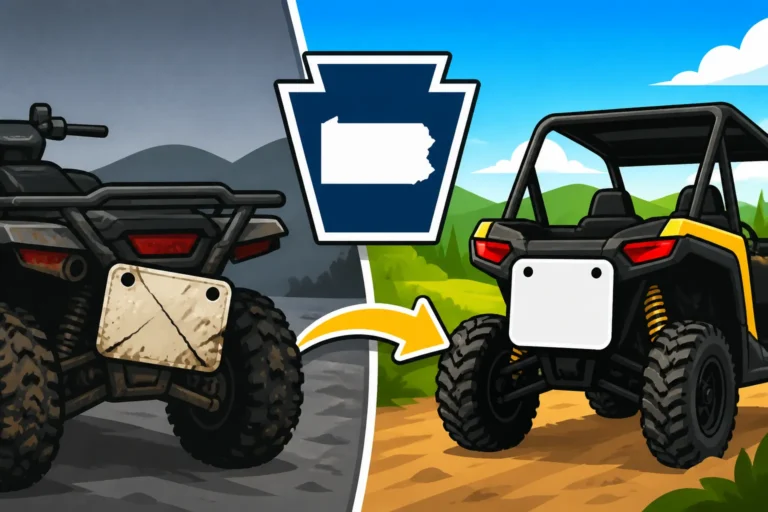
For farm owners who keep their machines strictly on their own property or contiguous land they lease, the state provides Pennsylvania’s Limited Registration for Your Own Land. A limited registration does not expire, costs nothing for the registration decal itself (though titling and processing fees still apply), and grants you a special plate designating restricted use.
Finally, there is an official agricultural exemption. Under specific statutory guidelines, machines used exclusively for agricultural production are exempt from both registration fees and the requirement to display a DCNR plate. However, this exemption is narrow. The moment that quad crosses off farm property for non-agricultural recreation, the exemption no longer applies.
Agricultural Exemption Criteria for Farm Quads
To legally claim full exemption from DCNR registration, your ATV or side-by-side must be used directly and exclusively in the commercial production of agricultural products. This includes activities like tending livestock, managing crops, maintaining pastures, spraying fields, or managing timber stands on land actively engaged in farming.
If your quad is primarily a workhorse for a commercial farm, you may qualify under The Farm and Business Exemption in Pennsylvania. However, state law looks closely at primary use. A quad used mostly for weekend joyriding around the county that occasionally hauls a bale of hay does not qualify for an agricultural exemption.
Additionally, claiming agricultural exemption status does not automatically clear you from titling requirements. Pennsylvania requires almost all ATVs purchased or transferred within the Commonwealth to hold a valid certificate of title to establish legal ownership, even if the machine never wears an active registration decal.
Step-by-Step Guide to Registering a Farm Quad with DCNR
Navigating state forms can feel overwhelming when you just want to get back to working your land. Whether you are buying a brand-new side-by-side from a power sports dealership or picking up a well-used farm quad from a neighboring farmer, following a structured process ensures your paperwork is accepted on the first try.
Gathering Essential Paperwork and VIN Proof
Before filling out state forms, gather all primary ownership documents. If you purchased the quad new from a dealership, you will have a Manufacturer’s Certificate of Origin (MCO) and a detailed bill of sale showing itemized tax calculations. If you purchased the machine used through a private sale, you will need the seller’s properly assigned Certificate of Title.
In cases where an older farm machine has been passed down through generations or purchased without clear paperwork, verifying the vehicle identification number (VIN) is critical. DCNR requires an accurate 17-digit VIN recorded on all paperwork. Inspect the metal frame rails—typically near the front bumper, rear axle housing, or lower frame tubes—to physically read the stamped VIN. If the quad was manufactured prior to modern standardized titling rules, you may need supplemental verification to establish a clean paper trail before DCNR will issue a new title or limited registration.
Filing Form DCNR-43 and Handling Proof of Ownership
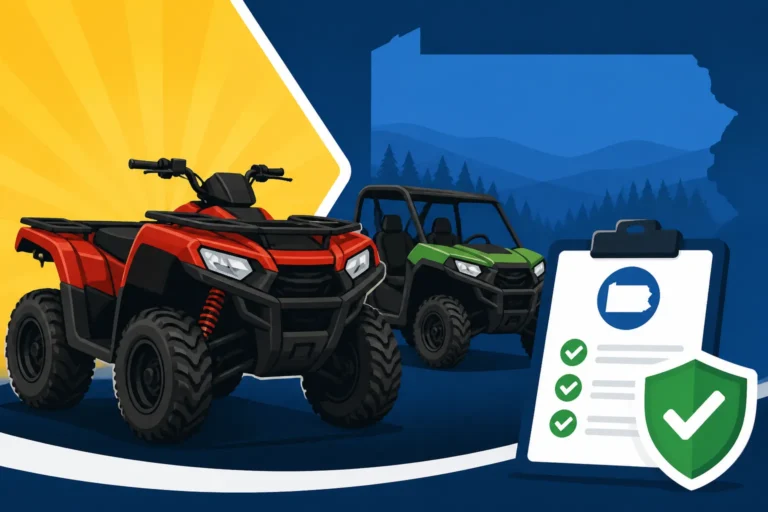
The core document for all off-road vehicle processing in the state is DCNR Form DCNR-43, officially titled the Application for Snowmobile/ATV Registration and Title. Knowing What Pennsylvania Asks on Form DCNR-43 helps prevent common processing delays. The form requires detailed information regarding:
- Applicant Details: Your legal name, physical farm address, mailing address, and social security number or tax ID.
- Vehicle Description: Make, model, year, displacement (cc), VIN, and primary hull/body colors.
- Registration Type Selection: Clear indication of whether you are requesting General Registration, Limited Registration (for private farm land), or recording an Exempt status.
- Lienholder Information: Details regarding any bank or agricultural credit organization financing the equipment purchase.
When submitting Form DCNR-43 for a limited registration on farm land, you must certify under penalty of law that the vehicle will be operated exclusively on land owned or leased by the applicant.
Executing Bills of Sale and Proof of Sales Tax
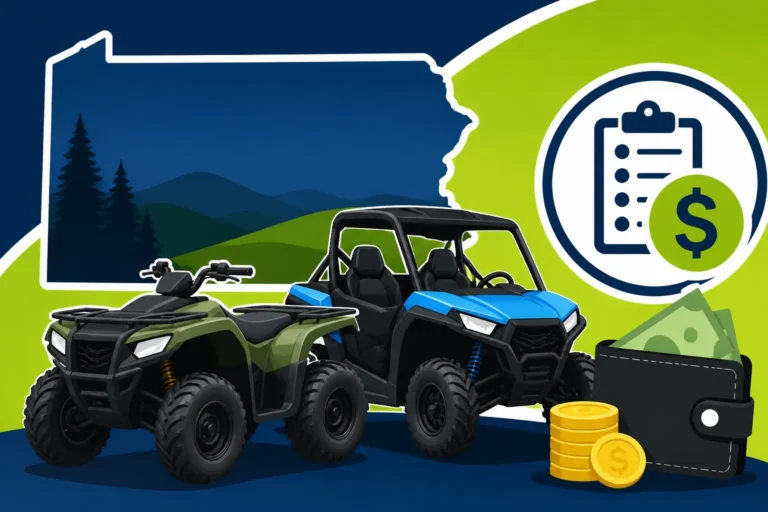
One of the largest hurdles farm owners face when titling and registering a farm quad is proving tax compliance. Pennsylvania imposes a standard 6 percent state sales tax (plus local surcharges in specific counties like Allegheny or Philadelphia) on ATV transactions. However, legitimate agricultural businesses may be eligible for a sales tax exemption on equipment used directly in farm operations.
To claim an agricultural tax exemption during registration, you must complete Pennsylvania Department of Revenue Form REV-1220 (Pennsylvania Exemption Certificate) and attach it to your DCNR application. This certificate documents your active farm status and verifies that the vehicle is used directly in commercial agricultural production.
When purchasing a farm quad through a private seller, you will want a clear, legal record of the transaction. Utilizing legal template services like LawDepot can help you draft a solid bill of sale that explicitly details the equipment condition, purchase price, VIN, and inclusion of any attached farm implements like plows or sprayers.
For state filing, a detailed bill of sale is required alongside the signed title. A custom bill of sale generated through LawDepot ensures that essential details like the vehicle identification number, selling price, and agricultural intent are cleanly documented to satisfy state auditors. Furthermore, if you are transferring ownership between family members or agricultural business partners, drafting an explicit transfer agreement using LawDepot can protect both parties and streamline Proving Pennsylvania Sales Tax Was Paid or establishing proper tax exemption eligibility.
If you cannot provide an official REV-1220 form or do not qualify for the state agricultural tax exemption, you must pay the required sales tax based on the purchase price listed on your bill of sale before DCNR will issue a title or registration plate.
Navigating Farm Quad Road Rights, Crossing Rules, and Trail Access
Farmers frequently need to move equipment between non-contiguous parcels of land, which often involves driving along or across public township and state roads. Assuming an agricultural quad has unrestricted access to public roads is a dangerous misconception that can lead to steep fines.
Farm ATV Use on Public Roads and Agricultural Exceptions
Under Pennsylvania’s Vehicle Code (Title 75), ATVs and UTVs are generally prohibited from operating on public highways and roads unless a municipality has formally designated a roadway as an open ATV route. However, special provisions exist for agricultural operations.
Farmers operating an ATV or UTV for farm purposes are permitted to cross public highways, provided the crossing is made directly at a 90-degree angle to the roadway, after coming to a complete stop, and yielding the right-of-way to all oncoming motor vehicle traffic. You cannot simply cruise down the shoulder of a state route for miles to reach another field unless that specific road is posted as a designated joint-use road. Reviewing Pennsylvania Rules for Riding a Road is essential if your daily farm tasks involve navigating public thoroughfares.
Safety gear rules also have specific farm exemptions. While state law generally mandates helmet use for off-road riders, Pennsylvania law includes Pennsylvania’s Agricultural Exception to the Helmet Rule. This exception waives mandatory helmet requirements for operators and passengers who are actively engaged in agricultural operations on farm property or while making direct road crossings between farm fields. However, wearing protective headgear remains highly recommended due to the unpredictable nature of rough farmland terrain.
Insurance Requirements and Limited Registration Boundaries
If you operate your farm quad strictly within the physical boundaries of property you own or lease, Pennsylvania state law does not mandate carrying liability insurance on the machine. However, the moment your farm quad leaves private property—whether crossing a public road shoulder or driving on public property—liability insurance becomes legally required.
Maintaining a basic liability policy on your farm quad is highly advisable, especially if farm employees or family members operate the equipment. Many farm owner policies allow you to add utility quad liability coverage as an affordable rider on your existing agricultural liability policy.
It is equally important to understand the legal limits of your registration plate. If you register your quad under the free limited registration structure, you are legally barred from riding that machine on public recreational trail networks, such as state forest trails or county riding parks. If you plan to use your farm quad for hunting trips on state land or weekend recreational trail rides, you must apply for a standard general registration and pay the associated biennial fees.
Farm Quad Registration & Exemption Comparison
To help you decide which path fits your farming operation, the following table breaks down the key legal requirements, permissions, and limitations for each category of ATV registration in Pennsylvania:
| Feature / Requirement | General DCNR Registration | Limited DCNR Registration | Agricultural Exemption |
|---|---|---|---|
| Primary Target User | Recreational trail riders & multi-use operators | Private landowners & farmers staying on-property | Commercial farm operations using quads strictly for farm work |
| Registration Fee | Standard biennial fee required | Free (one-time processing fee may apply) | No registration fee |
| Plate / Decal Issued | Standard DCNR plate & 2-year decal | Limited registration plate (no expiration) | No plate or decal issued |
| State Forest Trail Access | Yes (with valid registration & required permits) | No (restricted to private property) | No |
| Title Requirement | Mandatory | Mandatory | Mandatory (to establish official ownership) |
| PA Sales Tax Requirement | 6% sales tax paid at registration | 6% sales tax paid unless REV-1220 exempt | Exempt if REV-1220 form filed & approved |
| Public Road Crossing Rights | Permitted at 90-degree angles | Permitted at 90-degree angles | Permitted for direct farm-to-farm operations |
| Liability Insurance | Mandatory off private property | Required when crossing/using public roads | Required when crossing/using public roads |
Completing Your Farm Quad Registration Smoothly
Getting your farm utility vehicle properly documented with the Commonwealth of Pennsylvania does not have to disrupt your daily agricultural routine. By taking the time to organize your ownership documents, verify your VIN, and choose the correct registration class, you protect your farm business from unexpected liability and legal issues.
When buying or selling equipment privately within your agricultural community, taking proactive documentation steps is always wise. Using legal template tools like LawDepot ensures your bill of sale satisfies DCNR requirements, records exact purchase terms, and establishes clear tax exemption claims. If you ever need to prepare a bill of sale for a farm vehicle purchase or draft an agreement to lease contiguous land for farm quad access, having a legal document from LawDepot readily accessible in your record-keeping binder makes tax time and state filings far less stressful. Review Pennsylvania ATV Bill of Sale Requirements before finalizing your purchase to ensure every line item meets state standards.
Once your Form DCNR-43 is submitted with proper titling documents and tax exemption forms, you can operate your farm quad with total peace of mind—knowing your machine is fully legal whether you are pulling fence lines, managing herds, or crossing the road to complete the evening chores.
Disclaimer
This article is for general informational purposes only and does not constitute professional advice. Laws, prices and regulations vary by location and change over time. Consult a qualified professional for guidance on your specific situation.