Insurance Pennsylvania Requires to Ride
Riding your ATV or UTV across Pennsylvania's vast network of trails and designated roads is an incredible experience, but it also comes with a lot of confusion, especially when it comes to insurance. Many riders mistakenly believe that if their machine isn't "street legal" in the traditional sense, they don't need insurance, or they might be unsure of what the state actually requires. This guide is here to cut through that confusion, explain precisely when and why you need ATV insurance in Pennsylvania, and help you understand what kind of coverage protects you on the trails and beyond.
The Essential Role of ATV Insurance in Pennsylvania
Let's be real: buying an ATV or UTV is a big investment, and riding it often feels like pure freedom. But that freedom comes with responsibility, and in Pennsylvania, that responsibility almost always includes insurance. It's not just some extra hassle; it's a critical safety net that protects you, your fellow riders, and your wallet from unexpected mishaps.
Why Insurance Isn't Just a Good Idea, It's Often the Law
Think about it this way: when you drive your car, you wouldn't dream of hitting the road without insurance, right? That's because you understand the immense liability involved. An ATV, while different from a car, is still a powerful machine capable of causing significant damage or injury. The state of Pennsylvania recognizes this, which is why it mandates insurance for most situations where you're not on your own fenced-in property. If you're out on a state forest trail, exploring a joint-use road, or even just crossing a small township road to get to another section of trail, you're operating in an environment where the potential for an accident affecting others is real.
Without insurance, if you accidentally collide with another rider, damage someone's property, or worse, cause an injury, you're on the hook for every single penny. This isn't just about repairing a bent fender; it can involve medical bills that climb into the tens or even hundreds of thousands of dollars, lost wages for the injured party, and costly legal fees. That initial thrill of the ride can quickly turn into a financial nightmare. Insurance acts as your financial guardian, stepping in to cover these costs so your entire life savings aren't wiped out by one unfortunate moment on the trail.
The core principle here is shared risk. By having insurance, you're participating in a system where everyone contributes a little to cover the potentially massive costs when something goes wrong. It's a fundamental part of responsible ATV ownership in our state.
DCNR's Approach to Insurance Requirements
Now, here's where some of the confusion often arises for Pennsylvania riders. Unlike your car, which is registered and insured through PennDOT, your ATV or UTV falls under the purview of the Department of Conservation and Natural Resources (DCNR). DCNR is primarily concerned with regulating the off-road use of these machines, managing state forest and park lands, and ensuring rider safety and environmental protection.
When you go to [Registering an ATV in Pennsylvania] or [Registering a UTV in Pennsylvania], the DCNR will indeed ask for proof of insurance. Their stance is clear: if you plan to ride your ATV anywhere other than your own private land or land you lease, you must have insurance. The critical nuance, however, is that the DCNR itself doesn't stipulate a minimum dollar amount for that coverage. This can leave riders scratching their heads, wondering "how much is enough?" While DCNR may not specify a minimum, they absolutely require proof that a policy exists and is active. You need to be able to show that card, whether it's digital or physical, if a ranger or officer asks for it.
The main takeaway here is that DCNR is your go-to for registration and trail access, and they are firm on the presence of insurance for public riding. The exact level of that insurance, while not dictated by DCNR, is something you need to carefully consider with an insurance provider to adequately protect yourself.
The Crucial Distinction: Private Land Versus Public Access
This distinction is perhaps the most important point for Pennsylvania ATV owners to grasp. The law is quite specific: you need insurance when you operate your ATV "off your own land or land leased by you." What does this really mean in the muddy, dusty, and sometimes rocky reality of Pennsylvania riding?
"Your own land" is pretty straightforward—it's your private property, your backyard, your farm fields, where you have full control and ownership. If you're just tooling around your acreage, technically, the state doesn't require you to carry insurance. However, even in this scenario, many responsible riders choose to extend their homeowner's policy or get a separate ATV policy for liability protection, just in case a visitor gets hurt on their property, or if they accidentally damage a neighbor's fence.
But the moment your tires leave your property line, the rules change. This includes:
- State Forest and State Park Trails: Any time you're on designated [Pennsylvania's Sproul State Forest Trails], [Whiskey Springs and Pennsylvania's Longest Trail], or other DCNR-managed riding areas, insurance is mandatory.
- Designated Joint-Use Roads: Pennsylvania has specific township and borough roads designated for ATV use, often connecting trail systems or providing access to services. If you're riding these roads, your machine needs to be insured. Check out [Pennsylvania's Designated ATV Roads] and [Pennsylvania Joint-Use Road Rules] for more details on these routes.
- Other Private Property (with permission): Even if you're riding on a friend's private land with their permission, if it's not your land or land you lease, you should have insurance. While your friend might give you permission, their homeowner's policy isn't likely to cover your machine or your liability if you cause an accident.
- Crossing Public Roads: Even a quick, perpendicular crossing of a public road to get from one section of private land to another often triggers the insurance requirement, as you are briefly on a public thoroughfare.
The spirit of the law is clear: when you introduce your ATV or UTV into any public or semi-public space, you need to be covered. Don't take chances; assume you need insurance unless you are 100% certain you are operating exclusively on your own private, non-leased property.
Understanding Pennsylvania's Mandatory Insurance Requirement
The Pennsylvania ATV Act, specifically 17 Pennsylvania Code Chapter 51, lays out the rules for all-terrain vehicles. It's the legislative backbone that governs everything from registration to safety and, yes, insurance. This framework ensures that while riders can enjoy the diverse landscapes Pennsylvania has to offer, they do so with a measure of accountability and protection.
Where and When Insurance Becomes Legally Required
Let's dive deeper into the legal specifics. Pennsylvania law, under 17 Pa.C.S. § 7714, states that "No person shall operate an ATV or snowmobile on lands other than private property owned or leased by the operator unless the operator is insured with liability insurance coverage." That's the key phrase right there: "lands other than private property owned or leased by the operator." This simple sentence has profound implications for every Pennsylvania rider.
This means if you're planning a trip to the [Anthracite Outdoor Adventure Area in Pennsylvania], or heading out to explore the [Bloody Skillet's 38 Miles] of trails, you must have ATV liability insurance. It also applies to more mundane but equally critical situations. Imagine you're riding your farm quad, a machine that often falls under specific exemptions for registration, but you need to cross a township road to get from one field to another. That brief traverse on a public road means your quad needs to be insured for that moment. Or perhaps you're using a [The Farm and Business Exemption in Pennsylvania] machine for work, but that work takes you onto non-leased land or public access ways.
The rule isn't just about formal trail systems; it's about any operation beyond your explicitly owned or leased property. So, if you're riding a [Pennsylvania's Designated ATV Roads] to get to a local eatery, or connecting two pieces of your property via a shared township road, that insurance card needs to be in your wallet. The law is designed to cover situations where your actions, or the actions of your machine, could impact others who are not on your property.
What the Law Doesn't Specify: Minimum Coverage
Here's a common point of frustration for many riders: while the law clearly mandates insurance, it doesn't specify minimum coverage amounts. You won't find a line in the Pennsylvania ATV Act that says you need $15,000 in bodily injury liability or $5,000 in property damage, like you would for a passenger vehicle through PennDOT.
This ambiguity means that while you absolutely need a policy, the amount of coverage is left up to you, the insurance provider, and perhaps any lender if your machine is financed. On one hand, it offers flexibility; on the other, it places the burden on the rider to make an informed decision about how much protection is truly adequate. A minimal liability policy might satisfy the letter of the law for DCNR, but it might leave you dangerously exposed in a real accident.
Consider this scenario: you're riding on a state trail and, through no fault of your own, another rider swerves and you clip their brand-new side-by-side, causing significant body damage and a few broken bones for their passenger. If you only have a bare-bones liability policy, and the damages exceed your coverage limits, you're personally responsible for the rest. This is why, even without state-mandated minimums, it's wise to discuss robust coverage options with your insurance agent. They can help you evaluate your assets and risk tolerance to find a policy that truly protects you, not just fulfills a vague legal requirement.
Penalties for Riding Uninsured in Pennsylvania
Ignoring the insurance requirement is not just financially risky; it comes with direct legal consequences. If you're caught riding your ATV or UTV off your own property without proof of liability insurance, you could face significant fines and other penalties. The law is not shy about its enforcement, especially on state-managed trails and roads.
According to 17 Pa.C.S. § 7715, operating an unregistered or uninsured ATV is a summary offense. While the initial fine might be set, there are often additional "costs of prosecution" that stack up quickly. The [Pennsylvania Fines for No ATV Insurance] can be substantial, making that initial savings on premiums look like a very poor decision in retrospect. Beyond the immediate financial penalty, there's the possibility of your machine being impounded, which means towing fees, storage fees, and the hassle of getting it back once you've secured insurance and paid your dues.
But the real penalty often comes in the aftermath of an accident. If you cause property damage or bodily injury to another party while uninsured, you are personally liable for all those costs. This could mean wage garnishments, liens on your property, or even bankruptcy. Imagine you accidentally damage another rider's expensive machine or, worse, cause an injury that requires extensive medical treatment. Without insurance, those bills are yours, and they can be life-altering.
It’s also important to remember that while this article focuses on insurance, riding without proper registration also carries hefty fines. An [Pennsylvania Fines for an Unregistered ATV] can add another layer of trouble on top of an insurance violation. These rules are in place not to punish riders, but to foster responsible use and protect everyone who enjoys Pennsylvania's beautiful outdoors. Always carry proof of valid registration and insurance whenever you're out riding off your private land.
Types of ATV Insurance Coverage Available
Navigating the world of insurance can sometimes feel like trying to understand a foreign language, with all its specific terms and policy nuances. However, breaking down the main types of ATV insurance can help you choose the right protection for your machine, your riding style, and your peace of mind here in Pennsylvania. It's not just about meeting the legal requirement; it's about genuinely protecting yourself.
Liability Only: The Bare Minimum for Public Riding
When the DCNR and Pennsylvania law talk about mandatory insurance for ATVs and UTVs, they are primarily referring to liability insurance. This is the most basic form of coverage and is designed to protect other people and their property if you are at fault for an accident.
Here's how it generally works:
- Bodily Injury Liability: This part of your policy covers medical expenses, lost wages, and pain and suffering for anyone you injure in an accident where you are deemed responsible. For example, if you misjudge a turn on a trail and collide with another rider, sending them to the emergency room, your bodily injury liability would kick in to cover their medical bills and related costs.
- Property Damage Liability: This covers damage you cause to someone else's property. If, in that same scenario, you also dent their UTV, or perhaps you lose control and take out a section of someone's fence on a private property line adjacent to a trail, your property damage liability would pay for the repairs or replacement.
It's crucial to understand what liability-only coverage doesn't do. It does not pay for any damage to your ATV or UTV, nor does it cover your own medical expenses if you get hurt. This is where many riders get into trouble; they think "I have insurance," but if they roll their own machine or break an arm, they discover their basic policy offers no protection for themselves or their quad. While it satisfies the legal requirement for riding off your own land in Pennsylvania, it leaves you financially vulnerable to your own damages and injuries. For many riders, especially those with newer or more expensive machines, this minimal coverage often isn't enough.
Full Coverage: Protecting Your Investment
For most riders, especially those who have financed their ATV or UTV, or who simply want to protect their significant investment, full coverage is the preferred option. "Full coverage" isn't a single policy, but rather a combination of different coverages that offer a much broader safety net.
Typically, full coverage combines liability insurance with two other key components:
- Collision Coverage: This pays for damage to your ATV or UTV resulting from a collision with another object (like another vehicle, a tree, a rock, or even rolling over). It applies regardless of who is at fault. So, if you misjudge a jump and land hard, bending your frame, or you accidentally back into a tree while turning around, collision coverage helps pay for the repairs to your machine, minus your deductible. This is often a non-negotiable for financed machines, as lenders want to ensure their asset is protected.
- Comprehensive Coverage: This protects your ATV or UTV from damages that aren't caused by a collision. Think of things like theft, vandalism, fire, natural disasters (hail, floods, falling trees), or hitting an animal. If your prized side-by-side, kitted out with all the latest SuperATV accessories, is stolen from your garage, or catches fire due to an electrical issue, comprehensive coverage would help replace it. It's the "stuff happens" policy for your machine.
Choosing full coverage means that if you're involved in an accident or your machine suffers damage from a non-collision event, you're not solely responsible for the repair or replacement costs of your own quad. This provides immense peace of mind, especially when you consider the cost of parts and labor for specialized off-road vehicles. It’s a smart choice for anyone who sees their ATV or UTV as a significant asset worth protecting.
Beyond the Basics: Medical Payments, Uninsured Motorist, and Accessory Coverage
While liability and full coverage form the backbone of a solid ATV insurance policy, there are several other options that can further enhance your protection and are well worth considering, especially for Pennsylvania riders hitting the trails.
- Medical Payments (MedPay): This is a fantastic addition that many riders overlook. MedPay covers medical expenses for you and your passengers (if applicable) who are injured in an accident, regardless of who was at fault. This can be incredibly valuable because, as mentioned, standard liability doesn't cover your own injuries. Off-road riding, by its nature, carries risks, and even minor injuries can incur significant medical bills. MedPay provides immediate access to funds for hospital visits, doctor's appointments, and other related medical costs, without waiting for fault to be determined.
- Uninsured/Underinsured Motorist (UM/UIM): This coverage protects you if you are involved in an accident with another rider who either doesn't have insurance (uninsured) or doesn't have enough insurance to cover your damages and injuries (underinsured). As we discussed, Pennsylvania doesn't mandate minimum liability amounts, meaning some riders might only carry a very basic policy. If such a rider causes you harm, your UM/UIM coverage steps in to cover your medical bills and property damage, up to your policy limits. It essentially acts as if the other rider did have adequate insurance.
- Accessory and Custom Parts Coverage: This is particularly relevant for many Pennsylvania riders who love to customize their machines. Whether you've added a SuperATV lift kit, new tires, a winch, upgraded lighting, or a custom stereo system, standard collision and comprehensive policies often have a limited amount of coverage for aftermarket parts. If you've invested heavily in modifications, adding specific accessory coverage ensures that these valuable additions are also protected in the event of damage or theft. When getting a quote, be sure to detail any significant upgrades so your insurer can factor them into your policy.
- Roadside Assistance: While not directly insurance, some policies offer roadside assistance, which can be a lifesaver if your machine breaks down far from a trailhead or your tow vehicle. This typically covers towing services, saving you from a long, expensive recovery.
By considering these additional coverages, you can tailor your ATV insurance policy to truly fit your needs, providing a robust layer of protection for every adventure on Pennsylvania's diverse terrain.
Navigating the Insurance Application Process
Getting ATV insurance in Pennsylvania doesn't have to be a daunting task. Like any insurance product, it involves providing some basic information about yourself and your machine to help the insurer assess risk and calculate a premium. Understanding what they're looking for can streamline the process and help you secure the best possible coverage.
What an Insurer Needs to Know About Your Quad
When you contact an insurance provider for an ATV or UTV quote, they'll ask for specific details about your machine. These details are crucial for them to accurately price your policy, as they indicate the value of the vehicle and its risk profile.
Here’s a breakdown of the common information you’ll need to provide:
- Vehicle Identification Number (VIN): This is the single most important piece of information. The VIN uniquely identifies your ATV or UTV, much like a fingerprint. It tells the insurer the exact make, model, year, and often even the plant where it was manufactured. You can usually find the VIN stamped on the frame, often near the steering column, on a sticker, or on your registration documents. It's essential for looking up vehicle specifications and accident history.
- Make, Model, and Year: Knowing if you have a Polaris RZR, a Can-Am Outlander, a Honda Foreman, or a Kawasaki Mule, along with its specific model and the year it was manufactured, helps the insurer understand its base value, performance capabilities, and common risk factors.
- Engine Size (CCs): The engine displacement (e.g., 500cc, 700cc, 1000cc) is a major factor. Generally, larger, more powerful machines carry a higher risk (and thus potentially higher premiums) due to their increased speed and potential for more severe accidents.
- Purchase Price and Date of Purchase: This helps establish the initial value of your machine, which is critical for comprehensive and collision coverage. If you bought it new, they'll want to know the MSRP; if used, the price you paid.
- Intended Use: Will you be primarily trail riding for recreation, using it for farm work, or a mix of both? While the insurance is for riding off your own property, the intended primary use can sometimes influence risk assessment, especially if you have a specialized machine for heavy-duty tasks.
- Modifications and Accessories: This is where you'll want to mention any significant aftermarket additions. Have you installed a lift kit, bigger tires, a SuperATV winch, custom lights, or a plow system? These additions increase the value of your machine and may require specific accessory coverage to ensure they are protected. Be upfront about these, as failing to disclose them could lead to issues if you file a claim later.
Scenario: Insuring a brand-new, high-performance UTV like a Can-Am Maverick R with extensive modifications will undoubtedly cost more to insure than a decade-old, stock utility quad primarily used for hauling firewood. The higher value and performance potential of the UTV represent a greater risk to the insurer, both in terms of potential repair costs and liability.
Factors That Influence Your ATV Insurance Costs
Your annual premium for ATV or UTV insurance in Pennsylvania isn't just pulled out of thin air. It's the result of an intricate calculation that takes into account a variety of factors related to you, your machine, and where you live and ride. Understanding these can help you anticipate costs and potentially find ways to save.
Here are the key factors that typically influence your ATV insurance costs:
- Your Riding Experience and Age: Generally, more experienced riders with a clean driving record (for auto insurance, which can sometimes influence off-road policies) may see lower rates. Younger, less experienced riders, particularly those under 25, are often considered a higher risk and may face higher premiums. If you’ve completed a [Pennsylvania ATV Safety Certificate Requirements] course, some insurers might offer a discount.
- Location: Where you primarily store and ride your ATV can impact your rates. Areas with higher theft rates, for example, might lead to higher comprehensive coverage costs. Similarly, if you live in a rural area versus a more densely populated suburban one, your rates could differ.
- Type of Machine: As discussed, the make, model, year, and engine size play a huge role. High-performance sport quads and powerful utility side-by-sides often cost more to insure than smaller, less powerful utility ATVs, simply because their repair or replacement costs are higher, and they carry a greater potential for high-speed accidents.
- Coverage Limits and Deductibles: This is perhaps the most direct factor you control. Higher liability limits (e.g., $100,000 instead of $25,000) will increase your premium, but offer significantly more protection. Conversely, choosing a higher deductible (the amount you pay out-of-pocket before your insurance kicks in for collision/comprehensive claims) will lower your premium, but means more money out of your pocket if you file a claim.
- Claims History: If you've filed previous ATV insurance claims, especially for at-fault accidents, your premiums are likely to be higher. Insurers view past claims as an indicator of future risk.
- Storage Location: Where you keep your ATV or UTV when not in use can affect rates. A machine stored in a locked garage is typically considered less risky than one routinely left outdoors or in an unsecured shed.
- Bundling Policies: Many insurance companies offer discounts if you bundle your ATV insurance with other policies, such as your auto, homeowner's, or motorcycle insurance. It's always worth asking your current providers about potential multi-policy discounts.
By understanding these variables, you can have a more informed conversation with your insurance agent and make choices that balance cost with adequate protection. For more detailed insights, you might also look into [Pennsylvania ATV Insurance Costs].
Getting Quotes and Choosing the Right Policy
Once you understand what goes into an ATV insurance policy and what factors influence its cost, the next step is to actively shop around and compare options. This is not a "one size fits all" situation, and what works for one rider in Pennsylvania might not be the best fit for another.
Here's how to approach getting quotes and selecting the right policy:
- Gather Your Information: Before you start, have all the necessary details about your ATV or UTV (VIN, make, model, year, modifications) and your personal information (age, address, driving record) readily available. This will make the quote process much faster and more accurate.
- Contact Multiple Providers: Don't just go with the first quote you receive. Contact several reputable insurance companies that offer ATV policies. Major national carriers often have robust off-road vehicle programs, but local independent agents might also have access to specialized policies that better fit your needs as a Pennsylvania rider.
- Compare Apples to Apples: When you get quotes, ensure you're comparing identical coverage levels, deductibles, and policy exclusions. A cheaper premium might mean significantly less coverage or higher deductibles, which isn't a true saving in the long run. Ask for a detailed breakdown of what each policy covers and, crucially, what it doesn't cover.
- Ask About Discounts: Always inquire about available discounts. Besides bundling, some insurers offer discounts for:
- Safety Course Completion: If you (or a youth rider on your policy) have completed a DCNR-approved [Pennsylvania ATV Safety Certificate Requirements] course.
- Multi-Vehicle Policies: Insuring more than one ATV or UTV with the same company.
- Anti-Theft Devices: If your machine has a GPS tracker or other security features.
- Good Driver/Good Student: While primarily for auto, some insurers might extend these considerations.
- Read the Fine Print, Especially for Off-Road Use: This is vital. Ensure the policy explicitly covers recreational off-road use, including riding on designated state trails and joint-use roads in Pennsylvania. Some policies might have geographical restrictions or exclusions for certain types of competitive riding. Also, if you’ve added significant aftermarket parts, confirm how SuperATV accessories, for example, would be covered in a claim. You want to avoid any surprises down the road.
- Consider Your Comfort Level with Risk: The "right" policy is one that you feel comfortable with, balancing the premium cost with the level of financial protection it provides. If you're a cautious rider with few assets, a higher deductible and lower limits might suffice. If you're an aggressive rider with a high-value machine and significant assets to protect, investing in higher limits and comprehensive coverage is a no-brainer.
By following these steps, you can confidently choose an ATV insurance policy that meets Pennsylvania's legal requirements and provides the peace of mind you need to fully enjoy your adventures.
Proof of Insurance and Roadside Checks
So, you've done your homework, found the perfect policy, and your ATV or UTV is insured. Great! But the job isn't quite done. In Pennsylvania, having insurance isn't enough; you also need to be able to prove it when asked. This is a critical aspect of responsible riding, particularly when you're out on public lands or designated roads.
Carrying Your Proof of Insurance
The Pennsylvania ATV Act is clear: when you're operating your ATV or UTV off your own private property, you must have proof of financial responsibility, which means carrying proof of your liability insurance. This isn't just a suggestion; it's a legal requirement.
Think of it like carrying your driver's license in your car. If a DCNR ranger, state police officer, or local law enforcement official stops you on a state trail, a joint-use road, or during a crossing, they will likely ask for two primary things: your ATV registration and your proof of insurance.
What counts as proof?
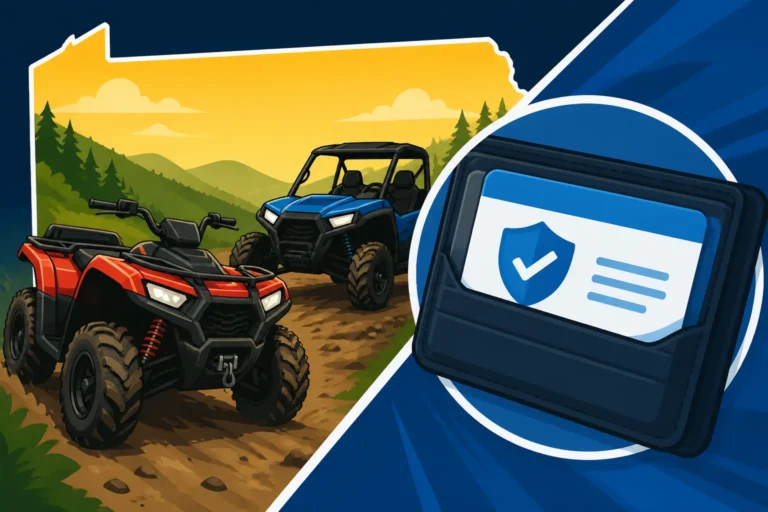
- Your Insurance Card: This is the most common and easiest form of proof. Many insurance companies issue a physical card that fits neatly into a wallet. Make sure the dates on the card are current.
- Digital Proof: In many cases, a digital copy of your insurance card or policy on your smartphone is acceptable. However, be prepared for areas with no cell signal.
- Policy Declaration Page: This is a more detailed document from your insurer outlining your coverage. While it works, it's less convenient than a small card.
The key is accessibility and legibility. You need to be able to produce it quickly and clearly. A common challenge for ATV riders is keeping paperwork dry and intact in the often-wet, muddy, or dusty conditions of the trail. Consider using a waterproof wallet, a sturdy Ziploc bag, or a dedicated [Keeping Paperwork Dry on a Wet Trail] holder that can be securely attached to your machine or carried on your person. Nothing is more frustrating than having valid insurance but being unable to prove it because your card turned into pulp after a creek crossing.
What a Ranger or Officer Checks Roadside
Enforcement on Pennsylvania's trails and designated roads is a reality. DCNR rangers and other law enforcement agencies are committed to ensuring safe and legal riding, and that includes verifying proper registration and insurance. They conduct routine checks, especially at popular staging areas, trailheads, or along key access routes.
Imagine you're at the [Registration Checks at Bloody Skillet] trailhead on a busy Saturday, or perhaps pulling into the parking lot at [Registration Checks at Whiskey Springs] after a long ride. It's common for a DCNR ranger to be present, engaging with riders and performing compliance checks.
When you're stopped, here's what an officer typically looks for:
- Valid ATV Registration: They'll check your registration plate (if required) and often ask to see your DCNR wallet card.
- Proof of Insurance: You'll need to present your insurance card or other valid proof. They'll verify the dates and the name on the policy.
- Safety Certificate (for youth): If a rider is between 8 and 15 years old, they must possess a valid [Pennsylvania ATV Safety Certificate Requirements]. The officer will ask to see this as well.
- Identification: The operator will also need to show personal identification, like a driver's license.
If you are unable to produce valid proof of insurance, the consequences can be immediate and severe. You could be issued a citation, which comes with significant fines, as detailed in [Pennsylvania Fines for No ATV Insurance]. In some cases, depending on the officer and the specific circumstances, your machine could even be impounded. The bottom line: always be prepared. Having your paperwork in order shows you're a responsible rider and helps ensure a smooth interaction with law enforcement.
Beyond the Card: The Full Spectrum of Compliance
While carrying your proof of insurance is absolutely essential, it's important to remember that it's just one piece of the larger puzzle of legal and responsible ATV riding in Pennsylvania. True compliance involves adhering to several interconnected regulations that ensure everyone's safety and the preservation of our riding areas.
Think of it as a checklist before every ride:
- Registration: Is your ATV or UTV properly registered with DCNR? Do you have your current registration plate mounted correctly and your wallet card handy? We've already touched on the [Pennsylvania Fines for an Unregistered ATV] if this isn't in order.
- Insurance: Yes, the topic of this guide! Is your liability insurance current, and do you have easy-to-access proof?
- Safety Certificate: If you have a rider aged 8-15, are they carrying their [Pennsylvania ATV Safety Certificate Requirements]? This is a mandatory component for youth riders on state lands.
- Age Restrictions: Is everyone riding legally permitted to operate their machine based on their age? For example, remember the [Pennsylvania Minimum Age to Ride a Road] rules for designated routes.
- Helmet Use: Is everyone wearing a properly fitted and DOT-approved helmet? Pennsylvania's helmet law is strict for ATV riders.
- Machine Compliance: Is your ATV or UTV equipped with a working spark arrester and a compliant exhaust system to minimize noise and fire risk? Are your lights working for night riding (if permitted)?
- Trail Rules: Are you riding on designated trails, within the posted speed limits, and adhering to specific rules for that riding area? Are you aware of [Pennsylvania Trails Closed in Spring] due to mud conditions?
All these elements work together to create a safe and enjoyable riding environment for everyone. When a ranger or officer conducts a roadside check, they aren't just looking for one thing; they're assessing overall compliance. Having everything in order—from your insurance card to your helmet—demonstrates you're a responsible steward of Pennsylvania's trails and a considerate fellow rider. It avoids citations, keeps you riding, and ensures that the sport remains accessible for years to come.
Special Considerations for Pennsylvania Riders
Pennsylvania's landscape and legal framework present some unique situations for ATV and UTV riders, especially regarding insurance and road use. It's not always as straightforward as just "on or off the trail." Understanding these specific nuances can help you avoid potential pitfalls and ensure your adventures remain legal and worry-free.
ATVs and Designated Roads: Bridging the Gap with Insurance
One of the most exciting, yet potentially confusing, developments for Pennsylvania riders is the increasing number of designated township and borough roads that are open to ATV and UTV use. These are not "street legal" roads in the traditional sense, meaning your quad isn't suddenly a passenger vehicle, but they do allow you to ride on certain public thoroughfares. This creates a critical bridge between trail systems or allows access to local amenities.
When you're riding on these [Pennsylvania's Designated ATV Roads] or [Pennsylvania Joint-Use Road Rules], your ATV or UTV falls under the same "off your own land" insurance requirement as if you were on a state forest trail. Even though you're on a paved or gravel road, you're still not on your private property, and therefore, you must carry liability insurance.
Consider this: you're riding a designated road that connects two parts of the [Allegheny National Forest Trails at Marienville], or perhaps a local township has opened a road to allow riders to access a gas station or restaurant. While you might not be navigating rocky terrain, you are sharing the road with other vehicles (sometimes cars) and pedestrians. The risk of an accident, even a low-speed one, still exists. Your insurance would cover damages or injuries you cause to others in such a scenario.
It’s also important to remember that these roads come with their own specific rules, such as the [Pennsylvania Minimum Age to Ride a Road] (generally 16 years old) and helmet requirements. Insurance is just one piece of this puzzle, but a critical one for staying compliant and protected on these valuable connector routes.
Riding Across State Lines: Reciprocity and Insurance
Pennsylvania is bordered by several states that also boast excellent riding opportunities. Many riders from New York, Ohio, West Virginia, Maryland, and New Jersey might visit Pennsylvania's trails, and vice-versa. This naturally raises questions about reciprocity—does your insurance from your home state cover you in Pennsylvania, or do you need a separate policy?
Pennsylvania does have registration reciprocity agreements with some neighboring states, meaning if your machine is legally registered in [Pennsylvania Reciprocity With New York], for example, you might be able to ride Pennsylvania's trails without needing a separate PA registration, provided that state also honors Pennsylvania's registration. However, reciprocity primarily applies to registration, not necessarily insurance.
While most out-of-state ATV insurance policies will extend their coverage to you when you ride in another state, it's absolutely crucial to confirm this with your insurance provider before you cross state lines. Don't just assume. Your policy might have specific exclusions for out-of-state use, or it might only provide the minimum coverage required in your home state, which could be insufficient for the laws or risks in Pennsylvania.
A quick call to your insurance agent is all it takes to clarify. Ask them: "Does my ATV policy cover me when I ride in Pennsylvania, specifically on state trails and designated roads, and if so, what are my coverage limits?" If you're a Pennsylvania resident planning to ride in another state, ask the same questions about states like Ohio or Maryland. Ensuring your coverage is valid and adequate wherever you ride protects you from legal trouble and financial exposure, regardless of which side of the state line you're on.
UTVs, Side-by-Sides, and Unique Coverage Needs
While this guide often uses "ATV" as a general term, it's important to specifically address UTVs and side-by-sides (SxS), which have rapidly grown in popularity across Pennsylvania. These machines, while sharing many characteristics with traditional ATVs, also have some unique features that can influence their insurance needs.
UTVs and side-by-sides are generally larger, heavier, and often more expensive than single-rider ATVs. They typically have multiple seats, a steering wheel, and sometimes enclosed cabs, making them more akin to small off-road vehicles. These characteristics can impact insurance in a few ways:
- Higher Value, Higher Premiums: The greater purchase price and more complex construction of UTVs often translate to higher repair or replacement costs, which in turn can lead to higher comprehensive and collision premiums.
- Multiple Passengers: With seating for two, four, or even six people, UTVs inherently carry more passengers, increasing the potential for multiple injuries in an accident. This might mean you want to consider higher bodily injury liability limits and more robust medical payments coverage.
- Accessories and Modifications: UTVs are incredibly customizable. Many owners invest heavily in aftermarket roll cages, windshields, doors, plows, sound systems, and performance upgrades from companies like SuperATV. Just like with ATVs, ensuring these valuable additions are covered under accessory coverage is essential.
- Usage Patterns: Some UTVs are used for heavy-duty work on farms or construction sites, while others are purely for recreational trail riding. Your intended use can sometimes influence policy options or rates.
- Trail Width Limits: While not directly insurance-related, remember that many Pennsylvania state forest trails have a 64-inch width limit. If your UTV exceeds this, your riding options on state land are restricted, which might affect your risk profile from an insurer's perspective. Make sure your machine is suitable for the trails you intend to ride, as stated in [Pennsylvania Trails for a Wide Machine].
When insuring a UTV or side-by-side, it's especially important to have an in-depth conversation with your insurance agent. Ensure they understand the specific type of machine you have, its value, its modifications, and how you intend to use it. This will help them tailor a policy that provides appropriate coverage for your substantial investment and unique riding needs. For registration specifics, check out [Pennsylvania Registration for a UTV] or [Pennsylvania Registration for a Side-by-Side].
What Happens in an Accident Without Insurance?
It's easy to dismiss the need for ATV insurance as an unnecessary expense, especially if you consider yourself a careful rider. However, accidents are, by definition, unexpected, and even the most cautious rider can find themselves in a challenging situation. When those situations arise, being uninsured in Pennsylvania can turn a bad day into a financial catastrophe.
The Immediate Aftermath: Citations and Financial Strain
Let's paint a realistic picture. You're out on a beautiful Saturday, navigating a rocky section of trail on state land, and despite your best efforts, you make a mistake. Perhaps you clip a tree, causing significant damage to your quad, or worse, you lose control and collide with another rider.
In the immediate aftermath, if law enforcement is involved and you're found to be riding uninsured, the first thing you'll likely face is a citation. As mentioned earlier, [Pennsylvania Fines for No ATV Insurance] are not trivial. These fines can quickly add up, and often include additional "costs of prosecution" imposed by the courts. You could be looking at hundreds, if not thousands, of dollars in immediate penalties.
Beyond the fines, the real financial strain begins. If you only had liability insurance (which, if you were uninsured, you wouldn't even have), you'd have no coverage for the damage to your own machine. So, repairing that bent frame, replacing those broken plastics, or fixing that engine issue is coming directly out of your pocket. ATV repairs are rarely cheap, and parts for specialized off-road vehicles can be expensive. A minor fender-bender that might have been a simple insurance claim with collision coverage suddenly becomes a major personal expense, potentially wiping out your savings or forcing you to defer other financial goals.
If you injured another person or damaged their property, the situation escalates dramatically. You are now personally responsible for their medical bills, their lost wages, and the repairs to their machine or property. These costs can start accruing immediately, even before any formal legal action is taken, creating immense financial pressure.
Long-Term Repercussions: Legal Battles and Debt
The immediate fines and repair bills are often just the beginning. The long-term repercussions of riding uninsured can be far more devastating. If another party was injured or their property was extensively damaged, you're almost certainly going to face a lawsuit.
Imagine that collision on the trail caused a severe injury to another rider, requiring surgery, rehabilitation, and months of lost income. Their medical bills alone could easily reach six figures. Their attorney will pursue you directly for compensation. Without liability insurance, you have no professional legal representation from an insurer, and no financial backing to pay for those damages.
This can lead to:
- Lawsuits and Judgments: You could be sued, and if a court finds you liable, a judgment could be entered against you. This judgment becomes a legal obligation to pay the injured party.
- Asset Seizure and Wage Garnishment: To satisfy a judgment, the court could allow the injured party to seize your assets, such as savings accounts, real estate (excluding your primary residence in some cases, but rules vary), or even place a lien on your property. They could also garnish your wages, meaning a portion of your paycheck is automatically redirected to pay off the debt.
- Bankruptcy: For some, the financial burden of an uninsured accident can be so overwhelming that it leads to personal bankruptcy, which has long-lasting negative impacts on your credit, financial freedom, and overall quality of life.
The seemingly small risk of riding uninsured can quickly snowball into a multi-year legal battle and crippling debt, fundamentally altering your financial future. It's a risk simply not worth taking.
Protecting Your Future: Why Insurance is a Non-Negotiable Investment
When you look at the potential consequences—the fines, the cost of repairs to your own machine, the staggering medical bills for an injured party, and the threat of lawsuits and bankruptcy—it becomes abundantly clear why ATV insurance is not just a good idea, but a non-negotiable investment for any responsible rider in Pennsylvania.
Think of it as peace of mind. For a relatively modest annual premium, you are shielding yourself and your family from potentially catastrophic financial losses. Even if you're the safest, most skilled rider on the planet, you cannot control the actions of others, the unpredictable nature of the trails, or unforeseen mechanical failures. Accidents happen, and when they do, insurance is there to catch you.
It allows you to focus on the joy of riding, the beauty of Pennsylvania's outdoors, and the camaraderie of fellow enthusiasts, rather than constantly worrying about "what if." It ensures that a momentary lapse in judgment or an unfortunate twist of fate doesn't derail your entire financial future.
So, before you air up your tires, check your fluids, and head out to the next great Pennsylvania adventure, take a moment to ensure your ATV or UTV is fully insured. It's the smartest investment you can make in your riding career, protecting both your passions and your future.
Disclaimer
This article is for general informational purposes only and does not constitute professional advice. Laws, prices and regulations vary by location and change over time. Consult a qualified professional for guidance on your specific situation.