Log Trucks on Forest Roads
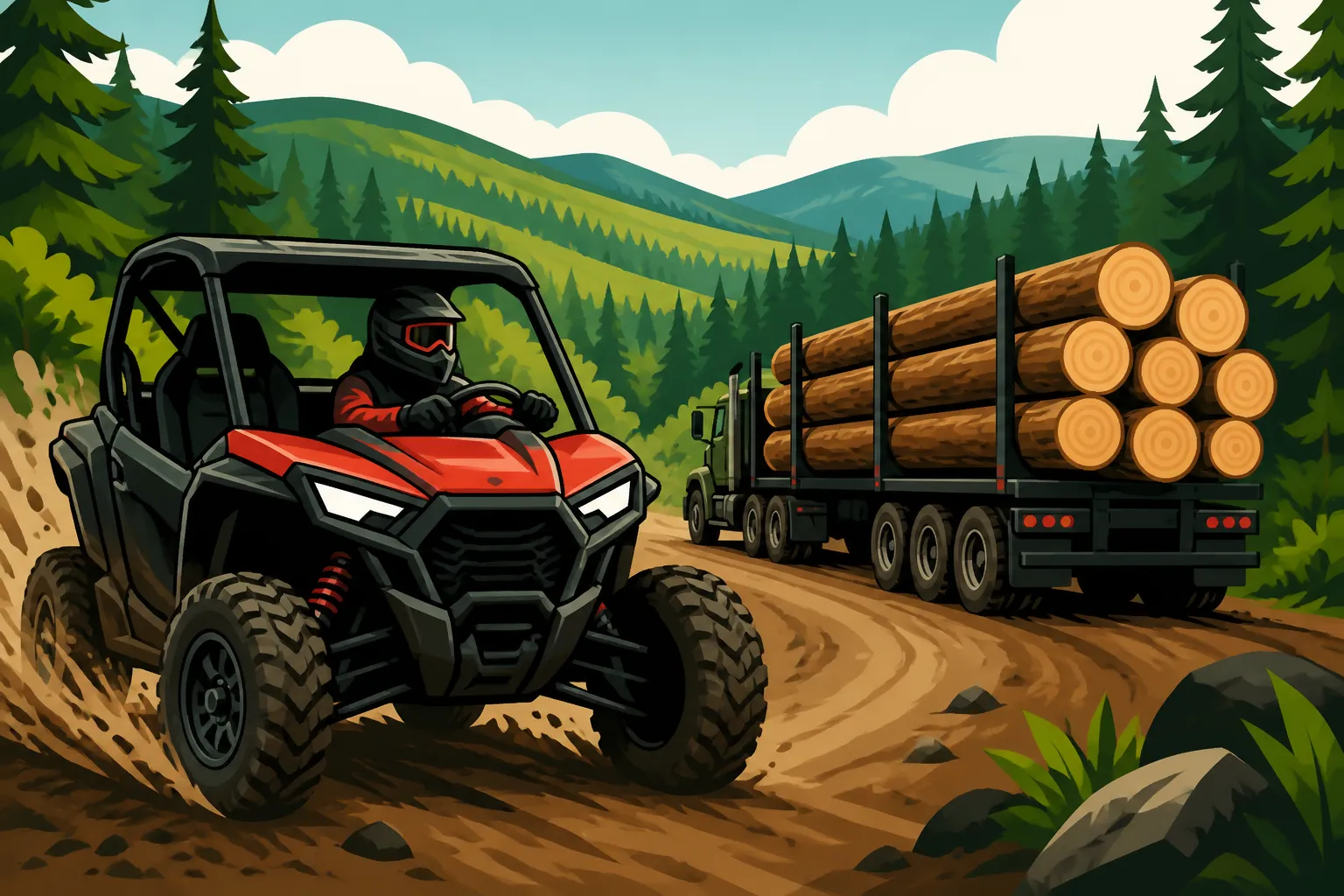
A log truck appearing around a blind bend can turn a peaceful Pennsylvania forest ride tense in seconds. Narrow roads, loose gravel, dust, steep grades, and limited places to pull over leave little room for guesswork. This guide explains how to prepare for logging traffic, respond safely when you meet a truck, and check whether a forest road is open to ATV or UTV riding.
Before riding a forest road with logging traffic
Confirm the road is open to your machine
A forest road is not automatically an ATV or UTV route just because it is unpaved, looks quiet, or appears on a map. Some roads are open only to highway vehicles; others may be designated for specific uses, closed temporarily, or subject to posted restrictions. A road used by a logging operation might also be private or closed to public riding.
Before setting out, check current signs at the road entrance and along the route, then confirm the route’s status with the responsible land manager when it is unclear. Start with Pennsylvania’s Designated ATV Roads and Why Some Forest Roads Take Highway Vehicles Only to understand why road access depends on designation rather than appearance. For more detail about riding on state forest roads, see Pennsylvania Rules for Riding a State Forest Road.
A map app can help you plan, but it cannot grant permission or override a gate, closure sign, or restriction. Riders who use onX Offroad to plan a route should treat it as a navigation aid, then check official information and posted signs before riding. This is especially important when a route crosses between state forest, national forest, township, and private land, where the rules and responsible contacts may differ.
Look for signs of active hauling
Logging work can change conditions quickly. A road that was quiet during your last visit may now be part of an active haul route, and a truck may come through after a long gap. Watch for logging equipment, fresh tire tracks, cut timber, disturbed shoulders, temporary signs, road crews, or trucks entering from a landing or side road.
Do not ride past a closure, barrier, or sign restricting access because the road ahead appears empty. If signs are missing or hard to interpret, do not assume the route is open. Turn around only where it is safe, and contact the land manager rather than riding farther to investigate. Spotting a Posted ATV Road can help you recognize the signs that indicate a road’s status.
Before leaving, check for current trail or road notices and have a second route in mind. onX Offroad can be useful for keeping a planned route and alternatives visible, but confirm any change in access with the agency or landowner responsible for that road. A downloaded map may help with navigation where cell service is poor; it does not replace current closure information.
How to ride when log trucks may be present
Ride as if you could meet a truck around any bend
On a narrow forest road, your safest speed is one that lets you stop within the distance you can see clearly. That distance can shrink on a blind curve, over a crest, in heavy dust, or where vegetation blocks the view. Ease off the throttle before corners and hills instead of waiting until you can see a truck.
Keep to the right side of the road, but do not hug a crumbling edge or ride through deep drainage ruts just to leave space. A shoulder can be soft, steep, or hidden by leaves. Leave room to steer and brake, and avoid riding side by side where the road is narrow. For additional guidance, see Blind Corners on a Mountain Road.
Dust is a real visibility hazard. If a truck has just passed, slow down and give the dust time to clear rather than continuing into a cloud. Use headlights where appropriate for visibility, and keep enough separation from other riders that you can react if the lead rider brakes suddenly.
Choose a safe place to stop and let the truck pass
If you see a log truck approaching, reduce speed smoothly and look for a wide, firm place to pull off. Stop well clear of the travel path, avoid soft shoulders and ditches, and keep your machine and body away from the truck’s swing and load. If there is no safe pull-off nearby, slow down and follow the road’s safest available space without making a sudden move.
Do not stop at a blind corner, on a narrow bridge, at the crest of a hill, or where the truck would have to make a sharp maneuver around you. If you are unsure whether there is room, pull into the first safe turnout you can reach and wait. Keep children and passengers close to the stopped machine, and do not let anyone stand beside the road to watch the truck pass.
Once the truck has gone by, wait until the dust settles and you can see clearly before moving again. A second truck may be following, or another vehicle may be coming from the opposite direction. Never assume one truck means the road is clear. On a route with narrow crossings or limited sightlines, Crossing a Bridge on a Designated Route offers useful reminders for approaching a constrained section carefully.
What to do during a close encounter
Stay predictable and avoid last-second moves
A loaded truck may need more room to turn, stop, or climb a grade than a smaller vehicle. The driver may also have limited visibility near the truck, particularly around the sides and rear. Do not weave, accelerate past the truck, or try to squeeze between it and the road edge. If you are moving, make your actions gradual and easy to anticipate.
If the truck is behind you, do not race ahead in an attempt to get out of its way. Look for a safe, visible pull-off and let it pass there. If you are uncertain whether the driver has seen you, do not rely on eye contact or a hand signal as proof. Stop in a safe place and give the truck room to proceed.
When meeting a truck head-on, do not enter a narrow section if there is not enough space for both of you to pass. If you can safely back up to a wider turnout, do so carefully, with a spotter if one is available and the situation allows. Avoid backing toward a drop-off, ditch, or blind curve. If neither vehicle can move safely, stay calm and use clear communication from a safe position rather than making a rushed maneuver.
Expect changing road and trail conditions
Logging traffic can leave loose stone, mud, ruts, branches, and debris behind. A road surface may be firm one day and badly churned after rain or repeated truck use. Slow down around fresh tracks and damaged edges, and do not attempt a rut or muddy section if you cannot see its depth or where it leads.
Heavy vehicles can also reduce visibility by raising dust, especially during dry conditions. In wet weather, mud can hide rocks, potholes, and soft shoulders. Give yourself extra stopping distance and avoid following another ATV or UTV so closely that you ride into the dust or debris it raises. Check Pennsylvania Trail Conditions Before You Go before your trip, and follow any road or trail closures.
When using onX Offroad or another navigation app, be alert to changes that may not appear on the map, including fresh closures, active work, or damaged sections. If a road is blocked or unsafe, turn around where permitted and choose a confirmed open route. Do not bypass gates or ride around barriers to stay on a planned track.
| Situation | Safer response | Avoid |
|---|---|---|
| You see a truck approaching | Slow early and stop at a wide, firm turnout | Braking suddenly at a blind bend |
| A truck passes and raises dust | Wait until visibility returns and check for following traffic | Riding straight into the dust cloud |
| The road has fresh ruts or debris | Reduce speed and assess the surface from a safe place | Charging into an unseen rut or muddy section |
| A sign or barrier restricts access | Stop and verify the route with the responsible land manager | Riding around the barrier |
| You meet a truck on a narrow section | Use a safe turnout or back up carefully if it is safe to do so | Squeezing past or backing toward an edge |
Plan a ride that reduces conflict
Build time and alternatives into your route
A route that looks short on a map can take much longer when it includes narrow roads, steep grades, or active work. Allow time to stop, wait for trucks, and turn around if conditions change. Before riding, identify wide places where your group can pull off and agree on what to do if riders become separated.
Share the route with someone who is not riding, especially if you expect limited cell service. Carry a charged phone, but do not depend on it for navigation or emergencies in a remote area. Keep your group together at junctions and stop in a safe place before checking a map. If you use onX Offroad for route planning, save the route information in a way you can access offline, then verify access restrictions before departure.
Plan a turnaround point rather than treating the far end of the route as a must-reach destination. A gate, active logging operation, washout, or truck queue may make continuing unsafe or unauthorized. Turning back is not a failed ride; it is often the best decision when the route has changed.
Respect closures and the people working there
Logging crews are doing work that may involve large vehicles, equipment, suspended loads, and changing traffic patterns. Give workers room, follow signs and directions, and never enter an active work area to ask a question or take a closer look. If a crew member tells you the road is closed or unsafe, stop and follow the instruction while you confirm the route status through the appropriate land manager.
A road that appears open from one end may be restricted farther along. Treat gates, barricades, and posted notices seriously, and do not assume a closure is only for full-size vehicles unless the sign or land manager makes that clear. For more on why access varies, read [Pennsylvania Rules for Riding a National Forest] and Pennsylvania Trail Etiquette on Narrow Trails.
If you are riding with a club or group, brief everyone before leaving the staging area. Make sure riders know to slow before blind turns, stay single file on narrow sections, avoid passing trucks, and stop only in safe locations. A short conversation before the ride can prevent the most dangerous response: several people making different decisions at once when a truck suddenly appears.
Disclaimer
This article is for general informational purposes only and does not constitute professional advice. Laws, prices and regulations vary by location and change over time. Consult a qualified professional for guidance on your specific situation.