Hunters and Riders Sharing a Forest
Sharing a Pennsylvania forest with hunters can feel tense when a quiet trail suddenly fills with trucks, orange clothing, and distant shots. The safest ride starts before you unload: confirm the route is open to ATVs, understand where hunting is allowed, make your machine visible, and give hunters room. This guide walks through those decisions so you can ride thoughtfully without guessing.
Plan Your Ride Around Hunting Activity
Check the land and route before you leave
“Forest” can mean very different things in Pennsylvania. A route through state forest land, the Allegheny National Forest, a private club property, or a township road may have different access rules. A road that appears on a map is not automatically open to ATVs, and a legal hunting area is not automatically a legal riding area.
Before heading out, identify the land manager and confirm that your specific trail or road is open to ATV use. Check for seasonal closures, posted signs, and notices at the trailhead. A route shown in a navigation app can help with planning, but it should not replace current information from the managing agency or the signs on site. For background on where riding may be allowed, see Pennsylvania Rules for Riding a State Forest Road and [Pennsylvania Rules for Riding a National Forest].
It helps to plan the entire trip, not just the trail mileage. Mark your parking and staging area, the route you intend to ride, and a sensible turnaround point. If a gate is closed or a trail is marked off-limits, do not try to work around it by following an unofficial woods road. That can put you on private property, a closed route, or land where ATV travel is prohibited.
A map app such as onX Offroad can help you review routes, identify nearby roads, and keep track of where you are when forest roads branch in several directions. Use it as a planning aid, then verify access with official notices and trailhead signs. That extra check matters in places such as Sproul State Forest or the Allegheny National Forest, where a route may pass through areas with different management rules.
Choose timing with care
Hunting activity can increase during fall seasons, but there is no single “hunting season” that covers every species, weapon, location, and date. Regulations and seasons can vary. Before riding, check the current Pennsylvania hunting calendar and any notices for the land you plan to visit. Also look for temporary trail closures or restrictions: Pennsylvania Riding in Hunting Season and Pennsylvania Trail Closures to Check First are useful starting points.
If your schedule is flexible, consider riding at a time when you are less likely to meet hunters walking in or out of the woods. Early morning and late afternoon can be busy periods in hunting areas, and vehicle traffic may increase around access points. Choosing a different time will not eliminate the chance of an encounter, but it can make shared use more predictable.
Weather and trail conditions are part of the timing decision, too. A wet stretch can make a narrow forest route harder to pass safely and more vulnerable to damage. Check for recent conditions and closures before setting out; Pennsylvania Trails After Heavy Rain explains why waiting for a trail to dry can be the responsible choice. A changed plan is frustrating, especially after loading the trailer, but it is better than getting stuck or leaving ruts that affect everyone’s access.
| Before you ride | What to confirm | Why it matters |
|---|---|---|
| Land status | Who manages the land and whether ATV use is allowed | Rules differ between public, private, and club property |
| Route access | Whether the specific trail or road is open | A visible road is not necessarily an authorized ATV route |
| Hunting activity | Current seasons and local notices | Hunters may be walking, parked, or posted near access points |
| Trail condition | Closures, weather damage, or seasonal restrictions | Wet or closed routes can be unsafe and vulnerable to damage |
| Machine and gear | Registration, required safety equipment, and visibility gear | Prepared riders are easier to identify and less likely to cause confusion |
Share Space Without Creating a Hazard
Make yourself visible and easy to identify
Visibility is not just about being seen from far away. A hunter needs enough time to understand that you are a rider, determine where you are going, and avoid confusing your movement with wildlife. Wear highly visible clothing, especially during fall rides, and keep it visible while riding rather than tucked beneath a dark jacket. The guidance in Blaze Orange on a Pennsylvania Fall Ride can help you think through practical visibility choices.
Bright clothing is only one part of the picture. Keep your ATV’s lights working, use them when conditions call for it, and avoid riding in a way that creates sudden movement near a hunter’s position. Do not assume that an engine noise alone tells someone exactly where you are or which direction you are traveling. In dense woods, terrain and vegetation can muffle sound and block sightlines.
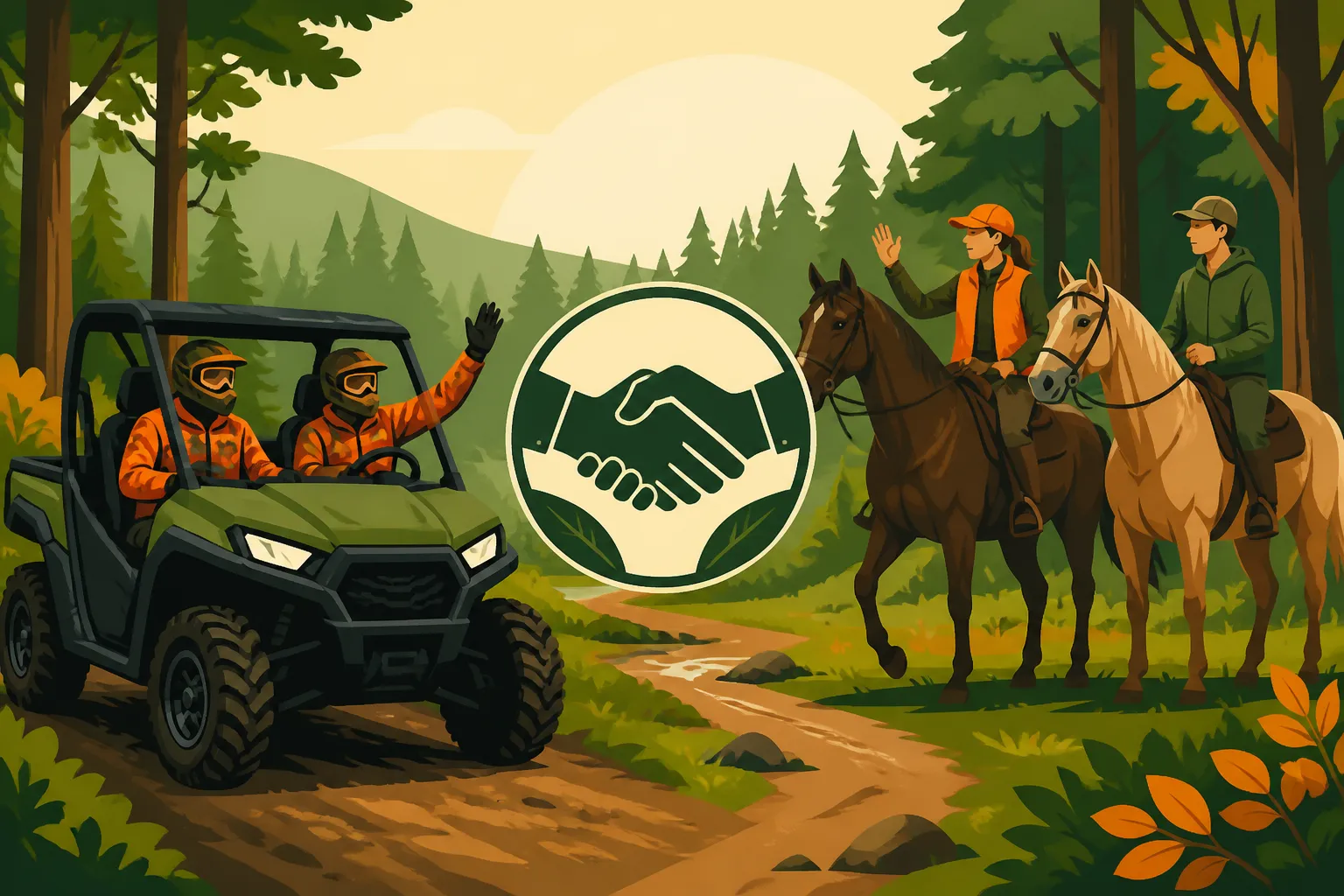
If you meet a hunter near a trail, slow down well before reaching them. Stop at a safe distance, make your presence clear, and wait for a response rather than revving the engine or squeezing through a narrow gap. A calm pause gives both of you time to assess the situation. If the trail is too tight to pass safely, ask whether the hunter would prefer that you wait or turn around.
Visibility practices should not be confused with a substitute for checking the rules. Requirements can depend on the activity and location, so review applicable regulations rather than assuming that a particular color, vest, or piece of equipment satisfies every rule. For broader safety preparation, see Pennsylvania Riding in Hunting Season.
Slow down near people, vehicles, and blind corners
A forest road that feels empty can change quickly. Hunters may park at a pull-off, walk along the edge of a route, cross between cover and a vehicle, or stand near a trail junction. A parked truck or a fresh set of tire tracks can be a clue that other people are nearby. Treat those signs as a reason to ease off the throttle, not as an invitation to pass quickly.
Blind corners deserve extra caution, especially on narrow mountain roads where vegetation or a rock cut can hide oncoming traffic. Stay to the appropriate side, keep speed under control, and leave room to stop. If you are riding with a group, avoid bunching up so tightly that the lead rider can stop but the riders behind cannot. Agree on a simple signal for slowing or stopping, and make sure each rider understands it before entering the trail.
When you approach a hunter on foot, keep a generous buffer. Do not ride close to someone’s position just to maintain your route, and do not assume they can safely move aside. If you cannot pass without disturbing or crowding them, stop and communicate. On a multi-use road, patience is often the difference between an ordinary encounter and one that feels threatening.
A route-planning tool such as onX Offroad can help you anticipate junctions and avoid unnecessary wandering, but it cannot show you every person in the woods. Keep scanning ahead, reduce speed where visibility is limited, and be prepared to stop even when the map shows a clear route.
Respect Closures, Boundaries, and Other Users
Do not treat a closure as a suggestion
A gate, barrier, closure notice, or posted sign can reflect seasonal management, unsafe conditions, active work, or a landowner’s restrictions. Do not ride around it on a shoulder or create a new track through the woods. An alternate-looking path may lead onto land where riding is not allowed, and bypassing a closure can damage the trail or put you in conflict with a land manager.
When you reach a closure, stop and reassess. If you have a confirmed legal route back to your staging area, use it. If not, retrace your route rather than improvising through an unmarked connector. A navigation app can help you understand where you are, but it cannot authorize an unmarked route or override a sign. The same caution applies to informal roads that appear on a map but are not designated for ATV use.
This matters particularly during hunting periods, when people may be using access points that are quiet at other times of the year. A closed route could also be closed for reasons unrelated to hunting. Do not assume a closure is temporary or that it applies only to vehicles other than yours. Check the notice or contact the managing agency when the reason or boundary is unclear.
For more detail on how to respond to a posted restriction, review [Pennsylvania Rules for Riding a Closed Trail]. If you are unsure whether a route is open, the safest choice is to stay off it until you can confirm access.
Keep your ride on authorized routes
Riding off an established, authorized route can disturb wildlife, damage vegetation, and create confusion about where motorized use is permitted. It can also bring you closer to hunters who are positioned away from the main road. Stay on the route you verified, resist making a short detour around mud or a downed branch, and do not follow tracks simply because another vehicle appears to have gone through.
Respect private property boundaries as well. A public forest road may pass near private land, and an adjoining trail may be managed by a club or landowner. A map line can be difficult to interpret on the ground, so look for signs and pay attention to gates and posted boundaries. If you cannot confirm that the route is open to you, turn back rather than treating the absence of a fence as permission.
Some areas also have separate restrictions for different kinds of public land. State game lands, for example, are not general-purpose ATV riding areas. Do not assume that a nearby public parking area or hunting access road permits ATV travel. Check the land designation and its specific rules before unloading.
onX Offroad can be useful for comparing a planned route with your location and avoiding accidental detours, but use it alongside official maps, land-manager information, and signs. If a digital map and a posted closure appear to conflict, follow the posted restriction and confirm the route with the responsible agency before returning.
Prepare for a Safer Day in the Woods
Set expectations with everyone in your group
Before the ride, tell your group that hunters may be present and agree on how you will respond. Decide who will lead, who will ride at the back, and how the group will communicate when someone sees a person, vehicle, closure, or hazard. A quick conversation in the parking area is easier than trying to make a plan while engines are running on a narrow road.
Keep enough distance between machines to allow each rider to react to a stop. If the lead rider slows near a blind corner, the rest of the group should be able to follow without hard braking or crowding. Avoid racing, sudden acceleration, and loud behavior near occupied hunting areas. Those habits are risky on any shared trail and can make an otherwise ordinary encounter feel intimidating.
If a rider in your group is inexperienced, explain that stopping is an acceptable decision. Nobody needs to prove they can squeeze past a hunter or keep going after a route becomes uncertain. Have a simple plan for regrouping if the group gets separated, and make sure every rider knows the return route.
You can use onX Offroad to share a planned route with your group or orient riders at a junction, but do not rely on everyone having the same map information or phone signal. Talk through the route before you leave and carry the required registration and other documents for your ride.
Know when to turn around
Turn around if you encounter an active closure, a route you cannot verify, unsafe trail conditions, or a situation where passing would put a hunter or rider at risk. It can be disappointing to abandon a loop, especially after a long drive to the trailhead, but continuing is not worth a citation, a damaged trail, or a preventable confrontation.
Use the same judgment if you see signs of a busy hunting area and cannot ride through without disturbing people. Move away from the immediate area only along a route that you know is authorized. Do not create a new path through brush or cross private land to find a different trail. If you are uncertain, return to a known access point and check with the land manager.
A good shared-use ride is not one where nobody else is present. It is one where riders and hunters can use the forest without surprising, crowding, or blocking one another. Planning ahead, staying visible, keeping to designated routes, and giving people space are practical habits that make that possible.
For a broader seasonal overview, see Pennsylvania’s ATV Trail Season. If your ride plan depends on a particular state forest or trail system, confirm its access status before loading up. Conditions and restrictions can change, and a short check can spare you the aggravation of arriving at a closed route with a trailer full of machines.
Disclaimer
This article is for general informational purposes only and does not constitute professional advice. Laws, prices and regulations vary by location and change over time. Consult a qualified professional for guidance on your specific situation.