Pennsylvania Game Lands and Why Quads Are Banned
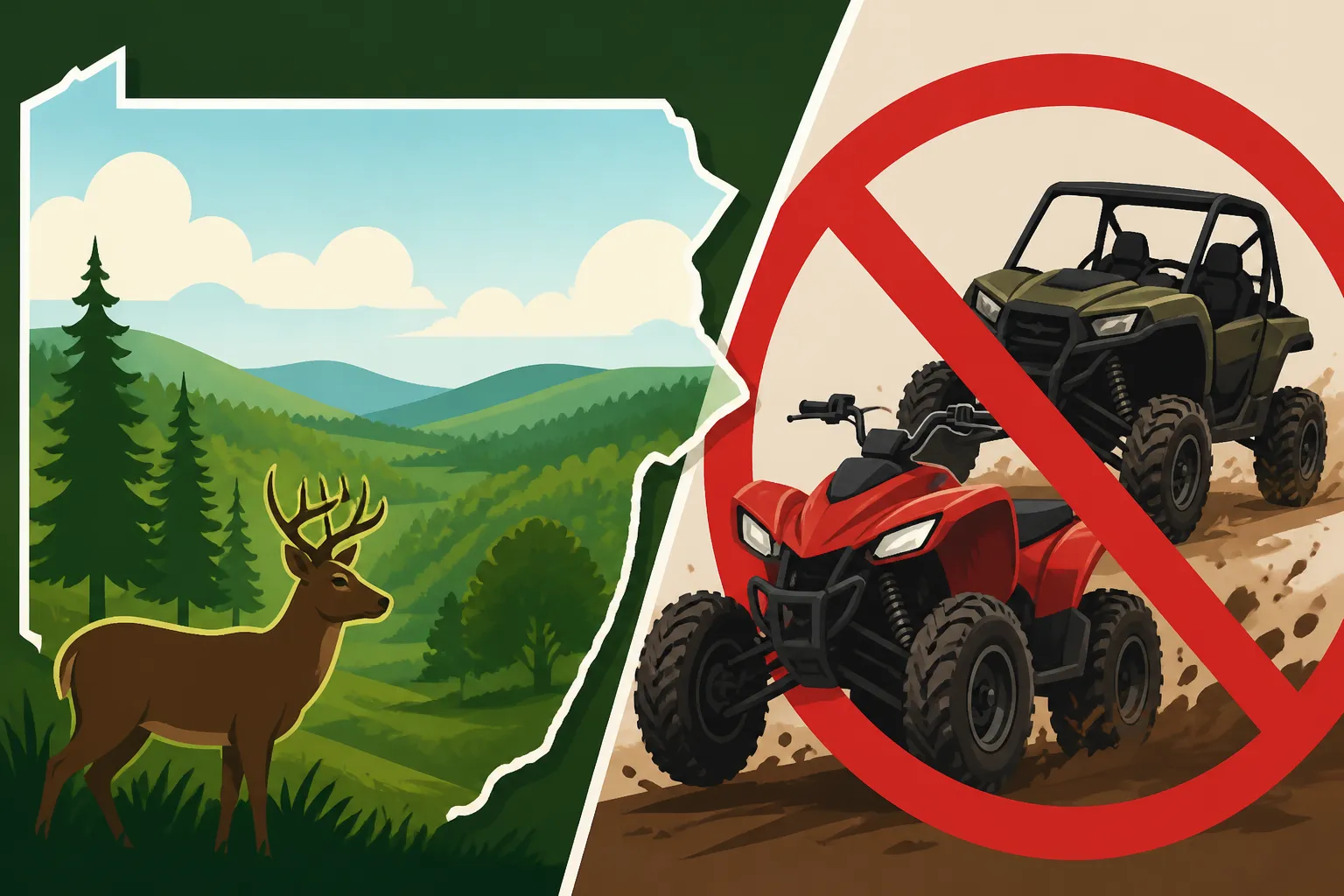
Pennsylvania’s State Game Lands are public land, but that does not make them open for recreational ATV or UTV riding. The restrictions can be confusing when a map shows roads, trails, or nearby state forest routes. This guide explains why quads are generally banned, what limited exceptions may apply, and how to check your route before you ride.
What the Ban Means in Practice
Pennsylvania State Game Lands are managed by the Pennsylvania Game Commission for wildlife conservation, habitat management, and hunting. They are not a general-purpose off-road riding network. As a practical rule, do not take an ATV or UTV onto Game Lands unless the Game Commission has specifically authorized your access or the route is clearly designated for that use.
This applies even if:
- You can see tire tracks.
- A road or path appears on a map.
- You have a current Pennsylvania ATV registration.
- You hold a trail permit for a different public-land system.
- You have ridden the route before without being stopped.
- The land looks unused or is not posted at the entrance.
A route’s appearance does not establish that it is open to ATVs. Some roads are for agency, forestry, emergency, or other authorized use. Some are closed to public motor vehicles, while others may be open only to certain vehicles or for a specific purpose. Gates, signs, and official access information matter more than the fact that a route is physically passable.
The restriction is about where you may ride, not whether your machine is properly registered. Registration and land access are separate questions. A valid registration does not give you permission to ride on Game Lands, and a permit for another trail system does not automatically authorize Game Lands access. For the broader distinction between those requirements, see Pennsylvania ATV Registration and Trail Access.
The rule is not simply “no quads anywhere near Game Lands.” A public road may pass through or along a Game Lands parcel, and an approved disability-access route may allow limited vehicle access. But those situations do not create a general right to leave the road or continue onto a closed trail. Treat each route as a separate access decision, and confirm it before setting out.
If a route is not clearly authorized for your machine and purpose, choose another place to ride. Pennsylvania has designated riding areas and state forest trails with their own rules; Game Lands are not a substitute when a preferred ATV route is closed.
Why Recreational ATV Riding Is Restricted
The restriction protects more than the surface of a trail. Game Lands are managed as wildlife habitat and hunting areas, and off-road vehicle traffic can affect land, animals, and visitors in ways that are difficult to control across a large property.
Protecting habitat and preventing damage
ATVs and UTVs can cause substantial damage when they leave established roads, especially on steep, wet, or easily eroded ground. Tires can break down stream banks, widen narrow tracks, churn up soil, and carry sediment into waterways. A route that looks firm in dry weather can become a muddy channel after rain or snowmelt.
Damage also spreads beyond the obvious tire ruts. Riders may cut new bypasses around mud, fallen trees, or a rough patch. Repeated use turns those detours into informal trails, which can fragment habitat and make the original route harder to maintain. A single machine may not appear to cause much harm, but repeated traffic across a network of unauthorized routes adds up.
Keeping recreational machines off Game Lands roads and trails also lets managers decide where motorized access is appropriate. If riders create their own routes, managers lose the ability to direct traffic away from sensitive areas and to close locations that need restoration.
Reducing disturbance to wildlife
Game Lands support wildlife throughout the year, not only during hunting seasons. Motor noise and repeated traffic can disturb animals that are feeding, nesting, raising young, or moving between habitat areas. Wildlife may also be displaced from places where they would otherwise find food or cover.
The impact depends on the location, season, and type of activity. A busy riding route near a sensitive habitat can create more disturbance than occasional authorized vehicle access along a managed road. Limiting recreation helps reduce that pressure and keeps management focused on wildlife rather than informal motorized use.
Protecting hunting and other lawful uses
Hunters and other visitors need safe, predictable access. An ATV moving through an area used for hunting can create noise, confusion, and potential safety concerns. It may also interfere with people walking to a hunting location or carrying equipment on foot.
The concern is especially clear during busy hunting periods, but the land is not an ATV park during the rest of the year either. People use Game Lands for lawful outdoor activities, while the Game Commission carries out habitat, access, and wildlife-management work. A recreational vehicle route would need to be planned and managed around all of those uses.
For current hunting-related restrictions and other land-use requirements, review Pennsylvania Rules on State Game Lands. Do not assume that a quiet day, an off-season date, or the absence of other visitors makes a closed route available.
Keeping management and emergency access workable
Game Lands roads may be used by wildlife managers, forestry crews, contractors, and emergency responders. Gates and restrictions help control wear, protect work areas, and keep access routes available when needed.
A public rider cannot reliably tell from the road surface whether a route is being used for management, whether it crosses a sensitive area, or whether a temporary closure is in place. The restriction gives the managing agency a way to control vehicle access without requiring each rider to make those judgments on the ground.
Making enforcement clearer
A general prohibition is easier to apply than a system in which riders decide which unmarked paths seem suitable. Clear restrictions reduce arguments over whether a route “looks public” or whether someone else’s tire tracks count as permission.
That does not mean every boundary or sign will be obvious. It means that uncertainty is a reason to stop and verify, not a reason to ride ahead. When you cannot confirm that a route is allowed, stay off it and contact the appropriate land manager.
Exceptions, Access Permits, and Special Use
There are limited situations in which a motor vehicle may be authorized on Game Lands. The important point is that an exception is specific. It does not turn the property into a general ATV riding area.
Disability access
The Game Commission has a disability-access process that may allow an eligible person to use a vehicle on designated routes or in designated areas. Approval, route limits, vehicle restrictions, and the permitted purpose can all matter. A disability-access authorization should be read as written; it is not a blanket permit to ride anywhere on Game Lands.
Start with How the Disabled Access Permit Works on Game Lands and Who Actually Qualifies for the Game Lands Permit. Confirm the current application process, eligibility requirements, route availability, and conditions directly with the Game Commission before traveling.
Do not assume that an access authorization for one property applies to another, or that it allows recreational riding beyond the route and purpose stated. If you are accompanying an authorized person, confirm what the authorization permits for companions and support vehicles as well.
Agency, land-management, and emergency use
Vehicles may be allowed for official work, emergency response, or other authorized purposes. That access is not a precedent for public riding. A machine used by a land manager or contractor may be operating under authority the public does not have.
The same caution applies when a road is open to some motorized traffic. A route may have limits based on vehicle type, purpose, time, or access point. Do not infer that an authorized pickup, maintenance vehicle, or utility machine means an ATV may use the route.
Public roads and roads that cross Game Lands
A road that passes through a Game Lands parcel can create a confusing boundary. If a road is legally open to public motor vehicles, that does not automatically authorize riding off the road onto the surrounding property. Nor does a route shown on a map necessarily mean it is open to recreational ATVs.
Check the road’s official status and signs at its entrances. If the road is a designated ATV route, confirm that the designation applies to the relevant segment and vehicle class. Otherwise, do not use it as a connector simply because it appears to lead toward a trail or parking area.
Retrieving game or accessing a hunting spot
A person’s reason for entering Game Lands does not by itself authorize ATV use. In particular, do not assume that an ATV may be used to retrieve game, reach a hunting location, carry equipment, or assist another person unless a specific rule or authorization allows it.
If your situation involves a disability, an access permit, or another special circumstance, ask the Game Commission before relying on an informal interpretation. For general landowner access questions outside Game Lands, see Pennsylvania Landowner Permission Requirements. Permission from a private landowner does not replace Game Commission rules on Game Lands.
Game Lands Are Not State Forest Trails
One common source of confusion is that Pennsylvania has several kinds of public land, each with its own rules. A trail or permit that applies to one system does not transfer to another.
State Game Lands are managed by the Pennsylvania Game Commission. State forest land is managed by the Department of Conservation and Natural Resources. National forest land is managed separately again. These properties can sit close together, and a ride may cross between them, but their vehicle rules and permit systems are not interchangeable.
For example, a permit that authorizes riding on certain state forest trails does not authorize riding on a nearby Game Lands road. A national forest permit is likewise limited to the land and routes it covers. Before riding, check the land manager and the designated routes for each segment of your planned trip. The state forest distinction is explained in Do You Need a Permit for Pennsylvania State Forest Trails?, and national forest rules are covered in [Pennsylvania Rules for Riding a National Forest].
| Land or route type | What to confirm | What not to assume |
|---|---|---|
| State Game Lands | Whether the Game Commission specifically authorizes the route and your use | That public ownership means recreational ATV access |
| State forest trail | Whether the trail is open to your vehicle and whether a permit is required | That a state forest permit covers nearby Game Lands |
| National forest route | Whether the route is open and what forest-specific permit or rules apply | That a state permit or registration is enough |
| Public road through or beside public land | Whether the road is legally open to your machine and whether the designation covers the full segment | That leaving the road is allowed |
| Private land or club trail | Whether you have the required permission or membership, plus any applicable registration and insurance | That a nearby public-land permit grants private-land access |
A practical way to plan is to divide your ride into segments. For each one, identify the property owner or manager, the route’s legal status, and any permit or vehicle restrictions. If a ride plan crosses several land types, check each section independently rather than treating the whole trip as one continuous trail.
This distinction is also important when maps use broad labels such as “forest road,” “trail,” or “public land.” A map can help you find a location, but it may not show current closures, vehicle restrictions, or the difference between a road and a recreational ATV route. Use official land-manager information for the final decision.
What Registration, Insurance, and Other Permits Do Not Do
Registration is an important requirement for riding, but it is not an access pass. A registered ATV may still be prohibited on a particular property or route. Likewise, insurance protects you financially under the terms of your policy; it does not grant permission to ride on closed land.
The same principle applies to trail permits. A permit is tied to the system and routes it covers. It does not give a rider access to every publicly owned property in Pennsylvania. Before riding, check the permit’s scope and the land manager’s access rules.
If you are bringing a machine from another state, do not assume that reciprocity changes where you may ride. Registration recognition and land access are separate issues. A visitor may meet the applicable registration requirements and still be barred from riding on Game Lands. For the registration side of that question, see Does Pennsylvania Honor an Out-of-State Safety Certificate? and Does Pennsylvania Honor Out-of-State Registration?.
A route check before you leave
Before loading the machine, verify:
- Who manages the land. Identify whether each part of the route crosses Game Lands, state forest, national forest, private property, or a designated riding facility.
- Whether the exact route is open to ATVs or UTVs. Confirm the vehicle class and any width or other restrictions.
- Whether a permit applies. Make sure it covers that land, route, machine, and riding purpose.
- Whether closures or seasonal limits are in place. A route can be closed temporarily or during particular periods.
- Whether you have permission for private sections. A public trail permit does not authorize crossing private land.
- What documentation you need to carry. Keep required registration, permit, insurance, and any special authorization available during the ride.
When information is unclear, contact the agency responsible for the land. A trail map from a retailer, club, or online marketplace can be useful for navigation, but it is not a substitute for an official access decision. Amazon may sell waterproof map sleeves or document holders that help keep paperwork dry; the route information inside still needs to come from an authoritative source.
Signs, Maps, Gates, and On-the-Ground Decisions
A good plan can still run into a changed condition: a closed gate, a washed-out road, a new sign, or an active management operation. Your responsibility does not end when you leave the staging area. Be prepared to stop and reassess.
Read signs at the entrance and along the route
Pay attention to signs at access points, intersections, gates, and trail junctions. A sign may prohibit all motor vehicles, limit access to authorized vehicles, or describe a closure. Do not remove, move, or go around a barrier. A route that appears open beyond a gate is not necessarily open to public use.
If signs seem inconsistent, take the conservative approach. Do not ride past a sign that could apply to your machine while trying to resolve the ambiguity farther down the route. Stop in a safe place and contact the land manager.
Treat informal tracks as unauthorized unless confirmed
Tire marks, worn paths, and homemade markers are not proof that the route is legal. Tracks might have been made by an authorized vehicle, a maintenance crew, or someone riding where they should not. Repeated use does not make an unauthorized route official.
This is one reason riders can mistakenly think that a route is accepted: the evidence on the ground appears to tell a different story from the regulations. When in doubt, follow official route information rather than the most visible tracks. For more on this distinction, see [Pennsylvania Rules for Riding Off the Trail].
Use maps as planning tools, not permission
Maps are valuable for identifying parcel boundaries, access roads, trailheads, and nearby riding options. But maps may be outdated, simplified, or designed for a different activity. A hiking map may show a path that is not open to motor vehicles. A road map may not indicate a gate or a temporary closure.
Amazon and other retailers offer printed maps, GPS units, and navigation accessories, but buying a map does not make the mapped route legal to ride. Use official maps and notices from the land manager to confirm access. If you use a GPS, do not let a route suggested by the device override a posted closure or a known land boundary.
Do not turn around by making a new trail
If you reach a closure or discover that you are on an unauthorized route, stop and turn around using an established, legal area where it is safe to do so. Do not make a new bypass around a gate, cut across vegetation, or continue until you find a different exit. Creating a new track can compound the original mistake and damage land beyond the road.
In a group, make sure the lead rider communicates the stop clearly. It is easy for riders behind to continue through an intersection or past a sign if they cannot see what is happening. Agree before the ride that anyone may call a stop when access is uncertain.
Keep gear useful but secondary
Basic equipment can help you stay safe and keep your paperwork usable, but gear does not change the access rule. A waterproof holder can protect registration documents or a permit. A first-aid kit, tire repair supplies, and a charged phone can help with ordinary trail problems, though cell service may be limited.
For example, Amazon may be one place to find a compact first-aid kit or a waterproof document pouch. Check that items are appropriate for your machine and trip, and carry any required official documentation separately from navigation notes. No accessory replaces permission to ride.
Safer Alternatives and a Simple Decision Process
If your goal is recreational ATV or UTV riding, choose a location that openly permits it. Pennsylvania offers designated riding areas and trails on other land systems, each with its own route limits, operating seasons, permits, and machine requirements. Confirm those details directly with the land manager or riding-area operator before you travel.
A useful decision process is:
- Name the property. Do not stop at “public land.” Identify whether it is Game Lands, state forest, national forest, private property, or a designated riding area.
- Find the official access rule. Look for information from the agency or operator that manages that exact property.
- Match the rule to your machine. A route that allows some vehicles may not allow every ATV or UTV.
- Check the route, not just the destination. A permitted trailhead may be reached only by a road that has separate restrictions.
- Confirm current closures. Look for notices, seasonal restrictions, weather-related closures, and gate conditions.
- Carry the documents and permissions that apply. Keep them accessible, and do not rely on another rider’s permit or registration.
- Turn back if conditions do not match the plan. A closed route is not an invitation to find an unofficial detour.
If you are asking for a disability-access accommodation, contact the Game Commission early enough to understand the application and route limitations. Do not plan a trip around an assumption that approval will be granted or that a requested location will be available. The process and eligible access locations may change, so confirm the current details with the agency.
If you are planning a group ride, be especially careful about route verification. One rider’s assumption can lead several machines onto a closed road. Share the route and access conditions with everyone before departure, identify legal turnaround points, and make sure each rider understands that permits for one land system do not cover another.
The safest rule is straightforward: use Game Lands only when a specific authorization applies. If you cannot establish that the route is open to your machine and purpose, choose a designated riding area instead. That protects the land, avoids conflict with other users, and prevents a map, old tracks, or someone else’s past ride from being mistaken for permission.
Disclaimer
This article is for general informational purposes only and does not constitute professional advice. Laws, prices and regulations vary by location and change over time. Consult a qualified professional for guidance on your specific situation.