Applying for a Disabled Access Route Permit
When a disability makes a long walk from a parking area to a scenic spot unrealistic, a motorized access permit may offer another way to reach certain Pennsylvania public lands. The key is knowing which agency controls the route, what the permit actually allows, and whether your ATV or UTV is eligible before you load up and travel.
What a Pennsylvania disabled access route permit may allow
It is permission for a specific kind of access, not a general trail pass
A disabled access route permit may allow a person with a qualifying disability to use a motor vehicle on certain routes that are otherwise closed to public motorized travel. It does not automatically open every forest road, ATV trail, or gate, and it is not a blanket authorization to ride wherever an ATV or UTV can physically go.
The exact permission depends on the land manager and the route. A road in a state forest, a trail on State Game Lands, a route in the Allegheny National Forest, and a private club trail may each have different rules and application procedures. Even routes close to one another can fall under different authorities.
Before planning a ride, ask the agency responsible for the land to confirm three things: whether a permit is available for your situation, whether the route you want to use can be approved, and whether your specific vehicle is allowed. Do not assume that a permit issued for one property or route covers another. For ordinary riding rules on state forest roads, see Pennsylvania Rules for Riding State Forest Roads.
A permit does not replace registration, insurance, or other requirements
A disabled access permit and ATV registration serve different purposes. A permit may authorize access to a particular route, while registration and other requirements apply to the machine or the activity. Before riding, confirm which obligations still apply to you, including registration, insurance, trail permits, operator age rules, and any route-specific restrictions.
That distinction matters when someone has received permission to use a route but assumes the permit also makes the ATV road-legal or provides access to a broader trail system. It does not necessarily do either. Pennsylvania also has separate rules for state forest trails, state forest roads, and designated public riding areas. Pennsylvania ATV Registration and Trail Access explains why access permission and machine registration should be treated as separate checks.
The same caution applies if you are considering land beyond a state forest. A DCNR-related access approval should not be treated as a State Game Lands permit or permission to cross private property. For those separate situations, review How the Disabled Access Permit Works on Game Lands and [Pennsylvania Rules for Riding Private Land].
How to check eligibility and apply
Start with the office that manages the route
First identify the land manager. If your proposed route is in a Pennsylvania state forest, contact the appropriate DCNR forest district office. If the route is on State Game Lands, contact the Pennsylvania Game Commission. If it is in a national forest, contact the U.S. Forest Service office responsible for that area. For a privately managed trail, ask the landowner or club directly.
Be specific when you call or write. Give the name of the forest or property, the nearest town or trailhead, and the road or route name if you know it. If you are unsure which office handles the location, ask the agency to direct you to the responsible district. A route near a popular riding area may still be outside the boundary you expect.
It helps to ask about the application before filling anything out. Confirm whether there is a current form, what supporting information is required, how the agency evaluates requests, and whether the permit must be approved before your planned trip. Requirements can differ by land manager, so use the instructions supplied by the office handling your request.
Describe the access need and the vehicle clearly
When an application or agency discussion asks about your request, explain the practical access need in plain language. For example, describe why reaching a site on foot is difficult and identify the destination or activity you are hoping to access. Follow the agency’s directions about medical or disability-related documentation rather than sending more personal information than requested.
Be equally clear about the machine. State whether you plan to use an ATV, UTV, or another vehicle, and ask whether that type is eligible on the route. Do not assume a permit for a passenger vehicle automatically covers an ATV, or that approval for one type of machine applies to another. Ask about dimensions, passenger rules, noise limits, and any equipment conditions that may affect approval.
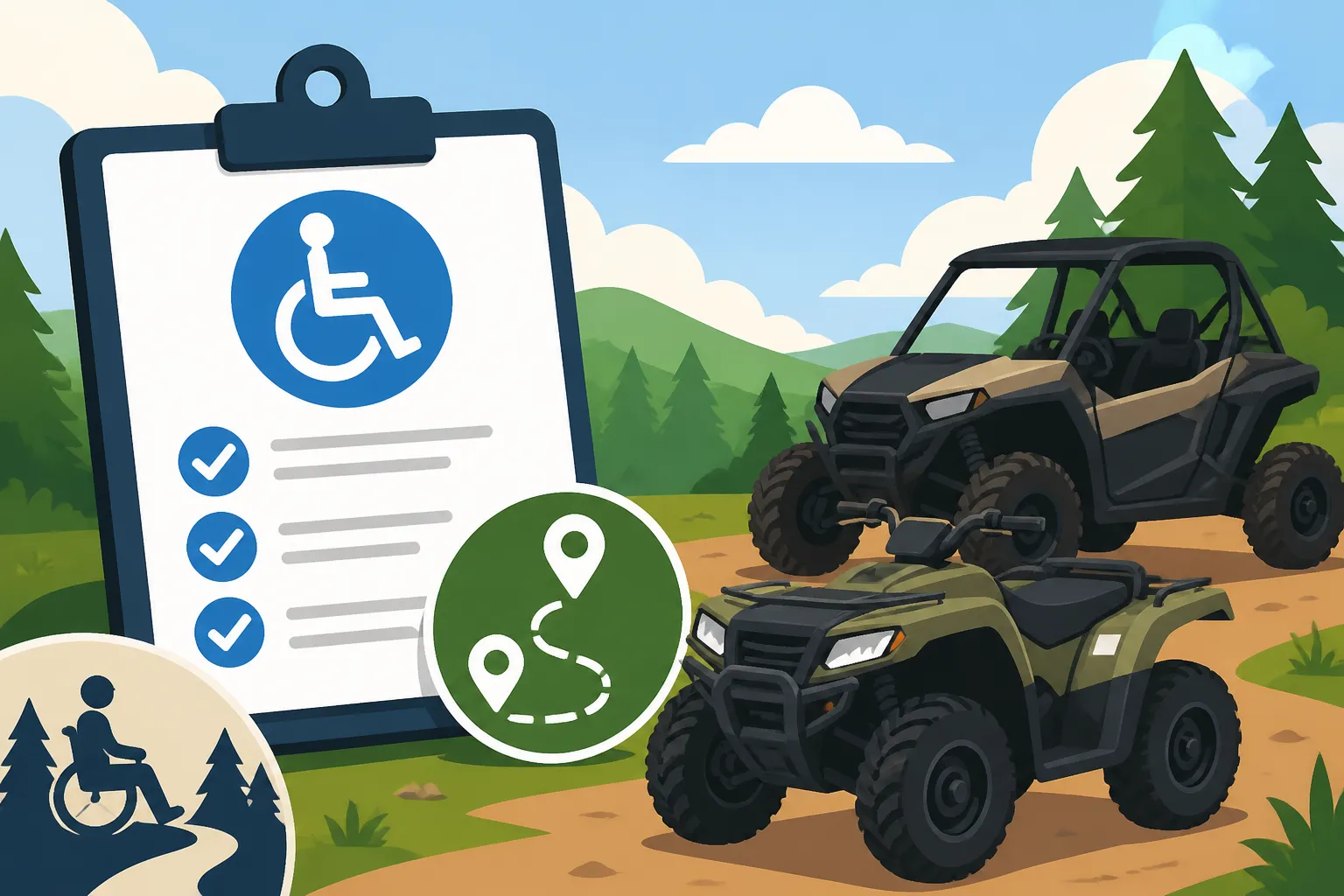
A useful pre-application checklist is:
| What to confirm | Why it matters |
|---|---|
| Which agency manages the land | Each agency may have its own rules and application process |
| The exact route or destination | Approval may be limited to specific roads or locations |
| Eligible vehicle types | An ATV or UTV may not be treated like a highway vehicle |
| Required application information | The agency can explain what documentation it needs |
| Other riding obligations | Registration, insurance, and trail permits may still apply |
| Route conditions and closures | A permit does not guarantee a route is open on your visit |
Keep a copy of the application, the agency’s response, and any issued permit together. If approval includes restrictions, such as a named route or limits on when you may travel, keep those details accessible during the trip. For other state forest recreation options and their separate rules, see [Pennsylvania’s Free State Forest Trails].
Planning the ride after approval
Confirm the route, boundaries, and current conditions
Once you have approval, make sure you understand exactly where it applies. Ask the issuing agency to identify the permitted route in a way you can follow in the field. A road name may be unclear, a gate may look like the route entrance, or a connecting road may cross onto land managed by a different agency.
Use official maps and instructions as your primary reference. A navigation app can help you understand the surrounding roads, but a mapped line is not proof that motorized travel is allowed. For example, onX Offroad can be useful for organizing a route plan and reviewing the area, but it should not replace written permit conditions or agency confirmation. Before leaving, compare your plan with the relevant official information, including Pennsylvania Trail Maps From DCNR.
Conditions can change after a permit is issued. A road may be temporarily closed for maintenance, weather, resource protection, or another management reason. Call or check with the land manager before traveling, especially if you are making a long drive to reach a remote trailhead. If a gate is closed or a sign conflicts with what you expected, stop and contact the agency rather than riding around the barrier.
Make the trip workable for the rider and companions
Plan the outing around the permitted access, not around an assumption that you can explore adjoining trails once you arrive. A route that reaches a viewpoint or recreation site may not connect to open ATV trails. Ask where you may park, whether a support vehicle can accompany you, and whether passengers or caregivers are allowed under the permit conditions.
Think through practical needs as well. Consider how far the rider must travel from the parking area to the vehicle, where companions can wait, whether the route has steep grades or rough surfaces, and what communication options are available. A scenic road can still have uneven gravel, narrow shoulders, loose stone, or limited places to turn around. If the rider needs assistance transferring or managing equipment, plan that before reaching a remote location.
A mapping tool such as onX Offroad may help you mark a staging area and keep your planned route organized, but route-planning software cannot determine whether a road is legally open under your permit. Keep the permit and the land manager’s directions available offline, since cell service can be unreliable in forested or mountainous parts of Pennsylvania. If your trip includes standard ATV trails, check whether a safety certificate or age-related rule applies; Pennsylvania ATV Safety Certificates covers those requirements.
Common mistakes and a practical pre-trip check
Avoid treating one approval as permission for the whole area
One of the easiest mistakes is assuming that a permit for a particular access route also allows riding on nearby trails. It may not. An approved road can end at a destination where the surrounding trails remain closed to motor vehicles, or where another permit is required. Confirm the permitted endpoint and whether you must return by the same route.
Another mistake is relying on a friend’s experience. A neighbor may have used a route under a different permit, during a different season, or in a different vehicle. Their experience can be a helpful lead, but the land manager’s current instructions should determine your plan. This is especially important when boundaries, gates, or road names are confusing.
Finally, do not treat an app, an old map, or a visible tire track as authorization. onX Offroad and similar mapping tools can support navigation and trip planning, but they cannot grant access or override a closure. Verify uncertain routes directly with the agency.
Use this checklist before you leave home
A short confirmation call can prevent a frustrating trip. Before loading the ATV or UTV, check that your permit is approved and that you understand its limits. Confirm the correct entrance, the authorized route, any seasonal restrictions, and whether the road is currently open.
Then check the machine and paperwork. Bring the permit and any required registration or insurance proof. Make sure the vehicle matches what the agency approved, and confirm that any passenger, trailer, or support vehicle arrangements are allowed. If you plan to ride beyond the access route, verify the rules for that separate trail or property instead of assuming the access permit covers it.
A practical final checklist:
- Confirm the land manager and the exact approved route.
- Read the permit conditions and keep a copy with you.
- Ask about closures, gates, weather impacts, and current road conditions.
- Verify that your ATV or UTV is an eligible vehicle for the route.
- Check registration, insurance, age, and trail-permit requirements that may still apply.
- Plan parking, companion access, communication, and a safe turnaround.
- Stop if signs, gates, or conditions do not match the agency’s directions.
The most useful next step is to contact the office responsible for the specific property and explain the route and vehicle you have in mind. A clear answer from the land manager is far more dependable than trying to infer access from a map or from what another rider has done.
Disclaimer
This article is for general informational purposes only and does not constitute professional advice. Laws, prices and regulations vary by location and change over time. Consult a qualified professional for guidance on your specific situation.