Why a Handshake Is Not Enough on Private Land
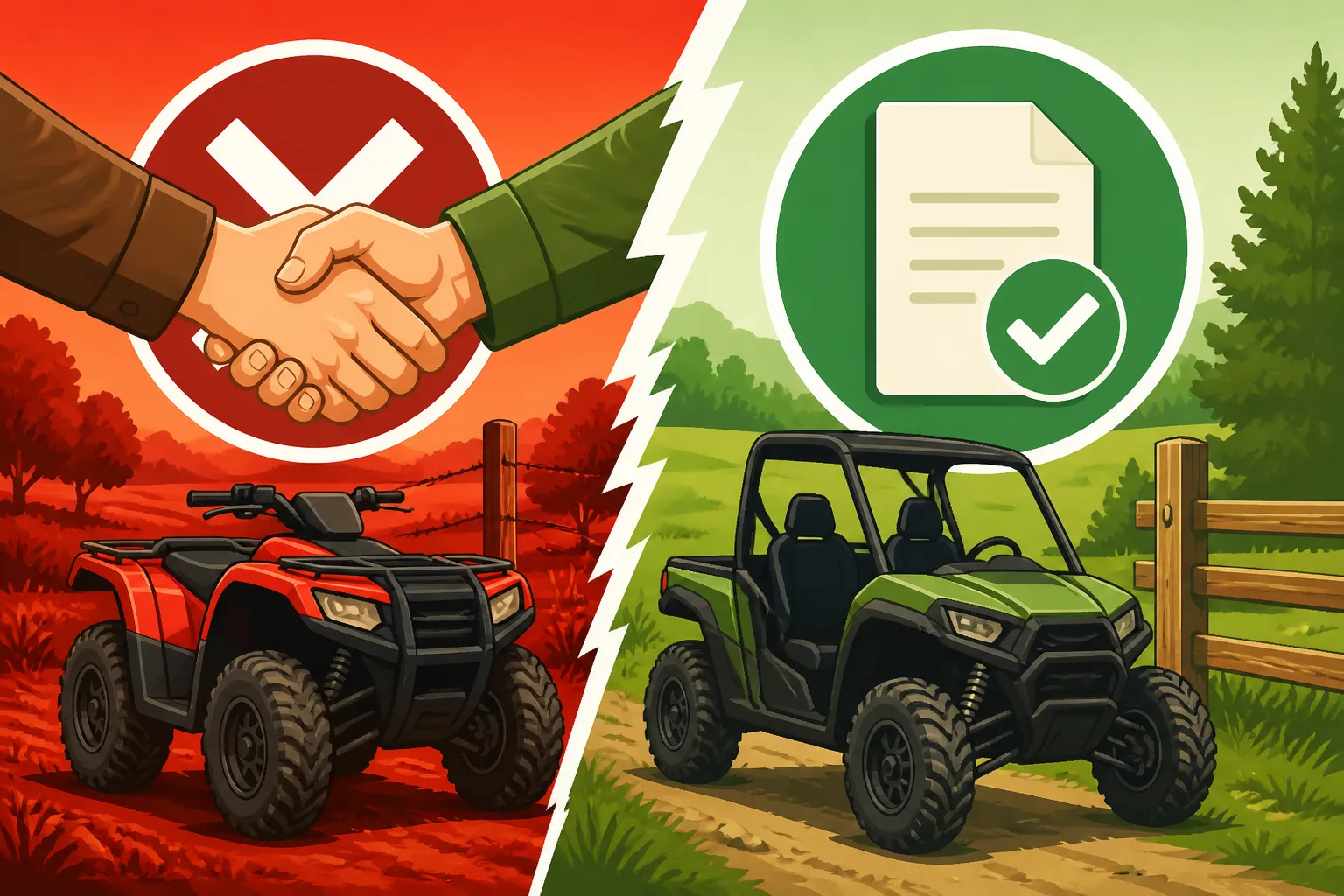
A landowner’s verbal okay can feel clear when you’re standing at the gate, but it may be hard to rely on later. On private land in Pennsylvania, a misunderstanding about boundaries, dates, routes, or who gave permission can turn a friendly arrangement into a dispute. A short written agreement helps everyone remember the same terms—and gives you something to show if your access is questioned.
What a handshake can and cannot establish
A landowner may give permission in a conversation, and a handshake can reflect a genuine agreement. The practical problem is proof. If a neighbor, caretaker, club member, or officer later asks why you are riding there, you may have no reliable way to show who authorized the ride or what they allowed.
Memory is not a dependable record, especially when the conversation was brief or happened months earlier. One person may remember permission to cross a field; the other may remember permission to use a trail. A rider may think the okay covers the whole property, while the owner meant one route, one weekend, or one machine.
Written permission helps pin down the details. It can show:
- Who gave permission and the property or area involved
- Which riders and machines are covered
- Where you may ride and where you may not
- When access starts and ends
- Whether guests, passengers, or a group ride are allowed
- What conditions apply, such as gates, speed, parking, or seasonal closures
That record does not make every ride lawful, and it does not replace other requirements. A landowner cannot use a note to waive rules that apply to the rider or property. You may still need proper registration, insurance, a trail permit, or authorization from another agency, depending on where and how you ride. For the basic distinction between landowner access and other obligations, see Pennsylvania Rules for Riding Private Property and Pennsylvania Landowner Permission Requirements.
A useful way to think about it is that permission answers one question: “Has someone with authority agreed to let me use this land, and on what terms?” It does not automatically answer whether your machine is registered, whether a public-land permit is needed, or whether a particular route is open to ATVs and UTVs.
| Situation | Why a verbal okay can be unclear | What to record in writing |
|---|---|---|
| Riding a neighbor’s property | The permitted area may be understood differently | A map, boundary description, or named route |
| Crossing land to reach another trail | The owner may allow access only to a specific crossing | Entry point, exit point, and travel direction |
| Riding with friends | Permission may have been given only to the person who asked | Names or number of riders, plus whether guests are allowed |
| Returning on a later date | The original permission may have been for one occasion | Dates, time period, or how to request each ride |
| Using a club trail on leased land | The club may not control every parcel or every condition | Who authorized access and which property is included |
A written record is not a substitute for asking clearly. If the owner says “sure, you can ride,” follow up with a specific question: Which part of the property? On what dates? Can other people come? Is the permission for an ATV, a UTV, or both? A clear answer is more useful than a broad yes that each person interprets differently.
Get permission from someone who can grant it
A signed note is only helpful if it comes from someone authorized to allow access. The person who lives at a property, maintains a gate, or happens to be nearby may not own the land or control its use. Likewise, a club member’s approval may not cover land the club leases or uses under a separate agreement.
Before riding, establish who has authority to grant permission for the specific parcel. Depending on the situation, that may be the owner, an authorized manager, or an organization with permission to control access. If the person you speak with is acting for someone else, ask them to confirm that they can approve ATV or UTV use.
Pay particular attention when land has several owners, a tenant, a caretaker, or a club arrangement. One person may approve access to one area but not another. A landowner may also have granted someone else specific use of a lane, field, or trail. If the answer is uncertain, pause and verify rather than treating the uncertainty as permission.
For club property, ask what the club’s authorization actually covers. Membership, a sticker, or an invitation from a member does not necessarily establish access to every parcel along a route. Some club trails run across leased or privately owned land, and the access terms can depend on the agreement between the club and the landowner. Club Trails on Leased Ground and How a Club Membership Opens Private Trails explain why it is worth checking who controls the route.
Make the permission specific
A simple written agreement does not need to read like a contract drafted for a major project. It does need to identify the arrangement well enough that the owner and riders can understand it later. Include:
- The landowner or authorized contact. Record the person’s name and a way to reach them.
- The property or permitted area. Use a property address, parcel description, marked map, or clear route description. Do not assume that permission for one area includes adjoining land.
- The riders and machines. List the riders or state whether named guests may join. Identify whether the permission covers an ATV, UTV, or both.
- The dates or duration. State whether access is for one ride, a defined period, or subject to renewed approval.
- The route and limits. Note entry and exit points, trails, roads, parking areas, and any no-go zones.
- The conditions. Include the owner’s requirements, such as closing gates, staying out of crops, avoiding wet ground, or respecting quiet hours.
- Confirmation. Have both sides acknowledge the terms, and keep a copy where riders can access it.
A text message or email can be better than relying only on memory if it clearly identifies the people, location, and terms. A signed note or map can be easier to understand when boundaries are involved. Whatever form you use, make sure the owner agrees to the exact wording; don’t turn a casual response into a broader permission than the person intended.
If the owner gives permission by phone, send a short message afterward summarizing what you understood and ask them to correct anything that is wrong. For example: “Thanks for letting us ride the marked lane on Saturday. We’ll stay on the lane, use the east entrance, and keep the gate closed.” A confirmation is not a replacement for consent, but it can catch misunderstandings before the ride.
Carry the permission or keep it accessible on your phone. A printed copy can be useful where cell service is poor, and a photo of a signed map can help show the route. Make sure everyone in the group knows the conditions; permission held by the person who arranged the ride may not be enough to resolve questions for guests who were never included in the agreement.
Define the route, boundaries, and conditions
“Ride on my land” may sound straightforward, but property lines can be difficult to see on the ground. A path that looks like a continuation of the landowner’s trail might cross another owner’s parcel, a public road, a protected area, or land where access has not been granted. A written description should make the approved area understandable without relying on assumptions.
A map is often the clearest tool. Mark the allowed route and entry point, then identify boundaries and places to avoid. If there is no useful map, describe landmarks carefully: a named lane, a field edge, a specific gate, or the point where the trail ends. Avoid vague directions such as “the back woods” when the property is large or shares boundaries with other land.
Clarify whether you may ride on existing trails only or create or alter a route. Permission to ride does not necessarily imply permission to cut brush, move barriers, dig, cross a stream, or use a different access point. Ask before doing anything that changes the property or could affect drainage, crops, fences, livestock, or other users.
Agree on practical conditions before arriving
A landowner may have conditions that are not obvious to a visitor. Ask about:
- Gates and barriers: Which entrance may be used, and should gates be left open or closed?
- Parking and unloading: Where can a truck and trailer be left without blocking access?
- Speed and noise: Are there limits or areas where engines should be shut off?
- Ground conditions: Should riders stay off muddy sections, fields, or areas that are soft after rain?
- Other people and activities: Are hunters, workers, hikers, or other riders likely to be on the property?
- Guests: Does permission cover only the person who asked, or can a named group come?
- Changes in access: Should riders check in before each visit, or does the owner expect notice if plans change?
These details are not merely formalities. A UTV may be wider or heavier than the machine the owner pictured when granting permission. A group can create more noise and traffic than a solo rider. If the permitted route has a narrow gate, bridge, or soft section, the machine type and conditions matter.
Do not assume that a trail shown on a map or used in the past is still open. A property owner can change access terms, and land may be sold, leased, posted, or closed. Ask again if the arrangement is old, if the route has changed, or if a new person is managing the property. When permission is withdrawn or its terms change, stop using the affected area and clarify the new limits.
Written permission can also help riders avoid accidental trespass. It is not a defense for knowingly riding beyond the approved boundary or ignoring a clear restriction. If there is a dispute over a boundary, stop and resolve it with the owner before continuing. See Pennsylvania Trespass Rules for Riders for more on why permission and boundaries matter.
Keep private-land permission separate from permits and safety requirements
Private-land access and public trail access are different issues. A landowner’s permission generally concerns that landowner’s property; it does not automatically authorize riding on a neighboring parcel, a state forest trail, a game lands road, or a public road. Nor does it automatically replace registration, insurance, safety, or equipment requirements that apply to the rider or machine.
Before the ride, identify every part of the route. A trip that begins on private land might cross a road, use a trail managed by a club, or enter public land. Each segment may have different access rules. For example, permission to use a private connector does not by itself grant access to a state forest trail that requires a separate permit. Check Pennsylvania ATV Trail Permits Explained if your route includes public trails, and Pennsylvania ATV Reciprocity With Other States if you are visiting with a machine registered elsewhere.
Do not treat “private property” as a blanket exception from all riding requirements. Requirements can depend on the machine, location, activity, and circumstances. Confirm the rules that apply to your ride rather than assuming the owner’s approval covers them. If you are unsure whether a route is private, public, or managed under a separate agreement, verify that before unloading.
A practical pre-ride check can prevent most avoidable problems:
- Confirm the person granting permission has authority over the exact property.
- Make sure every rider and machine is included.
- Review the approved route and mark the boundaries.
- Check that the dates and any check-in requirements are current.
- Confirm how to handle gates, parking, guests, and changes in conditions.
- Identify any public roads or public-land sections along the route.
- Check registration, insurance, permit, and safety requirements separately.
- Carry the written permission and make sure the group understands it.
- Stop and contact the owner if the route is blocked, the boundary is unclear, or conditions differ from what was agreed.
A short written record makes access easier to manage for both sides. It lets the owner set limits, helps riders stay within them, and gives the group a shared reference if questions come up. The key is not simply having a signature; it is obtaining clear permission from the right person, for the right land, with terms everyone understands.
Disclaimer
This article is for general informational purposes only and does not constitute professional advice. Laws, prices and regulations vary by location and change over time. Consult a qualified professional for guidance on your specific situation.