Written Permission From a Landowner
Getting a landowner’s okay can be the difference between a welcome ride and a trespass dispute. In Pennsylvania, permission matters, but a verbal yes can be hard to explain later if plans or boundaries are misunderstood. Written permission creates a clear record of what was agreed to. It does not replace registration, insurance, or rules that apply to the route.
What permission from a landowner does and does not cover
The Pennsylvania Department of Conservation and Natural Resources says ATVs may be operated on private property with the owner’s consent. Its guidance does not say that consent must be written. A written note is best understood as practical proof of permission, rather than a separate registration document or permit.
That distinction matters. Permission from a landowner can authorize riding on the private property that person controls, within the agreed limits. It does not automatically authorize riding across neighboring land, using a public road, entering a state forest, or riding on a club trail. Each place has its own access rules. For background, see Pennsylvania Rules for Riding Private Land and Pennsylvania Landowner Permission Rules.
It is also important to distinguish permission from ownership or a lease. The Pennsylvania Department of Conservation and Natural Resources requires liability insurance when riding an ATV on property the rider does not own or lease, and says riders must carry proof of that insurance while riding. Permission to use someone else’s land does not make the land yours or mean you lease it. Don’t treat an owner’s written okay as a substitute for insurance.
Permission does not replace registration either. The Pennsylvania Department of Conservation and Natural Resources says Pennsylvania ATVs generally must be registered and titled with the department, with an exception for vehicles used solely for business or agricultural purposes. Its Limited Registration is for use on the owner’s property; General Registration allows use off private property. If you are unsure which registration fits your riding, see Pennsylvania’s Limited and General Registrations and Pennsylvania ATV Registration and Insurance Proof.
| Situation | What the permission may establish | What it does not establish |
|---|---|---|
| Riding on private land | The owner has agreed to your use of the property, subject to the agreed boundaries and conditions | Permission to use adjoining land or public routes |
| Riding somewhere other than property you own or lease | The owner’s consent to enter and ride there | An exemption from the insurance requirement |
| Riding on a designated state trail | Nothing, unless the relevant access rules separately allow it | Permission to ride outside designated trails or on closed land |
| Riding on a public road | Nothing unless the road is legally open to ATV use and you meet applicable rules | A right to use a road just because it crosses or borders private land |
When an owner says yes, clarify the property and route covered. A landowner may allow access to a field but not a wooded area, or allow a direct route to a staging area but not open-ended riding. The safest approach is to treat permission as specific to the land, riders, machines, and activities discussed—not as a general invitation to explore.
For more on why a written record can prevent confusion, see Why a Handshake Is Not Enough on Private Land. If you are asking for access, Asking a Landowner for Permission can help you make a clear, respectful request.
How to make written permission useful
A useful permission note answers ordinary questions before they become a problem: who may ride, where they may ride, when access is allowed, and what conditions apply. There is no need to make it sound like a complex legal document. Clear, specific wording is more helpful than broad language that leaves everyone guessing.
Include the following details where they are relevant:
- The owner’s name and a way to contact them. This helps show who gave permission and gives riders a way to check details if plans change.
- The rider’s name and any other approved riders. Don’t assume permission for one person automatically covers a group.
- A description of the property or allowed route. Use a property name, recognizable boundaries, or a marked map if that makes the area easier to identify. Avoid relying only on a vague phrase such as “the back lot.”
- The permitted activity. State whether the permission covers ATV riding, access to a trail on the property, parking, unloading, or other specific uses.
- The dates or conditions of access. The owner may set a time window, ask riders to check in before each visit, or limit access to certain conditions.
- Any limits the owner wants followed. These might include staying on a marked route, avoiding a field or work area, closing gates, not bringing guests, or leaving promptly if asked.
- The date permission was given. This helps distinguish current permission from an old note that may no longer apply.
- A way to confirm the agreement. A signed note, email, or text can serve as a written record. Keep the original message or a readable copy.
These details are a practical checklist, not a claim that Pennsylvania requires every item. The key is to avoid a mismatch between what the owner intended and what the rider believes was allowed. If a route or boundary is unclear, ask before riding rather than treating uncertainty as permission.
For example, “You may ride on my property” may be too broad if the owner means only a particular trail. A clearer agreement could identify the approved route and explain that riding outside it is not included. If the owner’s permission depends on checking in, having a spotter, or avoiding certain areas, write that down too.
A map can help when the property is large or has several access points. Mark only the route the owner has approved, and don’t assume a line on a map gives permission to cross someone else’s parcel. If the map is sent separately, save it with the message or note that records the permission.
Keep the record accessible while riding. A printed copy in a protective sleeve or a saved message on a phone can be useful, but a phone may lose battery or signal. A waterproof document pouch from a general retailer such as Amazon may help protect a paper copy; the important part is keeping the permission legible and available, not the particular product.
If the owner changes the conditions, asks you to stop, or withdraws permission, follow that direction. A note is evidence of what was agreed at the time; it is not a permanent right to use the land.
Check the other rules before you ride
Written permission answers only the private-property access question. It does not decide whether your ATV is properly registered, whether insurance is required, whether riders meet age and training rules, or whether a route is open to ATVs.
The Pennsylvania Department of Conservation and Natural Resources says liability insurance is required when riding on property not owned or leased by the rider, and proof must be carried at all times while riding. The department does not establish minimum coverage standards for ATV liability insurance. Confirm that your policy covers ATV use and that you can show proof of coverage before setting out. More detail is available in Pennsylvania ATV Registration and Insurance Proof.
Registration also depends on how and where you ride. According to the Pennsylvania Department of Conservation and Natural Resources, Limited Registration is for use on the registrant’s property, while General Registration allows use off private property. A landowner’s permission does not turn someone else’s property into the registrant’s property. If you are relying on Limited Registration, confirm that it fits the intended use rather than assuming permission changes the registration category.
The location of the ride matters too. The Pennsylvania Department of Conservation and Natural Resources says ATVs on state-owned property may be operated only on clearly marked and designated trails. A landowner’s note cannot authorize riding on state land, a closed trail, or a route that is not designated for ATVs. See Pennsylvania ATV Registration and Trail Access for the difference between registration and trail access.
If a private route meets a public road, don’t assume the permission note covers road riding or crossing. Pennsylvania has separate rules for roads open to ATV use, and road access depends on the road’s designation and the rider meeting applicable requirements. A private owner cannot grant permission on behalf of a township or other road authority. See Pennsylvania Rules for Riding a Township Road and Pennsylvania Rules for Crossing a State Route before planning a route that touches public roads.
Riders also need to account for safety requirements. The Pennsylvania Department of Conservation and Natural Resources says operators must wear a securely fastened helmet and eye protection. It also says children ages 8 to 15 must complete an ATV safety course and obtain a certificate to ride on land that does not belong to their parents or guardians. If a young rider will be on the property, check the relevant training, supervision, and machine-size rules before the ride.
A practical process for getting permission
A short conversation followed by a written confirmation is often the simplest way to prevent a misunderstanding. Use this process before bringing a machine onto private land:
- Identify the person who can grant access. Ask the landowner or the person clearly authorized to manage access. If you are not sure who has authority, pause and clarify rather than relying on a neighbor’s assumption.
- Explain your plan. Say who will ride, what type of machine you will bring, where you hope to ride, and when you expect to use the property.
- Ask about boundaries and restrictions. Confirm the allowed route, any areas to avoid, parking or unloading arrangements, and any conditions the owner wants followed.
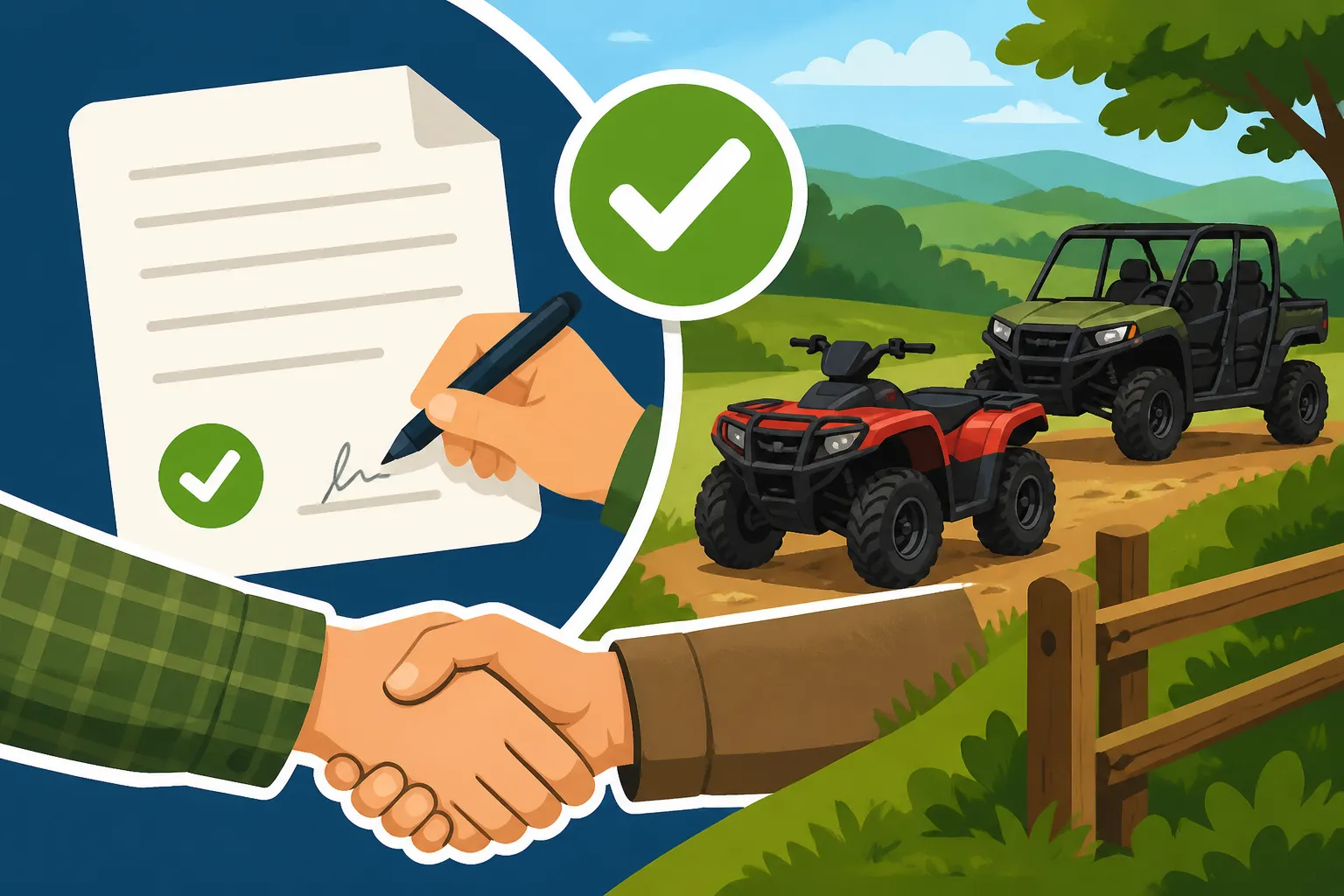
- Put the agreement in writing. A signed note, email, or text can capture the permission and its limits. Make sure the wording matches what the owner actually agreed to.
- Keep a copy with you. Save it somewhere you can access during the ride, and keep a backup if practical.
- Check registration, insurance, and route rules separately. Confirm that the machine and rider meet the rules that apply to the trip; the permission record does not replace those checks.
- Respect changes and stop when asked. If the owner’s instructions change or permission is withdrawn, leave the property as directed.
A useful request is direct and easy to answer: identify the land you mean, describe the planned route and timing, and ask the owner to confirm any conditions. If access is for several riders, name them or ask whether guests are included. Avoid pressuring someone to agree, and accept a no without trying to treat silence as consent.
Before each ride, compare your plan with the permission you have. If the owner approved one route but you want to explore another, ask again. If a gate is closed, a route is marked off, or the owner’s instructions are unclear, stop and check rather than assuming the written note grants broader access.
Sources
- Pennsylvania Department of Conservation and Natural Resources — Home Page – Snowmobile/ATV Registration (checked November 3, 2026)
- Pennsylvania Department of Conservation and Natural Resources — Trail Conditions – Snowmobile/ATV Registration (checked November 3, 2026)
Disclaimer
This article is for general informational purposes only and does not constitute professional advice. Laws, prices and regulations vary by location and change over time. Consult a qualified professional for guidance on your specific situation.