Pennsylvania Reciprocity With West Virginia
A West Virginia ATV registration can make a Pennsylvania ride possible, but it does not give you automatic access to every trail or road. The important questions are whether Pennsylvania recognizes your registration, what permits the riding area requires, and whether your machine meets the rules where you plan to ride. Here’s how to check those details before you cross the state line.
Does Pennsylvania Recognize a West Virginia ATV Registration?
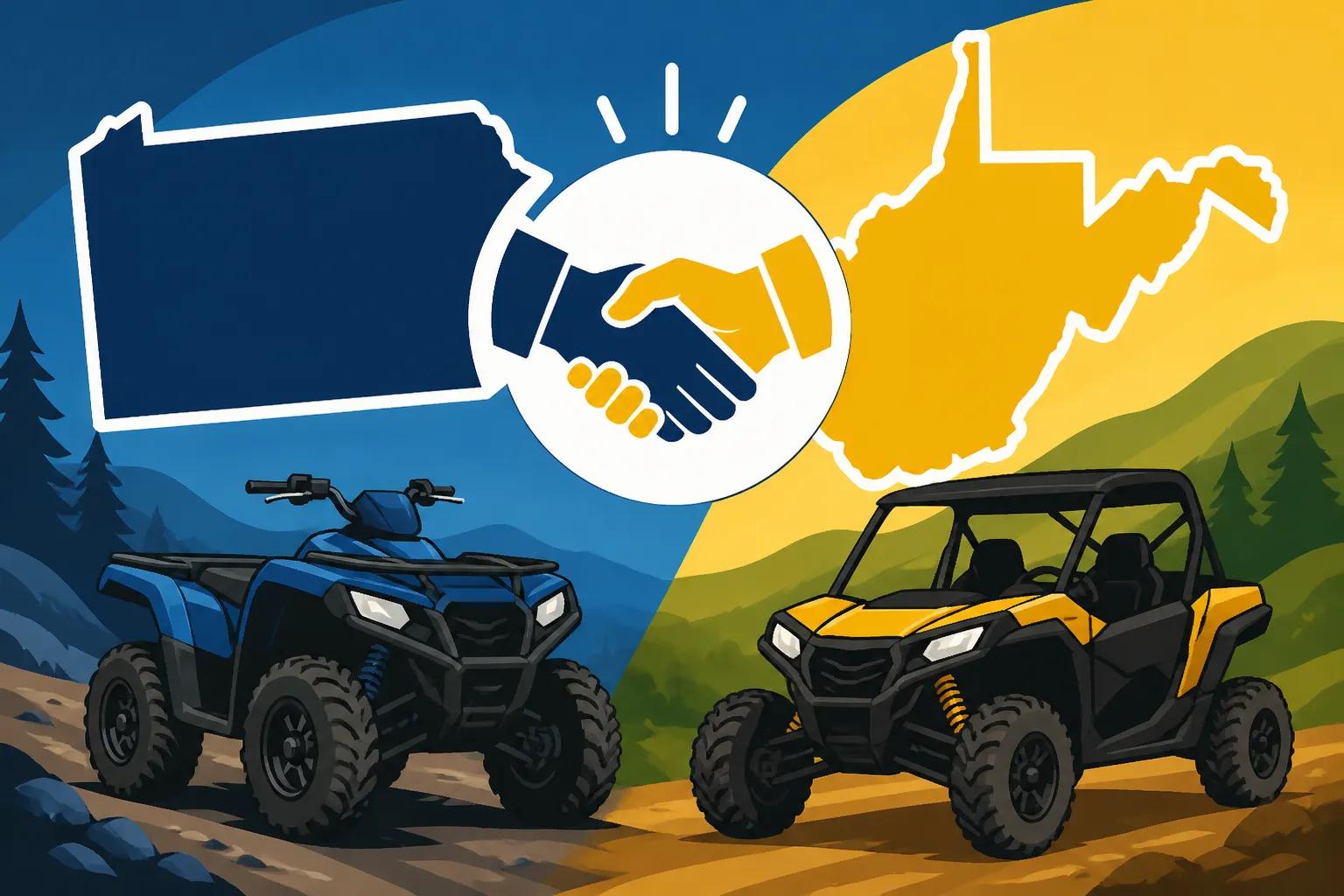
Pennsylvania’s reciprocity rule can allow a machine registered in West Virginia to be operated in Pennsylvania, provided the registration is valid and the reciprocal conditions are met. Reciprocity is about recognizing another state’s registration; it is not a general exemption from Pennsylvania’s riding rules.
Before your trip, confirm that your West Virginia registration is current and applies to the machine you are bringing. Carry the registration document or other proof issued for that machine. A plate, sticker, bill of sale, or insurance card is not necessarily a substitute for registration proof.
Reciprocity also works in the other direction only if the other state recognizes Pennsylvania registrations under its own rules. Do not assume that a Pennsylvania registration automatically covers a Pennsylvania rider in West Virginia. Check West Virginia’s current requirements for the machine, the riding location, and any required proof.
The practical distinction is simple: Pennsylvania may recognize a properly registered West Virginia machine, but the recognition does not turn the machine into a Pennsylvania-registered ATV or waive location-specific requirements. For more background on the rule, see Pennsylvania ATV Reciprocity With Other States and Does Pennsylvania Honor an Out-of-State Registration?.
| What you have or want to do | What reciprocity may cover | What it does not automatically cover |
|---|---|---|
| A current West Virginia registration | Recognition of the machine’s registration in Pennsylvania, if the reciprocal conditions are satisfied | A Pennsylvania trail permit, forest permit, or permission to use private land |
| A trip on a Pennsylvania trail | The registration requirement may be met through recognized out-of-state registration | Trail eligibility, seasonal access, machine-size limits, or local trail rules |
| Riding a road open to ATVs | The machine may meet a registration requirement | Permission to use a road that is not designated or posted open to ATVs |
| Riding back in West Virginia | Pennsylvania registration may be relevant if West Virginia recognizes it | Compliance with West Virginia’s riding rules and access requirements |
Reciprocity is not the same as a blanket visitor pass. It answers a narrow question about registration. The trail, road, forest, or private land you enter can impose additional requirements.
Registration Is Not the Same as a Trail Permit
A common trip-planning mistake is to treat registration as permission to ride anywhere. Registration identifies the machine for legal use under the applicable registration system. A permit, where required, grants access to a particular trail system or land-management area. Those are separate issues.
Pennsylvania has riding areas with different access arrangements. Some designated state forest trails require a separate permit, and the Allegheny National Forest has its own permit requirements. A West Virginia registration does not replace those permits. Check the rules for the exact riding area, rather than relying on a general statement that Pennsylvania recognizes your registration.
The same principle applies to private club trails and privately managed parks. A recognized registration does not buy a club membership, park admission, or landowner permission. Ask the operator what documents and equipment are required, and whether a visitor can ride with an out-of-state-registered machine.
If you are planning to use Pennsylvania state forest trails, start with Pennsylvania’s Northcentral Regional Trail Permit and Pennsylvania’s Allegheny National Forest Permit. For a broader comparison of registration, permits, and access, see Pennsylvania ATV Trail Permits Explained.
Before loading the machine, confirm these points for your destination:
- Registration: Is your West Virginia registration valid for the machine, and can you carry proof of it?
- Permit: Does this particular trail system require a permit in addition to registration?
- Machine limits: Is the ATV or UTV within the location’s size, width, and equipment limits?
- Dates and conditions: Is the route open on the day you plan to ride?
- Land access: Is the route public, or do you need permission from a club or landowner?
These checks matter especially for UTVs and side-by-sides. A machine can be registered and still be too wide or otherwise ineligible for a particular trail. Check the trail system’s rules directly, including any limits that apply to passengers, age, safety gear, or vehicle dimensions.
Road Use Is a Separate Question
Registration reciprocity does not make an ATV or UTV street legal in Pennsylvania. Pennsylvania road use is limited to roads specifically designated or opened for ATV use, along with narrow situations such as authorized crossings. A road that looks suitable, connects two trail sections, or is open to ordinary traffic is not automatically open to ATVs.
This matters on cross-border trips because a machine that is allowed on a road in one state may face different rules just across the state line. Follow Pennsylvania’s rules while riding in Pennsylvania, including posted restrictions and any requirements that apply to the road or route. Do not use an ordinary public road to reach a trailhead unless the route is legally open to ATVs.
For details on designated routes, see Pennsylvania’s Designated ATV Roads and Pennsylvania Joint-Use Road Rules. If your plan includes a short road section, verify that the specific road is open to ATV traffic instead of relying on a map route or a rider’s informal directions.
Registration, insurance, age rules, helmet rules, and road access can each be governed by separate requirements. Carrying a valid West Virginia registration does not, by itself, establish that you have met every Pennsylvania requirement. Review Pennsylvania ATV Registration and Insurance Proof and the rules for the place you intend to ride.
A Before-You-Go Checklist for West Virginia Riders
A little preparation can prevent a wasted drive or a citation. Start with the destination, not just the state line: identify each trail, road, or property you intend to use, then verify its rules and current access status.
Carry clear proof of registration
Keep the registration document with the machine or with the person operating it, in a condition that is easy to show. If the registration is electronic or you normally keep it on a phone, consider whether you can still access it without cell service. A printed copy can be useful as a backup, but confirm that it is acceptable proof under the applicable rules.
Make sure the registration information matches the machine. If the VIN is difficult to read or the document has an error, resolve the issue before travel rather than expecting a trail official to sort it out.
Check permits and opening status
Confirm whether the trail system requires a permit and whether your machine and registration qualify. Also check closures, seasonal dates, and temporary notices. A trail may be closed because of maintenance, weather, hunting-season restrictions, or other land-management decisions, even when the underlying registration is valid.
Do not assume that a permit for one Pennsylvania riding area works at another. A permit is generally tied to the area or program that issues it. Verify the details with the responsible trail operator or agency before you leave.
Confirm the rules for your machine and riders
Check any limits that apply to vehicle width, passenger capacity, rider age, safety equipment, and insurance. These rules can vary by riding location and activity. If you are taking a child, a passenger, or a UTV, check those requirements specifically rather than assuming the rules for a solo ATV rider apply.
For minors, see Pennsylvania Safety Certificates for Ages 8 to 15. For insurance questions, review Pennsylvania ATV Insurance Requirement. Also ask a private park or club whether it has additional requirements beyond state law.
Keep the route within authorized areas
Use current information from the trail operator or land manager, and follow signs at the site. Do not ride around a gate, onto an unsigned road, or beyond a marked trail because another route appears to connect. Permission for one trail does not authorize travel across nearby land.
If you cannot confirm that a road or trail is open, choose a known authorized route or contact the organization responsible for it. That is safer than treating another rider’s account, an old map, or a navigation app as proof of legal access.
West Virginia registration can be useful for a Pennsylvania visit, but it is only one part of the plan. Confirm reciprocity, carry registration proof, obtain any required area permit, and follow Pennsylvania’s access and operating rules wherever you ride.
Disclaimer
This article is for general informational purposes only and does not constitute professional advice. Laws, prices and regulations vary by location and change over time. Consult a qualified professional for guidance on your specific situation.