Who Votes to Open a Road
It's a familiar scenario for many ATV and UTV riders across Pennsylvania: you're looking at a map, seeing all these perfectly rideable roads, perhaps even gravel or dirt, and wondering why on earth you can't just take your machine from your property to a trailhead, or connect two existing trail systems. The frustration of limited road access is a huge hurdle for many, but understanding who actually holds the power to open these roads and how that process works can be the first step toward advocating for more riding opportunities. This guide will walk you through the specifics of how Pennsylvania's local roads get opened to ATV use and who makes those crucial decisions.
The Frustration of Limited Road Access for ATVs in Pennsylvania
There's a definite ache in the heart of many an ATV enthusiast when they see a perfectly good stretch of road – maybe a quiet, gravel township road that sees little traffic – and know it's off-limits to their quad or side-by-side. You've got your machine registered, you've got your [Pennsylvania ATV Safety Certificates], and you're ready to explore, but often, the biggest barrier isn't the terrain, but the asphalt that stands between you and it.
Why Most Roads Stay Closed by Default
In Pennsylvania, the default stance for most roads, especially those under municipal or state jurisdiction, is that ATVs are not permitted for travel. It’s not an arbitrary rule designed to annoy riders; it stems from a mix of historical regulations, safety concerns, and local community considerations. For decades, ATVs were seen purely as off-road recreational vehicles, and the infrastructure was never designed to integrate them safely with traditional vehicle traffic. There are concerns about noise, dust, and the potential for increased traffic or accidents. Local residents often express worries about their peaceful rural roads becoming thoroughfares for recreational vehicles, impacting their quality of life. Townships and boroughs are typically risk-averse, and the effort to open a road often comes with perceived liabilities and maintenance burdens that they are hesitant to take on without significant community push.
The Desire for Connector Routes and Local Access
Despite the default closures, the desire for expanded road access is strong, and for good reason. Riders aren't necessarily looking to commute to work on their ATVs, but rather to bridge gaps. Imagine being able to ride a short mile or two down a quiet township road to get from your camp to a designated trail, or to connect two separate trail systems that are just a stone's throw apart. These "connector routes" could drastically improve the riding experience, allowing for longer loops and more diverse terrain without having to load up the trailer every time. Accessing local amenities like gas stations, restaurants, or small-town shops is another significant driver. These small businesses often stand to benefit greatly from the economic boost that ATV tourism can bring, something we see in communities near successful trail systems like those in the Sproul State Forest trails or the [Anthracite Outdoor Adventure Area in Pennsylvania]. Companies like SuperATV, who produce aftermarket parts and accessories, understand this need for riders to get to and from their adventure spots safely and efficiently, often showcasing their products in scenarios where riders are looking for improved access.
Understanding Local Governance: Who Holds the Power?
When it comes to opening roads for ATV use in Pennsylvania, the power is highly localized. You won't find a statewide mandate dictating which roads are open, with the exception of specific DCNR-managed forest roads. For the vast majority of local roads, the decision rests with the folks right in your community.
Township Supervisors and Borough Councils
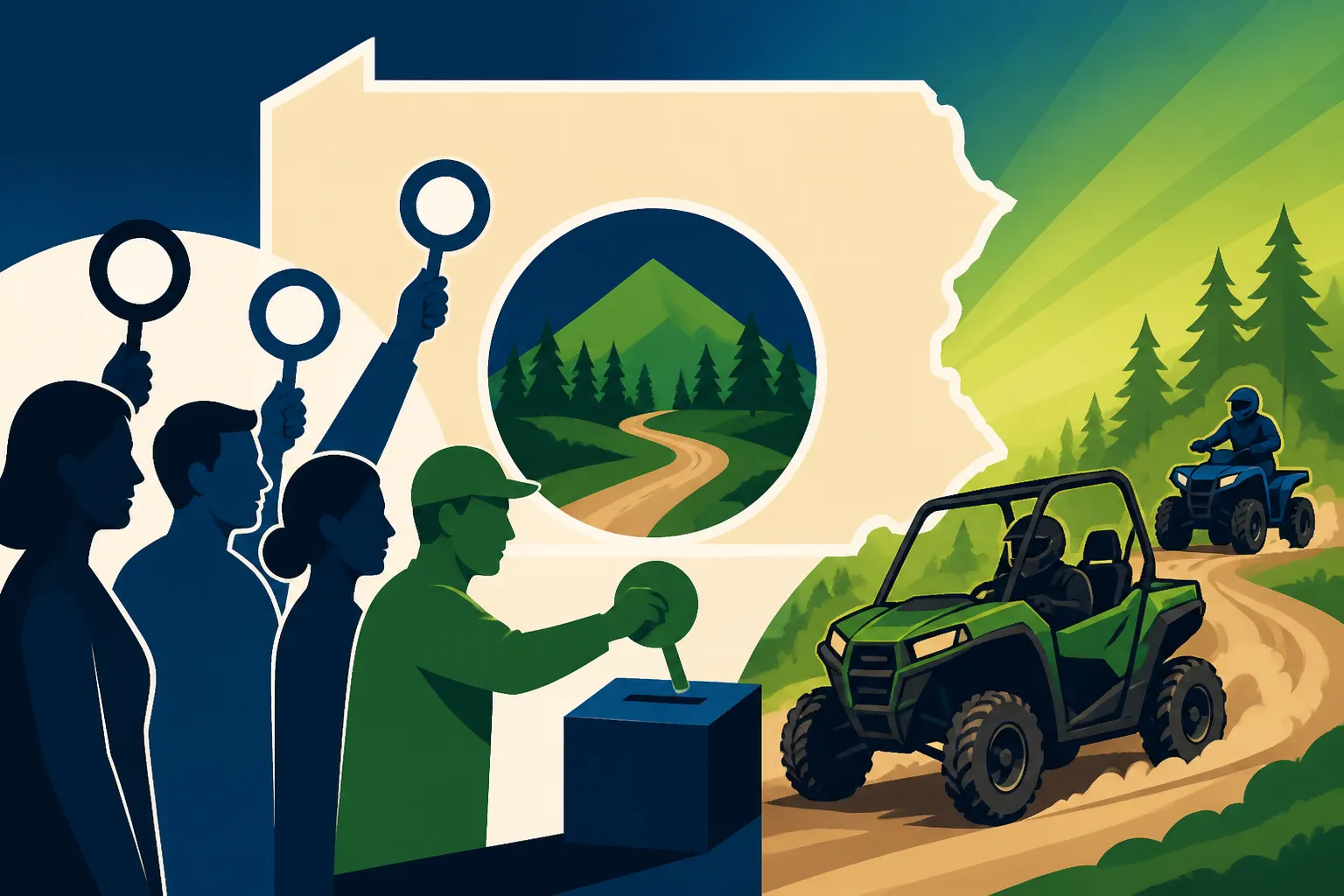
The primary decision-makers for opening local roads to ATV use are the elected officials at the municipal level: the Township Supervisors in townships and the Borough Councils in boroughs. These individuals are responsible for governing their respective communities, and that includes managing local infrastructure like roads. Pennsylvania's Vehicle Code grants them the authority to designate certain roads under their jurisdiction for ATV use. This authority is not taken lightly, as it involves balancing the interests of ATV riders with the concerns of other residents and ensuring public safety.
The process typically involves a formal vote by the supervisors or council members during a public meeting. Before such a vote, there's usually a period of discussion, public comment, and often, a feasibility study or impact assessment. They need to consider legal aspects, potential liabilities, the cost of additional signage (like the [The Green Sign on a Pennsylvania Township Road]), and how to enforce rules like [Pennsylvania's Minimum Age of Sixteen on Roads] for such routes. It's a localized, political process that requires community engagement and often, persistent advocacy from the riding community.
The Process of Requesting a Road Opening
If you're a local rider, part of a club, or a business owner who sees the potential in opening certain roads, you can initiate the process of requesting a road opening. This isn't a simple phone call; it's a structured approach that typically involves several steps:
- Research and Identification: Start by identifying specific roads that would make ideal connector routes or access points. Think about low-traffic roads, those that connect existing trail systems, or routes that lead directly to local services like gas or food. Consider safety aspects like visibility, speed limits, and residential density.
- Gathering Support: This is crucial. A single voice is easily dismissed, but a chorus of voices is much harder to ignore. Talk to your neighbors, fellow riders, local businesses, and community leaders. Get signatures on a petition. Show that there's significant local interest and support for the idea. This isn't just about riders; it's about demonstrating potential economic benefits and community development.
- Formal Proposal: Prepare a clear, concise proposal outlining which roads you want opened, why, and what benefits it would bring to the community (e.g., increased tourism, safer access to trails, economic boost for local businesses). Anticipate and address potential concerns like noise, safety, and enforcement. This is where you might mention how well-maintained machines, perhaps fitted with robust components from a company like SuperATV, are capable of safely navigating these routes under proper regulations.
- Presenting to the Township/Borough: Request to be placed on the agenda for a supervisors' or council meeting. Present your proposal professionally, backed by your gathered support. Be prepared for questions and feedback, both positive and negative, from the officials and other residents.
- Follow-Up and Advocacy: The decision often won't happen overnight. Be prepared for a lengthy process involving multiple meetings, workshops, and perhaps even public hearings. Continue to engage with your elected officials, attend meetings, and provide additional information or perspectives as needed. Showing consistent, polite, and organized advocacy is key.
The Road to Approval: What Influences the Vote?
A successful vote to open a road for ATV use is rarely a unanimous, spontaneous event. It's the culmination of careful consideration by local officials, influenced by a multitude of factors, and often shaped by the engagement—or lack thereof—from the community.
Factors Supervisors and Council Members Consider
When township supervisors or borough council members sit down to discuss opening a road to ATV traffic, they're not just thinking about whether riders want it. They're juggling a complex array of responsibilities and concerns:
- Public Safety: This is almost always the top priority. They'll look at road width, speed limits, sightlines, traffic volume, and how ATVs would integrate with other vehicles. They'll consider whether signage would be adequate and if there are any particularly dangerous intersections or stretches of road. They may also consider if there are sufficient enforcement resources available to ensure compliance with rules like [Pennsylvania's Sixteen-Year-Old Road Rule].
- Resident Feedback: Local officials are elected by the residents, so their opinions matter greatly. If a proposal faces strong opposition from a significant portion of the community due to concerns about noise, dust, property values, or increased traffic, it will be a much harder sell. Conversely, if residents are supportive, or at least indifferent, the path is smoother.
- Economic Impact: The potential for economic benefits can be a powerful motivator. Will opening a road bring more visitors to local businesses? Will it encourage tourism and provide jobs? For smaller, rural communities, a boost in tourism from ATV riders can be a lifeline, supporting everything from gas stations to restaurants and local shops. This is where companies like SuperATV, through their presence in the off-road market, indirectly highlight the economic activity generated by ATV enthusiasts.
- Maintenance Burden: ATVs, especially UTVs, are heavier and can put more wear and tear on gravel or dirt roads than typical passenger vehicles. Supervisors will consider the cost of maintaining the road, including grading, dust control, and pothole repair. They'll want to know if the benefits outweigh these potential costs.
- Legal Liability: Local governments are always wary of increasing their liability. They will likely consult with their solicitor about the legal ramifications of opening roads, ensuring they are protected from potential lawsuits in case of accidents.
- Existing Regulations: They must ensure that any decision aligns with state laws and DCNR guidelines. While they have local authority, it must operate within the broader legal framework. This includes understanding the specific sections of [17 Pennsylvania Code Chapter 51] that apply to ATV use on public roads.
Community Engagement and Local Politics
The success or failure of opening a road often boils down to the level and quality of community engagement. It's not enough to simply want a road open; you have to actively participate in the local political process.
- Organized Advocacy: An organized group, like an ATV club, often has a much greater impact than individual complaints or requests. Clubs can pool resources, present a unified front, conduct research, and provide a consistent voice at meetings. They can also educate members on [Pennsylvania ATV Trail Etiquette on Narrow Trails] and responsible riding, addressing potential concerns before they arise.
- Educating Officials: Many local officials might not be familiar with ATVs or the modern riding community. They might hold outdated stereotypes or simply not understand the economic and recreational benefits. It's up to advocates to educate them respectfully, providing facts, figures, and success stories from other communities that have successfully integrated ATV road access.
- Building Relationships: Establishing positive relationships with supervisors, council members, and even local law enforcement can be incredibly beneficial. Showing that riders are responsible, considerate members of the community can go a long way in building trust and garnering support.
- Compromise and Phased Approaches: Sometimes, asking for everything at once isn't realistic. A phased approach, perhaps starting with a short connector road and demonstrating its success before asking for more, can be a more effective strategy. Being open to compromise and addressing concerns shows good faith.
- Voter Influence: Ultimately, these officials are elected. Demonstrating that the ATV community is an engaged voting bloc can certainly get their attention. Voting in local elections and supporting candidates who are open to discussing responsible ATV access is a long-term strategy that shouldn't be overlooked.
Different Types of Roads and Their Rules
Pennsylvania has a complex network of roads, and the authority to open them to ATV traffic varies significantly depending on who maintains them. Understanding this distinction is vital before you even begin to advocate for change.
Township Roads Versus State Routes
The critical distinction in Pennsylvania is between locally maintained roads and state-maintained roads.
- Township Roads (and Borough Streets): These are the roads we've primarily been discussing, managed by local municipal governments (townships and boroughs). As detailed above, these are the roads where local supervisors or council members have the authority to designate them for ATV use under specific conditions outlined in state law. These are your best bet for advocating for new access points or [Connector Routes Between Pennsylvania Trails]. When you see signs saying [Township Roads Open to Pennsylvania ATVs], these are the ones where local decisions have been made.
- State Routes (PA Routes, U.S. Routes, Interstate Highways): These roads are under the jurisdiction of the Pennsylvania Department of Transportation (PennDOT). While local municipalities might have some input on state routes passing through their area, the power to open these roads to ATVs rests entirely with PennDOT. And historically, PennDOT's stance has been extremely restrictive. With very few, highly specific exceptions (like mandated crossings at ninety degrees), ATVs are not permitted on state routes. It is exceedingly rare for a state route to be designated for ATV use, and pursuing such a change would require significant legislative action at the state level, which is a much more challenging and improbable task than local advocacy. For most riders, campaigning for access on state routes is not a practical approach.
Joint-Use Roads and Green Signs
You might have heard the term "joint-use roads" or seen those distinctive green signs. These are specific types of roads that have been officially designated for shared use between conventional vehicles and ATVs.
- Joint-Use Roads: These are roads where, through a formal process, both ATVs and conventional vehicles are legally allowed to operate. These are typically local or state forest roads that have been identified as suitable for shared use. They are not always open year-round for ATVs, often following seasonal restrictions similar to those for designated trail systems, such as the [Pennsylvania's Summer Season Dates] and [Pennsylvania's Winter Season Dates]. The decision to make a road "joint-use" involves careful assessment of safety, road conditions, and the impact on other forest users. [Pennsylvania Joint-Use Road Rules] are specific and must be followed diligently by all users.
- The Green Sign: These are the visual indicators that a road is open for ATV use. The [The Green Sign on a Pennsylvania Township Road] is specifically designed to inform riders that they are on a legal route. These signs are crucial for clarity and safety, indicating to both ATV operators and other motorists that shared use is permitted. They typically specify conditions, such as the minimum age for operators, speed limits, and often, the need for [Pennsylvania Helmets for Operator and Passenger]. Seeing these signs is a welcome sight for riders, indicating that local advocacy and official decision-making have successfully created new opportunities. Without these specific green signs, you should always assume a road is closed to ATV travel, even if it looks like a perfect route.
Here’s a quick overview of who holds the reins for various road types:
| Road Type | Governing Body | Typical ATV Access | How Decisions Are Made |
|---|---|---|---|
| Township Roads | Township Supervisors | Can be designated by local vote | Formal vote by elected supervisors, often after public input and studies. |
| Borough Streets | Borough Council | Can be designated by local vote | Formal vote by elected council members, similar to townships. |
| State Routes | Pennsylvania Department of Transportation | Extremely rare; generally prohibited | Requires state-level legislative or PennDOT policy changes, very difficult to achieve. |
| State Forest Roads | DCNR (Department of Conservation & Natural Resources) | Some designated as joint-use roads or trail connectors | DCNR policy, often integrated with [Pennsylvania State Forest Trails] plans, seasonal access. |
| Private Roads | Private Landowner/Association | Requires explicit permission | Owner's discretion; always need [Pennsylvania Landowner Permission Requirements]. |
The journey to open more roads for ATV and UTV riders in Pennsylvania is certainly not a simple one, but it's far from impossible. It demands understanding the layers of governance, respectful engagement with local officials, and consistent, organized advocacy. When you're considering your next ride or planning how to get to your favorite trail systems, remember that the power to open local roads often lies right within your own community.
Disclaimer
This article is for general informational purposes only and does not constitute professional advice. Laws, prices and regulations vary by location and change over time. Consult a qualified professional for guidance on your specific situation.