Parking a Trailer at a Forest Trailhead
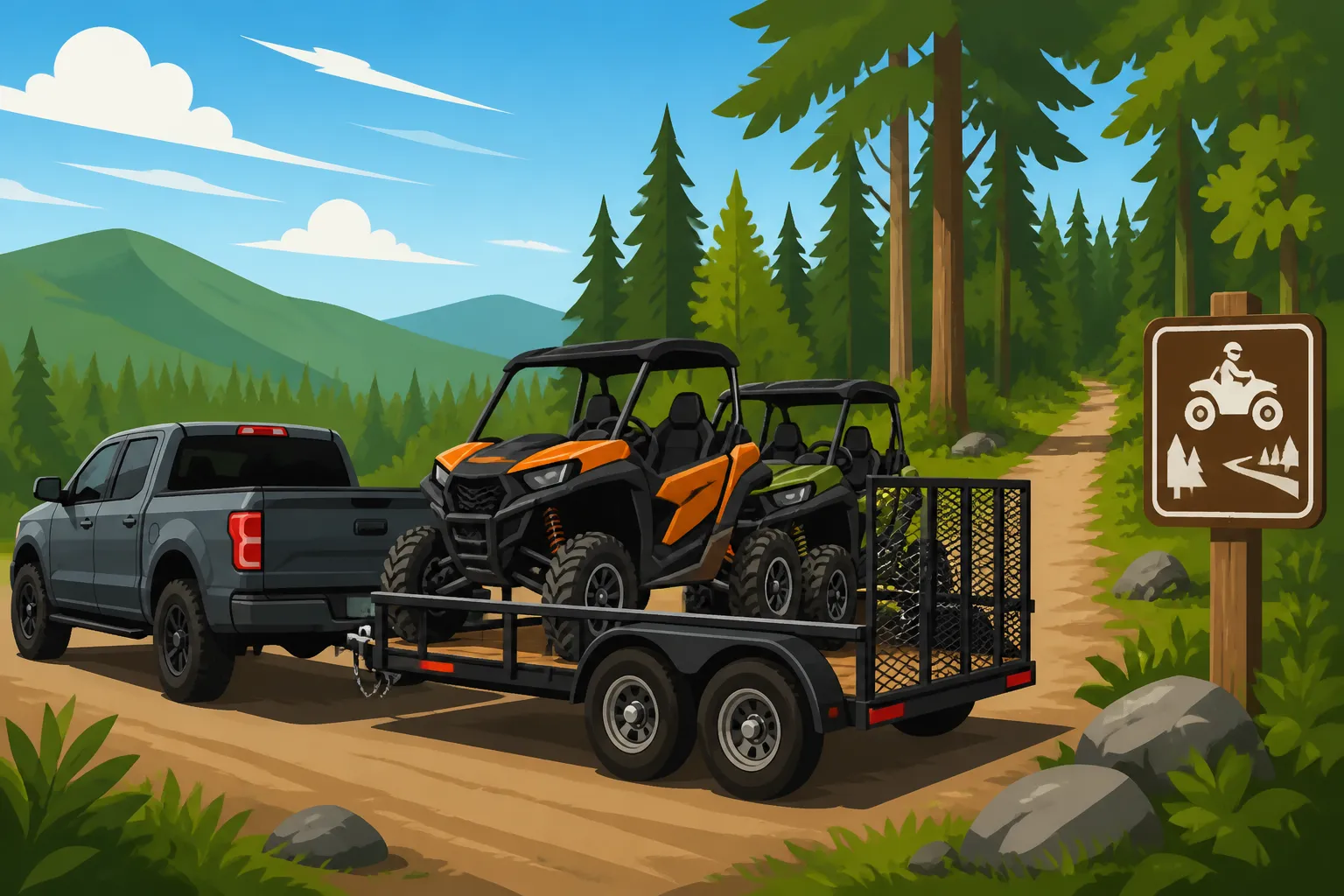
Arriving at a Pennsylvania forest trailhead with a truck, trailer, and one or more ATVs can turn into a stressful puzzle when the lot is small, busy, or unfamiliar. This guide explains how to check parking rules, choose a workable space, unload safely, and avoid blocking other visitors or access roads.
Check the trailhead before towing there
Confirm access and parking rules
A trail appearing on a map does not guarantee that its access point has room for a truck and trailer. Forest lots vary: some have marked spaces and room to turn around, while others are narrow pull-offs where a long rig can be difficult to maneuver. The land manager may also set rules for parking, overnight stays, gates, and seasonal closures.
Before leaving home, check the trail manager’s current information and look for posted signs at the entrance. For public forest routes, start with the relevant forest or agency information, including Pennsylvania Trail Maps From DCNR as a topic to investigate. If you are planning around Marienville, for example, distinguish between the trail system, its access points, and the places where vehicles may actually park. Allegheny Forest Trails at Marienville can help you frame that research, but the signs and rules at your chosen lot still matter.
A trail map app such as onX Offroad can be useful for checking your planned route and orienting yourself to nearby roads or trail access. Treat mapping information as a planning aid, not proof that a particular lot permits trailer parking or has enough room for your rig. Verify access and parking details with the land manager before you tow.
Match your rig to the lot
Think about your full setup, not just the truck. A long trailer, a second machine, a wide side-by-side, or a trailer with a tongue-mounted spare can take up more room than expected. A tight entrance or limited turning area may make a lot unsuitable even if you can technically fit into one parking space.
If the trailhead’s layout is unclear, check whether there is a designated staging area or contact the managing office to ask about trailer access. Questions worth asking include whether trailers may be left while riding, whether overnight parking is allowed, and whether a turnaround is available. For smaller access points, Trailer Size Limits at a Small Trailhead is a useful topic to keep in mind: a location that works for a short utility trailer may be awkward for a longer enclosed rig.
If you are using onX Offroad to compare possible access points, cross-check what you see with the land manager’s information. A mapped road or trail connection does not tell you whether the lot is open, whether a gate is locked, or whether there is safe space to unload. That quick double-check can save a long, uncomfortable backing maneuver on a narrow forest road.
Choose a space that leaves room for everyone
Park without blocking access
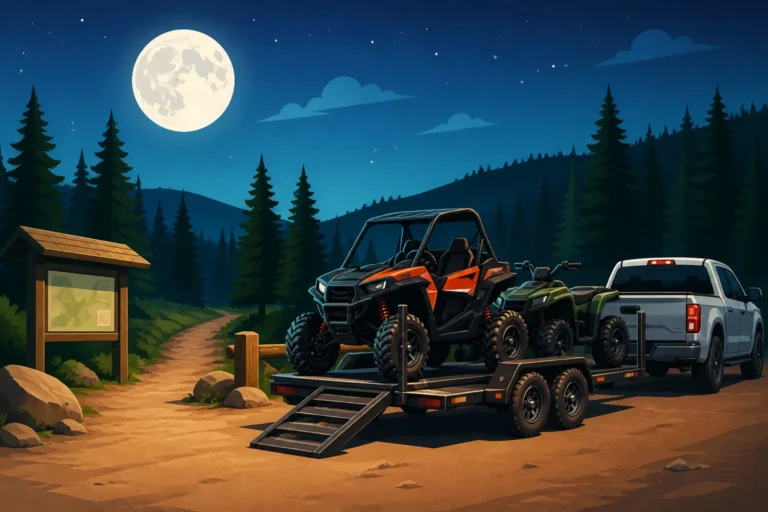
Once you arrive, pause before pulling into the first open-looking area. Look for signs, painted lines, barriers, gates, and enough clear space for other vehicles to enter and turn around. Keep the trailer inside the designated parking area where possible, and do not block a gate, road, driveway, trail entrance, or emergency access route.
Avoid taking up extra spaces simply because the lot is quiet when you arrive. A forest trailhead can fill while you are riding, and a rig parked across multiple spaces may leave another visitor nowhere safe to unload. If the lot is nearly full, do not assume that a nearby shoulder or pull-off is an acceptable overflow area. It may narrow a road, obstruct a sight line, or interfere with forestry, maintenance, or emergency vehicles.
| Situation | Safer choice | Avoid |
|---|---|---|
| The lot has marked trailer spaces | Use a marked space and keep the full rig within it | Straddling spaces or blocking the drive aisle |
| The lot is small or crowded | Ask the land manager about another suitable access point | Leaving the trailer on a road shoulder without permission |
| The lot has a gate or service road | Keep the gate and approach completely clear | Parking where a large vehicle cannot pass |
| You plan to stay overnight | Confirm overnight rules directly before leaving the rig | Assuming that daytime parking rules also allow overnight stays |
| The entrance is too tight to turn around | Stop and reassess before entering | Driving in and hoping to reverse out safely |
If there is no safe space for your entire rig, it is better to use an approved alternative staging area than to force a fit. This is especially important at narrow forest access points, where a trailer angled across the lot can make it difficult for another vehicle to pass or turn.
Consider overnight parking separately
Parking for the length of a ride and leaving a truck and trailer overnight are not automatically the same thing. Rules can depend on the land manager, location, season, and posted conditions. Check before you leave the vehicle unattended, and do not rely on another visitor’s setup as permission.
Review Overnight Parking at a Trailhead as part of your planning, then confirm the specific rules for your destination. If the trailhead is near a campground or a private riding park, that does not necessarily mean the trailhead lot allows overnight vehicle or trailer storage. Ask which area is authorized, whether a fee or reservation applies, and whether the lot closes at a particular time.
It also helps to plan for what you will do if the designated lot is full when you arrive. Identify a second authorized access point or decide in advance to postpone the ride rather than parking somewhere that blocks a road or risks a citation. Pennsylvania Trail Closures to Check First is a relevant planning topic because closures can change which access points are usable.
Unload and secure machines safely
Set up the trailer before unloading
Choose a level spot whenever possible. Put the tow vehicle and trailer in park, set the parking brake, and follow the trailer manufacturer’s guidance for wheel chocks and stabilizers. Keep people clear of the space behind the trailer while positioning it, and take the time to check that the ramp is fully seated and secured before anyone drives a machine down it.
Before unloading, look for soft ground, loose gravel, a slope, drainage channels, or a ramp that could shift. Muddy or uneven ground can make a ramp unstable, particularly when a heavy machine is moving over it. If the setup feels unsafe, reposition only if you can do so without blocking other vehicles or driving into an unapproved area.
Unload one machine at a time and keep bystanders out of the ramp path. A helper can watch for obstacles and other traffic, but should stand where the driver can see them and where they are not exposed to a rolling machine. When the machines are off, stow ramps and tie-downs rather than leaving them across a parking space or in the travel lane.
Secure the rig while you ride
After unloading, secure the trailer according to its design and the conditions at the lot. Locking the coupler, using a wheel lock, and keeping valuables out of sight can reduce avoidable problems, but no lock makes an unattended trailer impossible to access. Do not leave fuel, tools, or other items scattered around the vehicle.
Keep the parking area tidy. Pack out trash, straps, food containers, and broken parts. Avoid running a machine or revving the engine near other visitors longer than needed to load and depart. A little consideration matters at a shared forest access point, especially when riders, hikers, hunters, and forestry vehicles may be using the same area.
Parking is also only one part of preparing for a legal ride. Make sure your registration and any trail-specific permit requirements are handled before you unload. Pennsylvania ATV Registration and Trail Access and Pennsylvania ATV Trail Permits Explained are useful related topics to check while planning. A valid parking spot does not itself authorize riding on every nearby trail.
Make a plan for a crowded or unfamiliar trailhead
Arrive with a backup option
A busy opening weekend, holiday, or pleasant-weather Saturday can change a trailhead from roomy to cramped in a short time. If you expect crowds, arrive early enough to find an authorized space without rushing, and have an alternate access point in mind. Check Pennsylvania Trail Conditions Before You Go before setting out, especially after storms or during seasonal transitions when a route or access road may be affected.
Use onX Offroad or another mapping tool to organize your route and note possible alternatives, but verify each option through the responsible land manager. A nearby parking symbol may refer to a small pull-off, a lot that is not intended for trailers, or access that is temporarily unavailable. If you cannot confirm that a backup area is suitable for your rig, do not assume it is.
For a group ride, coordinate parking before everyone arrives. Multiple trucks and trailers can quickly overwhelm a small lot. Agree on where to meet, who will contact the land manager if the lot is full, and whether the group will split into smaller arrival times. Do not create an informal overflow line along a narrow road simply because several members of the group have already arrived.
Keep parking separate from trail access
A trailhead parking area is a staging point, not permission to ride every road, path, or connecting route nearby. Follow the signs and use only routes open to your machine and riding situation. On Pennsylvania forest routes, seasonal access, machine dimensions, permits, and land-manager rules can all affect where you may ride. The topic Pennsylvania’s Class II Trail Width Limit is worth checking if you ride a wider machine, and Pennsylvania’s Allegheny National Forest Permit is a useful reference when planning a ride in that forest.
Respect posted closures even if a route looks passable or another rider has gone through. A closed trail or road may be protecting a damaged surface, wildlife habitat, or maintenance work. If a parking area is full, do not use a closed route or a private drive as a shortcut to another place to unload.
Before driving away, take a final look around the rig and the space you used. Check that ramps, tie-downs, tools, and trash are accounted for, and make sure the trailer is properly connected and lights are working. A calm departure helps keep a crowded lot safer for the next truck pulling in.
Disclaimer
This article is for general informational purposes only and does not constitute professional advice. Laws, prices and regulations vary by location and change over time. Consult a qualified professional for guidance on your specific situation.