Finding a Pennsylvania Youth Safety Instructor
Finding a qualified youth ATV safety instructor in Pennsylvania can take more than a quick search, especially when local classes are offered only occasionally. Start with official state course information, then confirm that the instructor, course format, and class date fit your child’s age and riding plans. A little checking beforehand helps avoid signing up for a class that does not meet your needs.
Start With Pennsylvania’s Official Course Information
For a child who needs ATV safety training, the safest starting point is Pennsylvania’s official ATV program information. Use the state’s current course or instructor resources, or contact the Pennsylvania Department of Conservation and Natural Resources’ Snowmobile and ATV Section for guidance. The Pennsylvania’s DCNR Snowmobile and ATV Section can help you identify where to direct questions if an instructor listing is unclear or difficult to find.
State course information matters because a person who teaches riding informally is not necessarily authorized to provide the safety training or certificate you need. A dealer, riding-club member, or experienced family friend may be able to suggest local options, but treat those suggestions as leads. Before enrolling, verify through an official state resource that the instructor and course are recognized for the required safety training.
If the state provides an instructor directory or course search, use it to look for an instructor by county, nearby town, or course location. Search broadly enough to include neighboring counties if your local area has few classes. A course may be held in a community building, training facility, club property, or other approved location, so the instructor’s listed county may not be the only place a family can attend.
If you cannot find a current listing, contact the state program rather than relying on an old social media post or a directory copied onto another site. Ask where families can find the current instructor or course schedule. If you have already found a potential instructor, provide the instructor’s name and the proposed class details and ask whether that course satisfies Pennsylvania’s youth ATV safety training requirements.
Local organizations can still be useful for finding a class. An ATV club, community recreation group, school, dealer, or local riding network may know when an instructor plans to hold the next session. But those organizations may not maintain an up-to-date list, and a class announcement may describe general safety instruction rather than the state-recognized course. Confirm the official details independently before making plans.
Use this simple sequence:
- Check the state’s current ATV safety course information or ask the state program for help locating an instructor.
- Search your county and nearby areas for a class that fits your schedule.
- Ask the instructor whether the course is recognized for the safety certificate your child needs.
- Confirm the child’s age eligibility, registration process, class format, and any materials or preparation required.
- Keep the course confirmation and certificate information after training.
The Where to Take a Pennsylvania ATV Safety Course and In-Person Courses From a County Instructor pages can help you understand the kinds of course information to look for. For the rules that apply to a particular child, review [Pennsylvania ATV Safety Certificate Requirements] as well. Those details are worth checking directly with current state guidance because a course listing alone may not explain every age or riding-location rule.
Confirm That the Course Fits Your Child
Before enrolling, establish what the course is meant to do and whether it matches your child’s age. Pennsylvania has safety-training information for young riders, but not every course is designed for every age group. A general ATV orientation, a private riding lesson, and a state-recognized safety course are not interchangeable simply because all three discuss safe riding.
Ask the instructor what age range the class serves and whether the class is intended for the state safety certificate applicable to youth riders. The Pennsylvania ATV Course for Ages 8 to 15 and Pennsylvania Safety Certificates for Ages 8 to 15 pages provide useful context for families checking age-specific requirements. If the child is near an age cutoff, ask how eligibility is determined for that particular class and whether the state’s rules depend on the rider’s age at enrollment, course date, or time of operation.
A child’s age can affect more than course eligibility. It may also affect the types of machines or locations where the child may ride, and whether supervision is required. A certificate does not automatically make every ATV, trail, or road appropriate for a young rider. Check the separate rules in Pennsylvania Rules for Riders Aged 8 to 15, Pennsylvania Supervision Rules for Minors, and [Pennsylvania Minimum Age to Ride an ATV] before planning a ride.
If your child is eight or nine, specifically ask about any age-based engine-size limits that could affect the machine they use. Do not assume that a course certificate overrides such limits. Likewise, a class designed for young operators may not resolve questions about riding a UTV, riding with a passenger, or using public roads. Those are separate issues, and they may have different restrictions.
Ask whether the instructor has a place for your child
Course listings can be general, while enrollment may be limited by class size, equipment, or available training dates. Ask whether the instructor is accepting new students and whether your child’s age group will be included in the next class. If the instructor teaches multiple age groups, find out whether the instruction is separated by age or conducted together.
You should also ask whether the child needs to bring an ATV or whether machines and protective equipment are provided. Do not assume that a class uses the family’s machine. If your child is expected to ride a particular machine, ask whether it must meet any size, condition, or safety requirements. The instructor can clarify what is needed for class; state rules and trail rules still determine where that machine may be operated afterward.
Distinguish the certificate from riding permission
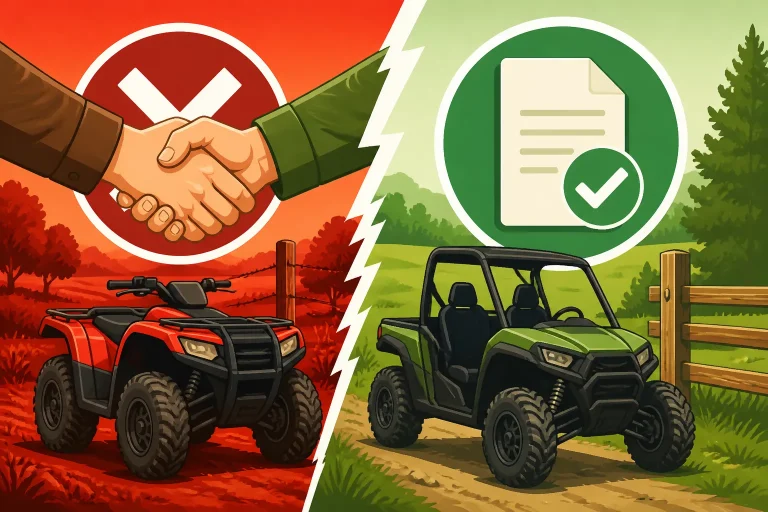
A common source of confusion is treating the safety certificate as a universal riding permit. It is not a substitute for every other requirement. The certificate documents safety training; registration, trail permits, landowner permission, supervision, and location-specific rules are separate questions.
For example, a child may complete a safety course but still be unable to ride on a particular trail because the machine is too wide, the trail is closed, the rider does not meet the trail’s age rule, or the required registration or permit is missing. Review Pennsylvania ATV Trail Permits Explained for the difference between a trail permit and other riding documents. If you are planning to ride on state forest trails, check the applicable trail rules before making the trip.
Keep these questions separate when speaking with an instructor:
- Does this class provide the safety training or certificate required for my child?
- What age and machine limits apply to my child after the course?
- What registration, permit, insurance, or permission will we need for our intended riding location?
- Does the planned trail or property allow a rider of my child’s age?
An instructor can be a helpful source for course details, but should not be treated as the only authority on every riding rule. If an answer about eligibility or where a certificate is accepted is uncertain, confirm it with the state program.
What to Ask Before You Enroll
A short call or email can prevent surprises on class day. Get the basic details in writing when possible, especially if the course is advertised by a local group rather than through an official listing. You do not need a complicated checklist; focus on recognition, age eligibility, logistics, and what happens after class.
| Question to ask | Why it matters |
|---|---|
| Is this a Pennsylvania-recognized youth ATV safety course? | Separates required training from an informal lesson or general safety talk. |
| What ages can attend this class? | Confirms that the instructor is accepting your child’s age group. |
| What is the class format and location? | Helps you plan transportation, time, and any in-person participation. |
| Does the student need to bring an ATV or safety gear? | Avoids arriving without required equipment or bringing an unsuitable machine. |
| Is there any prerequisite or registration step? | Helps you complete enrollment before the class fills or begins. |
| How will course completion be documented? | Clarifies how the certificate or completion record is issued and retained. |
| Who should we contact if plans change? | Gives you a direct route for schedule changes or follow-up questions. |
| What should we do if the class is canceled? | Helps you understand rescheduling or finding another recognized option. |
Ask whether the instructor needs information about the child in advance. The answer may include basic details needed for enrollment, but avoid sending sensitive personal information through an unverified email address or social media account. If you are unsure whether a contact is legitimate, confirm it through an official course listing or the state program before sharing information.
Get the class format clear
An in-person course may include classroom instruction, practical demonstrations, or both. The exact format can vary, so ask the instructor what the student will actually do. If the course includes riding practice, find out whether the student will operate an ATV, observe a demonstration, or participate in another way. This is especially important if your child has little experience or feels nervous around machines.
Ask how long the class is expected to last and whether students need to arrive early. Confirm the address, parking arrangements, and whether an adult must stay during the session. These details are practical, but they can also affect whether the child is able to participate fully.
If a class is described as online, make sure it is the correct course for your child’s age and certificate needs. Online options intended for older riders should not be assumed to satisfy youth requirements. The Pennsylvania ATV Course for Ages 8 to 15 is a helpful reference point when comparing youth training with courses or materials aimed at adults.
Check what completion means
Before enrolling, ask what proof the student receives after successfully completing the course and how long it takes to receive it. Find out whether the certificate is issued at the class, sent later, or recorded through another process. If it is electronic, ask how to access and save it. If a physical certificate is provided, check whether the family should keep the original in a safe place and carry a copy or other proof when riding.
Do not assume that attending every portion of a class automatically guarantees a certificate. Ask the instructor what the student must do to complete the course, including whether participation, a knowledge check, or a practical component is required. If your child misses a portion or needs an accommodation, discuss that before class rather than hoping it can be resolved afterward.
For questions about what the certificate proves or when it must be carried, see Carrying the Certificate on a Ride. The course instructor can explain the process for that class, while the state’s rules determine what documentation is required during a ride.
Prepare for Class and Follow Up
Once the instructor and course are confirmed, make the day easier by preparing your child and checking the logistics. A youth safety course is more useful when the student arrives ready to listen, ask questions, and participate without feeling rushed.
Before the class:
- Reconfirm the date, arrival time, location, and instructor contact method.
- Ask whether the student needs identification, enrollment confirmation, or any other documents.
- Confirm clothing and footwear expectations, particularly if the class includes an outdoor or practical portion.
- Find out whether the instructor supplies the ATV and protective gear or expects the student to bring them.
- Tell the instructor about any issue that could affect participation, such as limited experience, a mobility concern, or difficulty understanding the course language.
- Give your child a simple explanation of what to expect, without turning the course into a substitute for the instructor’s teaching.
If you are bringing an ATV, ask what condition it must be in and how it should be transported. Check the machine before leaving home: controls should work, tires should be in appropriate condition, and there should be no obvious mechanical problem that could make the session unsafe. The instructor may have specific requirements, so use those rather than guessing.
Protective equipment is another point to confirm. Ask what the course provides and what the child should bring. A helmet and other protective equipment may be required for riding activities, but the class’s exact requirements can vary. Check fit before the class rather than discovering at the training site that a helmet is too loose or uncomfortable. If you are buying gear, choose equipment appropriate for the child’s size and intended use; a child should not use an adult-sized item that does not fit securely just because it is available.
Help a young rider participate
Children learn at different speeds, and a safety course is not a test of whether a child is ready for every kind of riding. Encourage your child to ask questions and to say when a control, instruction, or safety step is unclear. A student who is anxious or unfamiliar with ATVs may benefit from knowing that it is acceptable to observe carefully and ask for clarification before operating a machine.
Parents and guardians can support the learning without taking over the instruction. Avoid coaching the child to rush through a maneuver or encouraging them to show off. The course is a chance to practice safe habits, including stopping when unsure and following directions. Those habits matter beyond the course, particularly on unfamiliar trails and around other riders.
After class, ask your child to explain a few key points in their own words: how to check the machine, what protective gear matters, how to respond if conditions change, and when to stop rather than continue. This is not a substitute for the course or an examination. It helps you see whether the child understood the ideas and gives you a chance to clarify any confusion before riding.
Keep the record and check the riding plan
Store the certificate or completion record where you can find it. Save a digital copy if the instructor or state process provides one, and keep any original document in a dry, secure place. If the record is lost, ask the course instructor or state program how to request replacement proof. Do not rely on memory of the class date as the only evidence that the child completed training.
Before the first ride after training, check the rules for the exact location. Private property, a state forest trail, a trail system, and a road do not necessarily have the same requirements. Confirm that the child’s age, machine, supervision, registration, permit, and any required documentation all fit the planned ride. A certificate is an important piece of preparation, not a blanket authorization.
If you are planning a ride in a state forest, verify that the route is open and that your machine is allowed. If you intend to ride on private property, confirm permission from the landowner. If the planned route involves a public road, check the separate road-use rules rather than assuming a youth safety certificate permits road riding.
When the child is ready, ride at a pace that suits their ability and the conditions. Start with a suitable route, keep the child within direct supervision where required, and agree in advance on what to do if the group becomes separated or the rider feels uncomfortable. The course can teach safety principles; responsible adult supervision helps apply them to real conditions.
Frequently Asked Questions
How do I find a youth ATV safety instructor near me?
Start with Pennsylvania’s official ATV safety course information or contact the DCNR Snowmobile and ATV Section for direction. Search nearby counties if your area has limited classes, and verify that the instructor and course meet the state’s youth safety training requirements before enrolling.
Can an ATV dealer or riding club provide a youth safety certificate?
A dealer or club may be able to point you toward a local class, and some organizations may host instruction. A recommendation or safety talk does not by itself prove that a course is state-recognized. Confirm the instructor and course through an official state resource.
Is an ATV safety certificate the same as a trail permit?
No. A safety certificate records training; a trail permit is a separate requirement for certain riding areas. Registration, supervision, landowner permission, and location-specific restrictions may also apply. Check each requirement for the place where the child will ride.
What if there is no class scheduled nearby?
Ask the state program whether another instructor or upcoming class is available in a neighboring area. You can also ask local clubs or community organizations whether they know of a recognized course, then verify the details before signing up. Do not substitute an informal lesson for required training without confirming that it meets the applicable rules.
Disclaimer
This article is for general informational purposes only and does not constitute professional advice. Laws, prices and regulations vary by location and change over time. Consult a qualified professional for guidance on your specific situation.