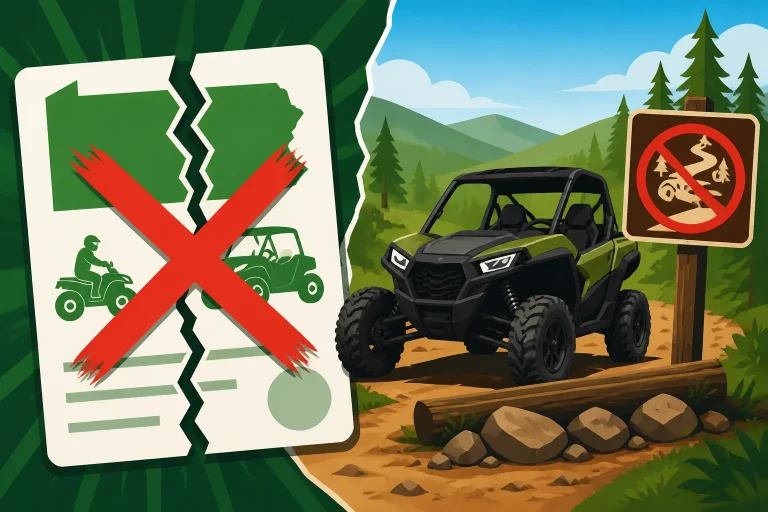
Renting a Machine as a Visitor
Renting an ATV or UTV can make a Pennsylvania trip easier, but a reservation does not automatically give you permission to ride every trail. The machine’s registration, the route’s permit rules, age limits and insurance all matter. Before you book, confirm what the rental includes and where that specific machine may legally go.
Before You Book a Pennsylvania ATV or UTV Rental
Start with the place you want to ride, not just the rental listing. Pennsylvania’s rules depend in part on who manages the land. A private riding park, a state forest trail and a route in the Allegheny National Forest can have different access requirements. A machine that is ready for one location may not be authorized for another.
Ask the rental company which trails or riding areas are covered by its rental arrangements. Get the names of the areas, not just a general assurance that the machine is “trail ready.” Then check whether the machine can be used there during your rental dates and whether it meets that area’s size and equipment rules. Some state forest trails, for example, have a width limit. A side-by-side that is too wide for a trail is not made eligible by having a permit.
A rental package may include a trail pass or access charge, but don’t assume that it does. The rental price, a private park’s admission, a state forest permit and an Allegheny National Forest permit are separate things unless the company clearly says otherwise. Ask what each included charge covers and whether the proof of access is issued for the machine, the rider or the rental period.
These questions are useful before paying a deposit:
- Is the machine currently registered, and what proof will I carry?
- Does the rental include any permit or trail access fee? If so, which area and dates does it cover?
- Can this exact machine ride the route I’m planning to use?
- Are there limits on rider age, passenger age or passenger capacity?
- What insurance does the rental agreement provide, and what coverage must I arrange?
- Is a safety certificate or other document required for the rider or passenger?
- What happens if a trail closes, the machine is not allowed on the route, or the rental is delayed?
A company may know its usual routes well, but confirm the rules for the specific land manager and trail. The rental office’s directions are helpful; they are not a substitute for a permit or permission that the route requires. For a broader checklist, see What a Weekend Visitor Needs to Ride Pennsylvania.
| What to confirm | Why it matters | What to ask the rental company |
|---|---|---|
| Registration | The machine must have the registration or other authorization required for the ride. | Is it registered for Pennsylvania use, and what document or plate will be on it? |
| Trail permit | Some public trail systems require access authorization beyond registration. | Is a permit included, and which trail system does it cover? |
| Route and machine fit | A route may limit vehicle width or restrict access to designated trails. | Is this machine allowed on the exact route I plan to ride? |
| Insurance | Rental coverage and legal requirements may not be the same thing. | What is covered, what is excluded and what proof should I carry? |
| Rider eligibility | Age and safety-certificate rules can vary by setting and rider. | What age and certificate requirements apply to this ride? |
Registration and Reciprocity: What a Visitor Should Check
A rental machine should not be treated like an unregistered personal vehicle just because the renter is visiting from another state. Before leaving the pickup location, look for the machine’s registration plate or other required display and ask to see the registration proof. The renter should know what paperwork must remain with the machine or be carried while riding.
If the rental machine has an out-of-state registration, Pennsylvania’s reciprocity rules may affect whether it is recognized here. Reciprocity is not a blanket guarantee that any home-state plate works on every Pennsylvania route. The state’s rules can depend on whether the other state recognizes Pennsylvania registrations, and a trail system can have additional access requirements. Review Pennsylvania ATV Reciprocity With Other States and Does Pennsylvania Accept an Out-of-State Safety Certificate? if you are relying on documents issued elsewhere.
A rental company may have a Pennsylvania-registered fleet, which can simplify the registration question. Still, ask rather than assume. If the machine is registered in another state, confirm that the registration is valid for the planned Pennsylvania ride and ask the company what proof you should carry. Carrying Proof of an Out-of-State Registration covers why having the document available matters.
Registration and a trail permit do different jobs. Registration identifies the machine and satisfies registration rules where applicable. A trail permit is permission to use a particular system or type of land. One does not automatically replace the other. A machine can be registered but still lack access to a trail that requires its own permit.
For a rental, clarify whether the registration belongs to the machine and whether it remains valid for the rental period. Do not remove or swap a plate, sticker or permit from the rental machine. If something is missing or unreadable, ask the company to resolve it before departure. A photo of paperwork may be useful as a backup, but do not assume it substitutes for required physical documents or displays.
Rental agreements also need careful reading. They may require you to keep the machine within an approved riding area, prohibit road use, or make you responsible for fines and damage. A rental firm’s permission to use its machine is not permission to enter private property or ride a closed public trail. For the rider-specific details, see Pennsylvania Rules for a Rented Machine.
Permits Depend on Where You Ride
The phrase “Pennsylvania trail permit” can refer to different access systems, so ask which authority manages your destination. A permit for one system does not grant access to every public trail in the state. Nor does a private park pass necessarily cover a nearby state forest route.
Pennsylvania’s Northcentral regional permit applies to designated trails in the covered area, rather than serving as a statewide pass for all riding. A visitor planning to ride there should check the current permit requirements and whether the rental company has arranged the required authorization for the machine. The regional details are explained in Pennsylvania’s Northcentral Regional Trail Permit and Pennsylvania ATV Trail Permits Explained.
The Allegheny National Forest has a separate permit system for ATV use on its designated routes. Do not assume that a state forest permit or private park admission covers those routes. Confirm the forest’s current requirements, including what proof must be shown and whether the rental machine qualifies. What the $35 Allegheny Forest ATV Permit Covers describes the separate forest permit; check the official forest information for current conditions before riding.
Private parks and club properties set their own access terms. A day pass or rental package may cover a defined riding area, but it does not authorize riding beyond that property or onto connecting land without permission. Ask whether the fee covers the rider, the machine or both. Also find out whether a passenger needs a separate admission, whether a helmet is supplied, and whether the park requires proof of insurance or a signed waiver.
Some land is not open to recreational ATV riding even if it looks accessible on a map. State Game Lands, private property, closed trails and roads without authorization are not fair game for a rented machine. Ask the land manager or use official trail information to confirm the route. If an access point or road is not clearly open to ATVs, do not treat the rental company’s route sketch as permission to proceed.
Road riding is another issue to settle before the trip. A rental machine is not automatically street legal, and Pennsylvania’s limited rules for designated roads do not make every road available to ATVs or UTVs. A road connection may require a particular designation, and rules can apply to the machine and rider. Unless the rental company confirms a lawful route and the machine is equipped and authorized for it, plan to trailer the machine to a permitted riding area rather than ride it on public roads. For the broader distinction, see Riding Pennsylvania With an Out-of-State Plate.
Trail access may also depend on the machine itself. Check width restrictions, passenger capacity and any equipment requirements for the route. A rental company may offer a machine that is suitable for its private property but too wide for a public trail system. Confirm the machine’s actual width and the trail’s limit before booking, especially when renting a side-by-side.
Pickup-Day Checks, Age Rules and Insurance
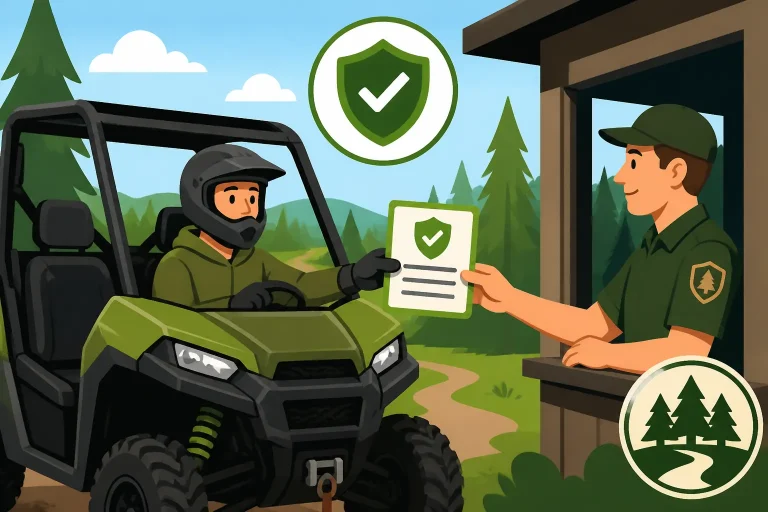
At pickup, take a few minutes to match the paperwork and machine to the plan. Check the plate and permit display, confirm the registration document is present, and make sure the machine’s identification matches the rental paperwork. Ask what to do if a sticker comes loose or a document is damaged during the ride. Keep required documents dry and accessible rather than buried in a bag on a trailer.
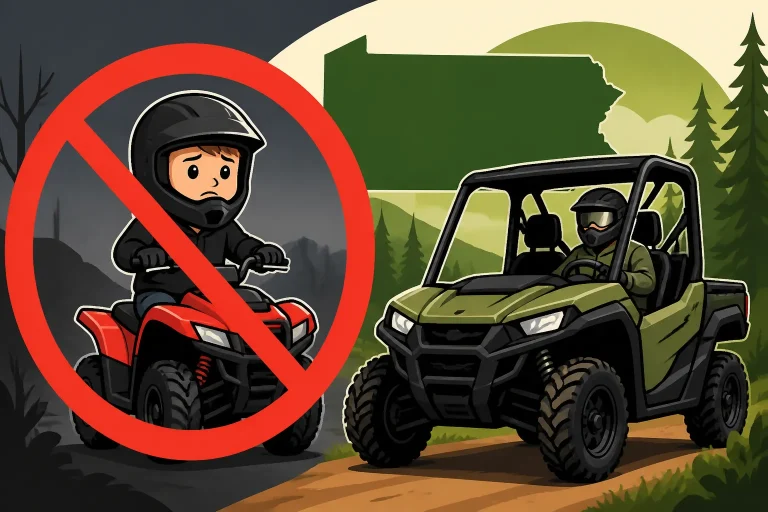
Age rules deserve particular attention when children are riding. Pennsylvania has safety-certificate requirements for some young riders on public land, and minimum ages and supervision rules may apply. A rental business can also set stricter minimum ages than the state’s rules. Ask separately about the operator and passenger: a child who may legally ride as a passenger is not necessarily allowed to operate the machine. Review Pennsylvania ATV Safety Certificate Requirements and confirm requirements for the specific trail and rental company.
Do not infer that a rental includes suitable insurance from the fact that the company owns the machine. Ask for a plain-language explanation of what the rental policy covers, who is insured, and what you could owe after a collision, rollover or theft. Pennsylvania’s insurance requirements can apply to ATV riding away from the rider’s own land, while a rental agreement may impose additional coverage obligations. Check Pennsylvania ATV Insurance Requirements and ask the company for written confirmation of the coverage that applies to your rental.
Before setting off, get a short orientation. Find out how to shut the machine off, use the brakes and lights, select the right drive mode, and respond if the machine becomes stuck or breaks down. Make sure any passenger has an appropriate seat and handholds. A UTV’s seat belts and doors should be used as designed; don’t carry more people than the machine is built to hold.
Use this pickup checklist:
- Confirm the approved riding area and the route’s current status.
- Check that the registration plate, permit display and required paperwork are present.
- Verify whether the rental includes the required access permit or if you must obtain it separately.
- Confirm rider and passenger age requirements, safety-certificate rules and helmet expectations.
- Review insurance, damage responsibility, breakdown assistance and rules for towing or recovering the machine.
- Inspect tires, brakes, lights, steering, belts and visible damage with the rental staff.
- Save the company’s contact information and agree on what to do if you become separated or need help.
If the company cannot tell you which permit applies or whether the rented machine is allowed on the route, pause the booking or choose a riding area with clear access rules. Sorting out registration, permits and eligibility before departure is much easier than trying to settle a dispute at a trailhead.
Disclaimer
This article is for general informational purposes only and does not constitute professional advice. Laws, prices and regulations vary by location and change over time. Consult a qualified professional for guidance on your specific situation.