Does Pennsylvania Accept an Out-of-State Safety Certificate?
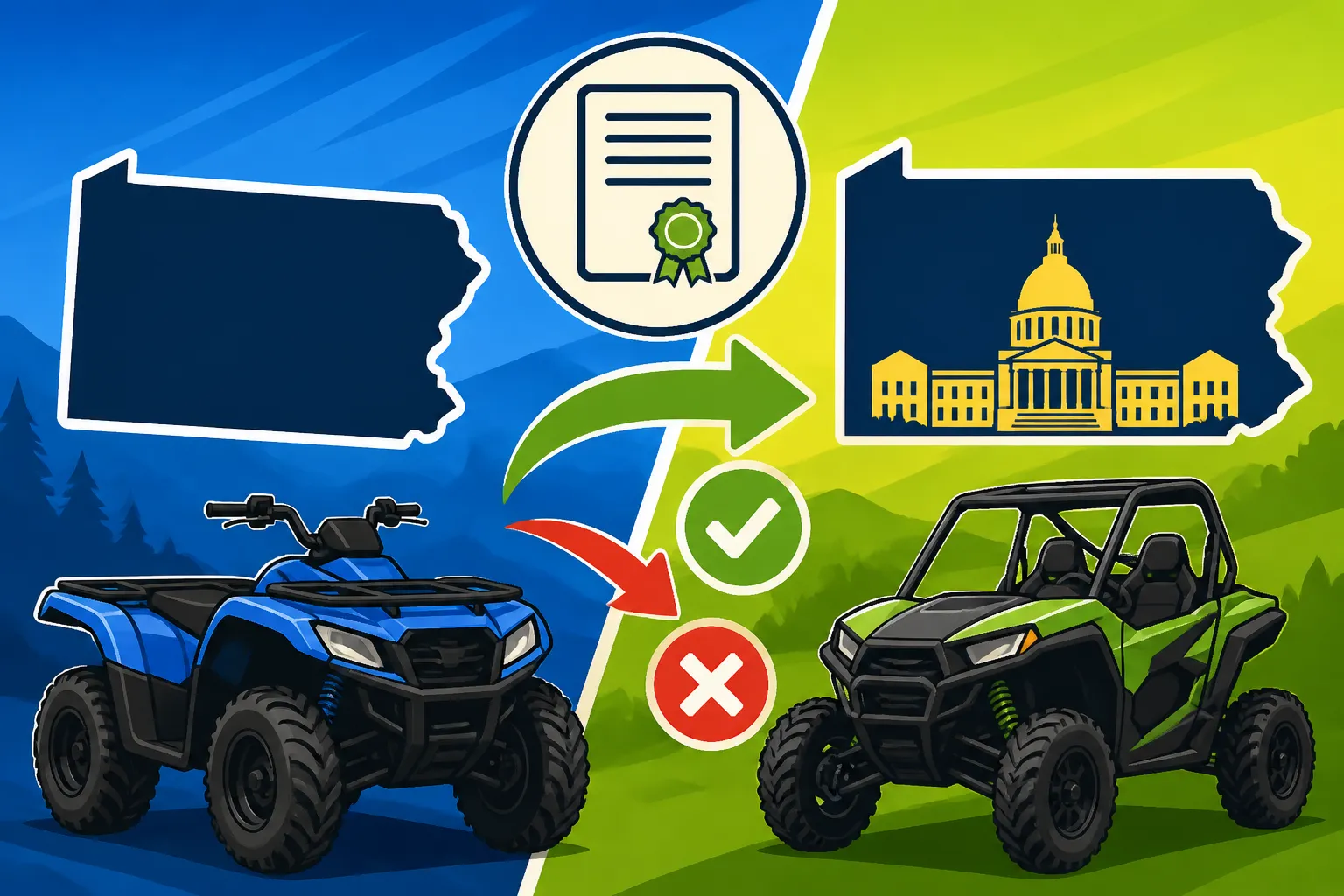
If a young rider completed an ATV safety course in another state, it’s reasonable to wonder whether that certificate counts in Pennsylvania. In general, Pennsylvania can recognize valid out-of-state ATV safety training, but the certificate must show completion of an acceptable course. Age limits, supervision rules, registration, and trail permits are separate requirements.
The short answer: usually, if the certificate is valid
Pennsylvania’s focus is whether a young rider has completed an approved ATV safety course, not simply where the rider lives. A certificate from another state may provide acceptable proof, provided it clearly documents successful completion of ATV safety training that Pennsylvania recognizes.
That qualification matters. “Safety card” can mean different things: an official course-completion certificate, a registration document, a club card, or a participation card from an informal training session. Those documents are not interchangeable. A receipt, registration card, or certificate for a different type of vehicle course does not necessarily prove that an ATV safety requirement has been met.
If the certificate was issued outside Pennsylvania, check the course provider or issuing agency and confirm that it represents successful completion of a recognized ATV safety course. If the wording is vague, the course was online, or the rider completed training in a different state system, ask the Pennsylvania Department of Conservation and Natural Resources, or DCNR, before traveling. Confirming ahead of time is easier than trying to resolve a certificate question at a trailhead.
Pennsylvania’s youth certificate rules are particularly important for riders ages 8 to 15. The state’s requirements depend on the rider’s age and where they plan to operate, so an out-of-state certificate does not replace checking the rules for the intended riding area. For background on the age-specific requirement, see Pennsylvania Safety Certificates for Ages 8 to 15 and Pennsylvania Rules for Riders Aged 8 to 15.
The practical approach is:
- Check that the document identifies the rider and shows successful completion of an ATV safety course.
- Find out who issued the certificate and whether the course was recognized by the issuing state or training program.
- Confirm that Pennsylvania will accept that particular certificate if its status is unclear.
- Carry the certificate while riding, along with any other required documents.
- Check the age and site rules for the land or trail system before setting out.
| What the document proves | Is it a substitute for an ATV safety certificate? |
|---|---|
| Completion of a recognized ATV safety course | It may qualify; confirm that Pennsylvania accepts the specific certificate if uncertain. |
| ATV registration in another state | No. Registration and safety training are separate. |
| A trail permit or club membership | No. These do not establish course completion. |
| Attendance at an informal lesson | Not necessarily. Attendance alone may not show successful completion of an approved course. |
| A certificate for another vehicle type | Do not assume it counts for ATV operation. Check with the issuing agency and DCNR. |
What the certificate does and does not cover
A safety certificate is evidence of training. It is not a general permission slip to ride anywhere in Pennsylvania. Even with a valid certificate, riders must follow the age, supervision, equipment, access, registration, and permit rules that apply to their situation.
It does not change age restrictions
Pennsylvania has specific limits for younger riders, and those limits can depend on where the machine is being operated. A certificate does not make a rider old enough to use a route or property where their age would otherwise prevent riding. Nor does it remove any supervision requirement that applies.
For example, do not treat a course card as an exception to the restrictions that apply to children on state land. Review Why Under Eights Cannot Ride Pennsylvania State Land if the rider is under eight and intends to ride on state property. For a child who is old enough to ride, check the applicable youth rules as well as the certificate requirement.
It does not replace registration
A safety certificate concerns the rider. Registration concerns the machine. A Pennsylvania registration or valid out-of-state registration does not establish that a young rider completed safety training, and a safety certificate does not register the ATV.
Visitors should check the rules for their machine and the places they plan to ride. Pennsylvania’s acceptance of certain out-of-state documents does not mean every state’s registration rules are identical. For that separate question, see Does Pennsylvania Honor an Out-of-State Registration? and Pennsylvania ATV Reciprocity With Other States.
It does not provide trail access by itself
A certificate does not act as a trail permit, landowner’s permission, or club authorization. Some places require separate access permission or permits, while other locations have different conditions. Check the rules for the specific site rather than assuming that a safety certificate covers entry.
This distinction is useful for visitors planning a weekend ride: the certificate addresses training, while access documents address where the ATV may be ridden. What a Weekend Visitor Needs to Ride Pennsylvania explains the other requirements to consider before leaving home.
It does not prove insurance or ownership
A course certificate is not proof of insurance, ownership, or permission to use someone else’s ATV. Keep those records separate. If an operator is required to carry proof of insurance or registration for a particular ride, the safety certificate will not take its place.
A simple document pouch can help keep the papers together, but organize them so it is clear which document answers which question. Do not rely on a wallet card or registration record to stand in for course completion.
How to check an out-of-state certificate before a Pennsylvania ride
A quick review of the document can reveal whether it is likely to be useful, but unclear cases should be checked with the issuing agency or DCNR. A certificate does not always use the same wording or format in every state.
Read the certificate closely
Look for the rider’s name, the course subject, the completion status, the date if one is shown, and the identity of the issuing organization. The document should make it clear that the rider completed an ATV safety course, rather than merely registering for one or attending a general safety talk.
If the certificate is electronic, save a copy that can be opened without a reliable cell connection. A printed copy is a practical backup, especially when riding somewhere with limited service. If the original was lost, ask the course provider or issuing agency how to obtain a replacement before the trip.
Ask the right question
When contacting the issuing organization or DCNR, provide enough detail for a useful answer. Have the rider’s age, the state that issued the certificate, the name of the course, and a description or copy of the certificate available. Ask whether that specific course-completion document satisfies Pennsylvania’s applicable ATV safety-certificate requirement.
A broad question such as “Does Pennsylvania accept out-of-state certificates?” may not resolve a case where the course type or document is unusual. The important issue is whether the particular course and certificate are acceptable for the rider and planned activity.
For training options within Pennsylvania, see Pennsylvania ATV Course for Ages 8 to 15 and Finding a Pennsylvania Youth Safety Instructor. Riders who are older should not assume that a voluntary or adult course has the same legal effect as a youth certificate requirement; check what the course provides and what the riding location requires. Pennsylvania Online Courses for Riders Sixteen and Over may help identify training options, but course availability alone does not determine access or age eligibility.
Carry the certificate on the ride
Once you have confirmed that the certificate qualifies, keep it accessible. A rider may be asked to show documents during an inspection or when checking in at a riding area. A clear photo can be a useful backup, but do not assume that a photo will be accepted in every setting. Carry the original or an official copy when practical.
Keep the certificate with, but distinct from, registration and permit documents. Before leaving, confirm that all papers are for the correct rider and machine. If several family members are riding, each young rider should have their own certificate rather than relying on another person’s paperwork. See Carrying the Certificate on a Ride for more on keeping proof available.
A simple checklist for families and visitors
Before a Pennsylvania ride, work through these questions rather than relying on the certificate alone:
- Does the rider’s age permit the planned ride? Check the rules for the trail, road, or property. A certificate does not override age restrictions.
- Is this an ATV course certificate? Confirm that it shows completion of an ATV safety course, not just registration, attendance, or a different type of training.
- Is the out-of-state document recognizable? If the issuer or course is unclear, ask DCNR or the course provider about that exact certificate.
- Is the machine properly documented? Review registration requirements separately from operator training.
- Does the riding area require additional access documents? A certificate is not a trail permit or permission to use private land.
- Can the rider show the certificate during the trip? Carry a legible copy and keep a backup if possible.
- Have local and site-specific rules been checked? Requirements can differ between roads, state land, private property, and managed trail systems.
A valid out-of-state certificate can save a young rider from repeating a course unnecessarily, but only when it clearly represents acceptable ATV safety training. If there is any doubt, verify the document before traveling. That check also gives you time to arrange a Pennsylvania course if the certificate does not meet the applicable requirement.
Disclaimer
This article is for general informational purposes only and does not constitute professional advice. Laws, prices and regulations vary by location and change over time. Consult a qualified professional for guidance on your specific situation.