Pennsylvania Reciprocity With New York
A New York ATV registration may let you ride in Pennsylvania without getting a Pennsylvania registration, but it does not automatically open every trail or excuse you from local riding rules. The key is to keep the registration valid, carry proof, and check whether your destination requires a separate permit. Here’s how to sort out reciprocity before you load the machine.
Does Pennsylvania Honor a New York ATV Registration?
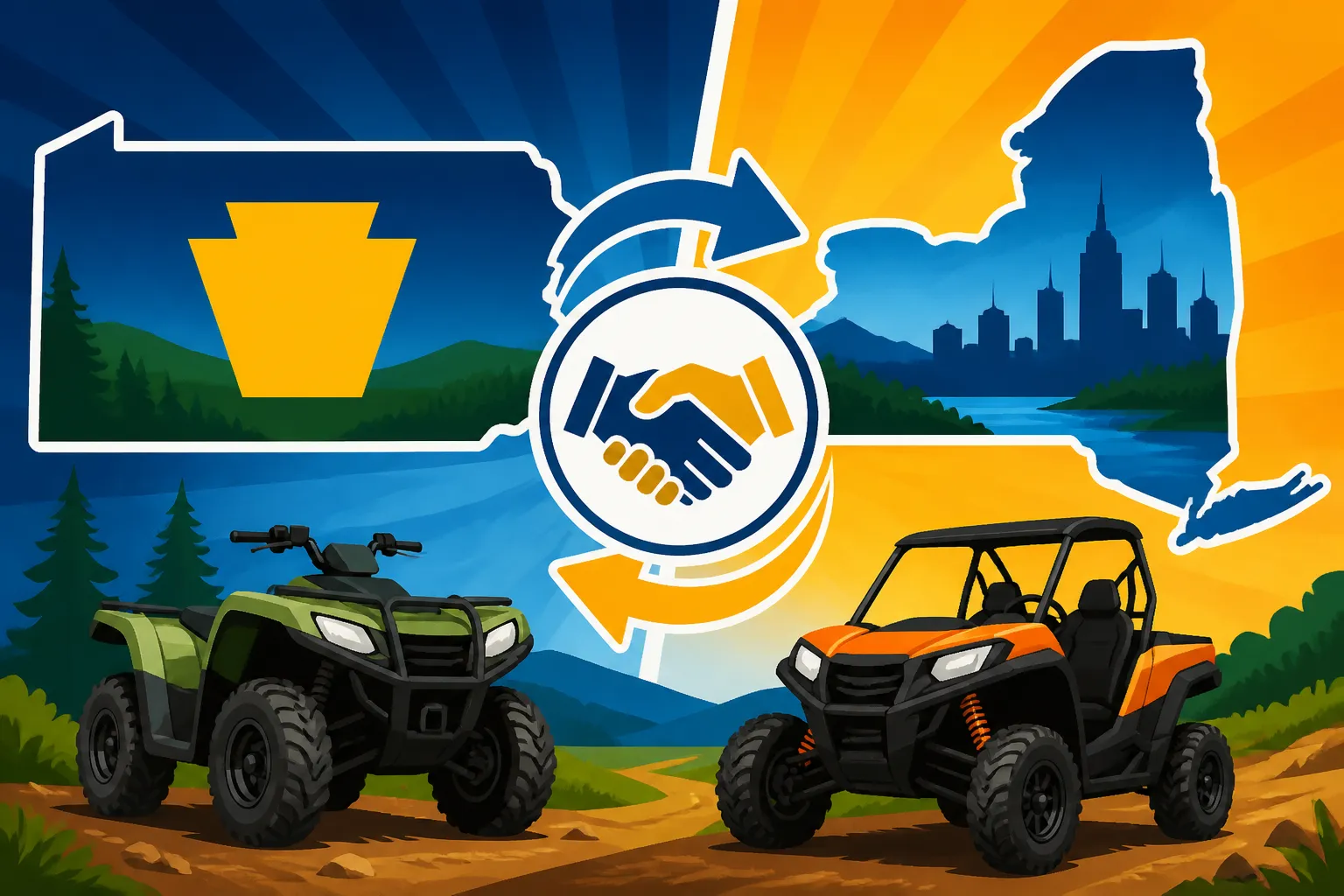
Pennsylvania generally recognizes a valid New York ATV registration for a nonresident riding in Pennsylvania under its reciprocity rules. That means a visitor whose ATV is properly registered in New York may not need to obtain a separate Pennsylvania registration just to ride here.
Reciprocity is about registration, not blanket permission to ride anywhere. Your New York registration does not automatically authorize access to every Pennsylvania trail, state forest route, private club system, or road. Trail operators and land managers can have their own requirements, and Pennsylvania’s rules still apply while you are riding here.
The practical first step is to check the current reciprocity information from the Pennsylvania Department of Conservation and Natural Resources, or DCNR, before your trip. Reciprocity depends on the relevant states recognizing one another’s registrations, and requirements can change. Check that your machine and registration qualify, especially if your ATV has an unusual registration status or you are unsure whether it is registered for off-highway use.
If you want an overview of the rules for visitors, see Does Pennsylvania Honor Out-of-State Registration? and Riding Pennsylvania With an Out-of-State Plate. For a New York rider, the important question is not only whether Pennsylvania recognizes the registration, but whether the registration is current and applies to the machine you are bringing.
What to have with you
Carry the New York registration certificate or other official proof of registration, and make sure the machine displays any plate or decal required for its registration. A photo of the document can be a useful backup, but do not rely on a phone image as your only proof. Bring the original document or an official duplicate if you have one.
Keep proof of insurance with you as well. Pennsylvania requires insurance when an ATV is operated away from land owned by the operator, subject to the details of the law. A New York registration does not replace Pennsylvania’s insurance requirements. Confirm that your policy covers the kind of off-road use planned in Pennsylvania, rather than assuming that a policy for another use or location will do so. See Pennsylvania ATV Registration and Insurance Proof and Carrying Proof of Insurance in Pennsylvania.
It can help to keep paperwork together in a waterproof sleeve or holder. A small document holder from a general retailer such as Amazon may be useful for protecting registration and insurance papers from rain, mud, or a wet storage compartment. Keep it secured so the papers do not become a trail hazard.
Before leaving home, check that the registration information matches the machine’s identifying details. If the machine has changed hands, confirm the registration is still valid for the current owner and machine. A document that belongs to another ATV, or a registration that has expired, may not provide the protection you expect.
Reciprocity Does Not Replace Trail Permits or Access Permission
A recognized New York registration can satisfy the registration issue, but Pennsylvania has several different kinds of riding access. A registration is not the same thing as a trail permit, a club membership, or permission from a landowner.
Before setting out, identify the land manager for the specific trail or route. Public trail systems may have seasonal openings, machine limits, permits, or other conditions. Private trails may require permission or a membership. Some roads are open to ATVs only when specifically designated, and a road that appears to connect two legal riding areas is not automatically open to ATV use.
| What you need | What it covers | What to check before riding |
|---|---|---|
| Valid New York registration | Registration recognition under reciprocity, if the machine and registration qualify | Current status, correct machine, and Pennsylvania’s current reciprocity guidance |
| Pennsylvania trail or land permit | Access to a particular trail system or managed area when required | Which permit applies, where it is valid, and whether it must be displayed or carried |
| Landowner or club permission | Access to private property or club-managed routes | Whether permission covers your machine, dates, and intended route |
| Insurance proof | Evidence of coverage where Pennsylvania requires insurance | Whether the policy covers off-road riding and the trip’s location |
| Safety certificate or other rider qualification | Compliance with age-related or location-specific rules | Rider age, destination, and the current Pennsylvania requirements |
A visitor heading for Pennsylvania state forest trails should check the applicable trail and permit information separately from registration reciprocity. A permit for one trail system may not work somewhere else. Likewise, trails operated by a private club can set access requirements that are independent of state registration.
For a broader explanation of permits, see Pennsylvania ATV Trail Permits Explained and Do You Need a Permit for Pennsylvania State Forest Trails?. If your plans include the Allegheny National Forest, check its separate requirements rather than assuming that state registration or a state forest permit covers it. Pennsylvania’s Allegheny National Forest Permit explains that distinction.
Do not treat an online map, trail app, or route shared by another rider as proof that a road or trail is open. Land managers can close routes, and access can differ by season. Check the current trail information and signs at the access point. A registration recognized across state lines does not override a closure or a posted restriction.
Pennsylvania Rules Still Apply to New York Riders
Once you ride in Pennsylvania, you need to follow Pennsylvania’s operating rules, even if your ATV is registered in New York. Reciprocity does not make a visitor exempt from rules about insurance, helmets, age, road use, machine dimensions, or where riding is allowed.
Insurance, helmets, and age
Confirm that your insurance meets Pennsylvania’s requirements for the places where you plan to ride, and keep proof with you. If you are uncertain whether a policy covers riding in another state, ask your insurer before the trip. A policy that is valid for the machine may still have limits on where or how it can be used.
Helmet rules can depend on the operator, passenger, and circumstances. Do not assume that a helmet rule from New York is the only one that matters. Check Pennsylvania’s requirements for everyone riding, including passengers. See Pennsylvania Helmet Law for ATV Riders and Pennsylvania Helmet Law for Passengers.
Age requirements also matter, particularly for younger riders and riding on state land. Pennsylvania has safety-certificate requirements for some younger riders, and additional age or machine-size limits may apply. Check the rules for the specific location and rider before bringing a child on a trip. Pennsylvania ATV Safety Certificate Requirements and Pennsylvania Rules for Riders Aged 8 to 15 provide more detail.
Roads are a separate issue
A New York registration does not make an ATV street legal in Pennsylvania. Pennsylvania permits ATV use on certain designated roads and crossings under specific conditions; a visitor should not assume that a public road is open simply because it connects a trail to a fuel stop or lodging.
Look for the required signs and confirm that the road is designated for ATV use. Follow applicable crossing and road-use rules, and avoid riding on an unposted road unless you have confirmed it is legally open. Read Pennsylvania’s Designated ATV Roads and Pennsylvania Joint-Use Road Rules before planning a route that uses public roads.
The same caution applies to side-by-sides. A UTV may be subject to width restrictions on a trail even when its registration is recognized. Check the dimensions allowed on the trail system you intend to use, and do not rely on reciprocity to resolve a machine-size restriction. Pennsylvania Rules for a Side-by-Side on a Trail covers that separate issue.
A Pre-Trip Checklist for New York Visitors
A little preparation can prevent a registration question from turning into a missed ride. Work through these checks before towing the ATV into Pennsylvania.
- Confirm the registration is current. Check the New York registration document and make sure it identifies the machine you are bringing. If ownership has recently changed, resolve any registration or transfer issue before traveling.
- Check Pennsylvania reciprocity. Review DCNR’s current guidance for New York registrations. If your registration situation is unusual, contact the relevant agency before relying on reciprocity.
- Carry the paperwork. Bring registration proof and insurance information. Keep them protected from water and accessible if an officer or trail manager asks to see them. Carrying Proof of an Out-of-State Registration has additional practical guidance.
- Identify the land manager. Find out whether your destination is a state forest trail, a national forest route, a private club trail, a designated road, or another type of riding area.
- Check permits and access conditions. Confirm whether the destination requires a permit, membership, landowner permission, or advance registration. Check current opening dates, closures, and machine restrictions.
- Review Pennsylvania riding rules. Check insurance, helmet, age, passenger, width, and road-use rules that may affect your group or machine.
- Plan a legal route to the trailhead. Do not assume that a short road connection is allowed. Confirm each road segment is designated for ATV use or otherwise legally accessible.
If you are stopped during a ride, stay calm and be ready to show your registration and insurance documents. Explain where you are headed and what permit or access permission applies. If a sign or closure conflicts with your planned route, do not ride past it based on the fact that your New York registration is valid.
The short version: Pennsylvania reciprocity can make a valid New York registration useful for visiting, but it is only one part of a legal ride. Confirm current recognition, carry documents, and separately verify permits, trail access, and Pennsylvania operating rules before unloading.
Disclaimer
This article is for general informational purposes only and does not constitute professional advice. Laws, prices and regulations vary by location and change over time. Consult a qualified professional for guidance on your specific situation.