Carrying Proof of an Out-of-State Registration
Carrying Proof of an Out-of-State Registration
Visiting Pennsylvania with an ATV or UTV means more than bringing a machine and its home-state plate. You need to know whether Pennsylvania recognizes that registration, what proof to carry, and whether the place you plan to ride requires a separate permit. Sorting out those details before the trip can prevent a trailhead delay or a citation for missing paperwork.
Does Pennsylvania Recognize an Out-of-State Registration?
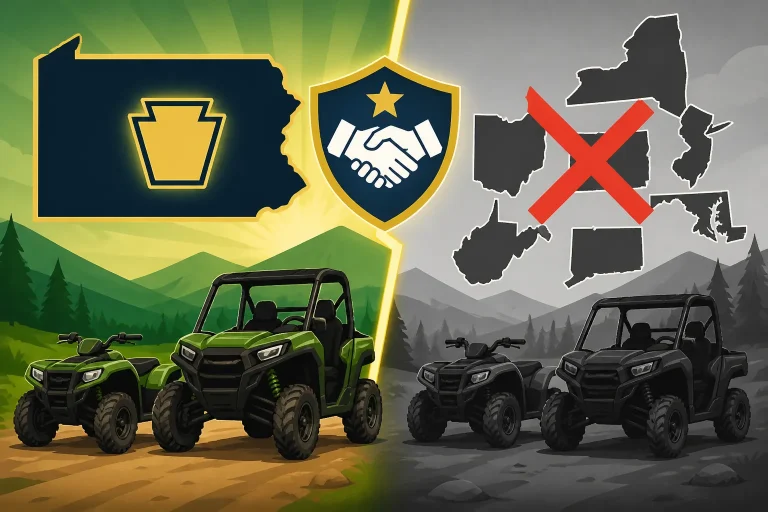
Pennsylvania’s recognition of an out-of-state ATV registration depends on reciprocity. In practical terms, an out-of-state registration is not automatically accepted just because it is current in the state where it was issued. The home state must provide reciprocal treatment to Pennsylvania residents, and the machine and registration must qualify under the applicable rules.
That makes two checks important before you travel:
- Confirm that your machine has a current registration in its home state.
- Confirm that Pennsylvania currently recognizes registration from that state for the type of machine and riding you have planned.
Reciprocity is about registration recognition. It does not mean that every other state’s equipment rules, trail permits, insurance arrangements, or local riding permissions automatically carry over to Pennsylvania. Nor does an out-of-state plate give you permission to ride on any road or trail. Your route, the land manager’s rules, and any required trail permits still matter.
For a state-by-state starting point, see Pennsylvania ATV Reciprocity With Other States. If you are traveling from a particular neighboring state, you may also want to check the specific information for Pennsylvania Reciprocity With New York, [Pennsylvania Reciprocity With Ohio], Pennsylvania Reciprocity With West Virginia, or Pennsylvania Reciprocity With Maryland. Treat those pages as a prompt to verify the current rule for your trip, not as a substitute for checking with the Pennsylvania agency responsible for registration.
Registration is not the same as a trail permit
A valid home-state registration may satisfy a registration requirement when Pennsylvania recognizes it. It does not necessarily cover a separate permit required for a particular riding area.
Pennsylvania has state forest riding opportunities with separate access rules. Some regional trail systems and the Allegheny National Forest have their own permit requirements. A rider may therefore need to carry registration proof and a site-specific permit at the same time. A registration card does not replace a permit, and a permit does not replace registration.
The difference is worth checking before you load the machine:
| Document or approval | What it generally establishes | What it does not automatically establish |
|---|---|---|
| Home-state registration | The machine is registered in its home jurisdiction | That Pennsylvania recognizes it, or that you may ride every Pennsylvania trail |
| Pennsylvania registration, when required | The machine meets Pennsylvania’s registration requirement | Permission to ride private land or a trail requiring another permit |
| Trail or forest permit | Access to the specific trail area covered by that permit | Registration, insurance, or permission to ride elsewhere |
| Proof of insurance | The machine has the insurance coverage shown on the policy | Registration or trail access |
| Landowner or route permission | Permission for a specific private route or property, where applicable | Permission to use unrelated trails or roads |
Before traveling, identify the exact places you intend to ride and check their rules individually. Does Pennsylvania Honor an Out-of-State Registration? covers the reciprocity question, while Pennsylvania ATV Trail Permits Explained helps separate registration from riding-area permits. For the Allegheny National Forest, check Pennsylvania’s Allegheny National Forest Permit and its current application and riding requirements.
Don’t confuse visitors with Pennsylvania residents
A nonresident visiting Pennsylvania and a Pennsylvania resident using a machine registered elsewhere are different situations. A visitor may be able to rely on reciprocal home-state registration if the conditions are met. A Pennsylvania resident should not assume that registering a machine in another state avoids Pennsylvania’s requirements.
If you live in Pennsylvania or have recently moved there, review A Pennsylvania Resident Registered in Another State and Pennsylvania Registration for a Machine Registered Elsewhere. Those situations can involve different obligations from a short visit by a rider whose home and machine are both based outside Pennsylvania.
If you have moved to Pennsylvania, do not treat a visitor’s reciprocity rule as a permanent registration solution. Check Moving Here With a Registered Machine for the steps to take after establishing residency.
What Proof to Carry on the Ride
Carry the registration document issued for the machine, not just a picture of its plate or a note with its registration number. A plate helps identify the machine, but the registration document is the paperwork that connects that plate and machine to the registration. Keep the document current and make sure it belongs to the ATV or UTV you are riding.
A practical document set for a Pennsylvania ride can include:
- The current home-state registration card or certificate.
- A government-issued photo ID.
- Proof of insurance, if required for the ride or applicable to your operation.
- Any required trail or forest permit.
- Any youth safety certificate or other rider document that applies to the rider.
- Written permission, if you are riding private property with the landowner’s consent.
What you need depends on the rider, the machine, and where you are going. Do not assume a single card covers everything. Before departure, compare the documents you have with the rules for each route and riding area.
Keep the machine details consistent
The registration document should match the machine you brought. Check the identifying details before leaving home, especially if your household has multiple ATVs or UTVs. A registration card for one machine does not prove that another machine is registered, even if both are the same model or share an owner.
If the paperwork lists a vehicle identification number, compare it with the number on the machine. This can help catch a swapped card or a record that was not updated after a purchase or transfer. If the VIN is difficult to find or read, resolve that before the trip rather than relying on an unclear photo taken at a trailhead. Carrying Registration Proof as a Visitor and Tracing a VIN From the Frame cover related issues.
Also check that the registration has not expired. A plate still attached to the machine is not proof that the registration remains current. If the renewal date is unclear, verify it through the agency that issued the registration.
A phone image is useful, but do not rely on it alone
A clear photo of the registration can be a useful backup. It can help if the original document is damaged or misplaced, and it can preserve a record of the plate and machine details. But a photo is not guaranteed to be accepted as a substitute for the required document. Requirements can depend on the applicable rule and the officer or land manager checking the paperwork.
The safer approach is to carry the original registration card or certificate, protected from water and dirt, and keep a readable digital copy separately. A sealed document pouch or a purpose-made holder can help keep papers dry, but make sure you can reach the document without removing equipment or unpacking cargo.
Do not leave the only copy of your paperwork in a truck or trailer parked far from the machine. If a check happens on the trail, you may need to show proof where you are riding. A wallet card holder or a small waterproof pouch secured to your gear can make documents easier to retrieve. Avoid putting papers where they can be crushed, soaked, or lost during a rollover.
Carry insurance proof separately
Registration and insurance are separate. If Pennsylvania’s insurance rule applies to your ride, a home-state registration does not establish that you have the required coverage. Check the policy itself and confirm that it covers the kind of off-road use you plan to do. Some policies may have limitations on where or how a machine is operated.
Carry proof of insurance in a form you can access on the ride. If you use a digital insurance card, confirm that the relevant requirement permits it and that you can open it without cell service. A printed copy is a useful backup in areas with weak reception or a dead phone battery.
For details on coverage and proof, see Pennsylvania ATV Registration and Insurance Proof and Carrying Proof of Insurance in Pennsylvania. If a state forest permit application asks for evidence of insurance, make sure the information on the document matches the machine and policy you will use.
Registration Proof Does Not Grant General Trail Access
A current registration can answer one question: whether the machine is registered in a way Pennsylvania recognizes. It does not settle whether the trail is open, whether your machine fits the trail restrictions, or whether you have the required permit.
Before the trip, check the riding area’s current rules for:
- Whether the route is open to ATVs, UTVs, or both.
- Whether a trail permit is required, and which permit applies.
- Width, weight, or other machine restrictions.
- Seasonal closures and operating dates.
- Age, helmet, insurance, and passenger requirements.
- Road crossings, connector routes, and private-property access.
- Whether the area requires a permit for each machine or each rider.
A permit for one riding area should not be assumed to cover a second one. Likewise, being allowed to ride on a designated trail does not automatically let you use an adjacent road or private connector. If a route leaves the managed trail system, confirm that the connection is legal and open.
Check special permits before you travel
Pennsylvania’s permit options can be easy to mix up because they relate to different riding areas. The Northcentral regional permit is associated with designated trails in particular counties, while the Allegheny National Forest has a separate permit system. Some state forest trails may have different access arrangements. Read the requirements for the place you plan to ride rather than choosing a permit based only on the word “Pennsylvania.”
For a trip focused on the Northcentral region, check Pennsylvania’s Northcentral Regional Trail Permit and The Four Pennsylvania Counties the Permit Covers. For the Allegheny National Forest, use What the $35 Allegheny Forest ATV Permit Covers as a starting point, then confirm current permit details with the responsible authority. Do not assume a permit from a private park, club, or another state meets a Pennsylvania public-land requirement.
A rental machine may require extra checking. Ask the rental provider what registration and permit paperwork is included, what you must carry, and whether the permit covers the location you selected. Do not assume that a rental’s plate or paperwork makes you responsible for no additional documents. Does a Rental Include the Permit? explains the questions to raise.
Roads and trails have different rules
Registration does not make an ATV or UTV street legal. Pennsylvania limits where off-road machines may operate on roads, and access can depend on a designated route, local authorization, or a permitted crossing. A visitor should check the road rules just as carefully as the trail rules.
If your plan includes connecting a trail to a road, confirm that the specific segment is open to your machine and that you meet the applicable requirements. A route shown on a map is not necessarily an authorized ATV route. See Riding Pennsylvania With an Out-of-State Plate, Pennsylvania Designated ATV Road List, and Pennsylvania Rules for Crossing a State Route for related questions.
Do not follow another rider onto a road simply because they have an out-of-state plate or appear to know the route. Their registration status may differ from yours, and their route may be authorized for a reason that does not apply to your machine.
A Pre-Trip Check for Out-of-State Riders
A short paperwork check at home is easier than trying to resolve an issue after you arrive. Use this process for each machine you plan to bring.
- Confirm the home-state registration is current. Check the renewal date and make sure the registration belongs to the machine you are transporting.
- Verify Pennsylvania reciprocity. Check whether Pennsylvania currently recognizes the registration from your home state and whether the rule applies to your ATV or UTV.
- Identify your riding locations. List the trail systems, forest areas, roads, and private properties you expect to use.
- Check each location’s permit rules. Determine whether you need a regional, forest, club, park, or other permit, and whether it must be purchased or displayed in a particular way.
- Review insurance requirements. Confirm that your coverage applies to Pennsylvania off-road use and gather proof.
- Gather rider-specific documents. Check age-related safety or helmet rules, passenger restrictions, and any required certificates.
- Pack documents for trail access. Carry the current registration document and other required proof in a dry, reachable place. Keep a separate backup if possible.
- Recheck shortly before departure. Trail openings, permit procedures, and local access rules can change. Confirm the current information with the agency or land manager responsible for the riding area.
The registration issuer and the Pennsylvania agency can answer different parts of the problem. Your home-state authority can confirm that the registration is valid and explain what document proves it. Pennsylvania’s DCNR registration staff can help clarify Pennsylvania registration questions and current reciprocity information. The trail manager or permit issuer can explain access rules for the specific riding area.
When contacting an agency, have the home state, machine type, registration status, and planned riding location ready. If the machine is a UTV, identify it as a UTV rather than assuming the rules are identical to those for a smaller ATV. Ask directly whether your home-state document is accepted as proof and whether you need a Pennsylvania or site-specific permit in addition.
If you are stopped or asked to show paperwork
Stay calm, stop safely, and follow the officer’s or land manager’s instructions. Present the registration document for the machine you are operating. If you have a permit, insurance proof, or youth certificate that applies, have those ready as well. A clear, organized set of papers makes it easier to answer a question without searching through loose gear.
If you cannot find a document, explain the situation plainly and show any backup you have. A phone image may help clarify the machine’s details, but do not argue that it must replace an original document unless you have confirmed that it is accepted. If you receive a citation or notice, keep a copy and follow the stated instructions for responding. For issues involving a Pennsylvania registration citation, Appealing a DCNR Citation may help you understand the next steps.
Frequently Asked Questions
Is my out-of-state registration automatically valid in Pennsylvania?
No. Pennsylvania recognition depends on reciprocity and the applicable requirements. Confirm that the home state and registration qualify before riding.
Is a photo of my registration enough?
Do not assume so. Carry the registration document issued for the machine and keep a clear photo as a backup. Confirm document-format rules with the responsible agency.
Does my out-of-state registration include a Pennsylvania trail permit?
No. Registration and trail permits serve different purposes. Check the rules for each riding area you plan to use.
Do I need to carry insurance proof too?
If insurance requirements apply to your operation, registration does not prove coverage. Check the applicable rules and your policy, then carry proof you can access on the ride.
Can I ride Pennsylvania roads because my ATV has a home-state plate?
Not automatically. A registration plate does not make an off-road machine street legal. Check the rules for designated routes, crossings, and local road access.
Disclaimer
This article is for general informational purposes only and does not constitute professional advice. Laws, prices and regulations vary by location and change over time. Consult a qualified professional for guidance on your specific situation.