Paying a Club Instead of the State
If you plan to ride in Pennsylvania, a club membership or trail fee may look like an alternative to buying a state permit. Sometimes it is a way to access private trails; sometimes it pays for something entirely different. The key is matching the fee to the land you’ll ride and checking what access it actually provides.
What a club fee pays for
A riding club may operate trails on land it owns, leases, or has permission to use. A membership, day pass, or event fee can give you access under the club’s rules. In that situation, you are paying the club for access to its riding area, not buying a permit from Pennsylvania.
Clubs can use fees to support trail maintenance, signage, insurance, land-use arrangements, facilities, or club activities. What a fee covers varies. One club may include trail access with membership; another may require a separate ride pass or charge for certain events. Some access may be limited to members, specific dates, or organized rides.
Before paying, confirm the basic terms:
- Which trails or riding areas are included?
- Does the fee cover one machine, one rider, or a household?
- Is access valid for a day, a season, or another period?
- Are guests allowed, and do they need their own pass?
- Are there machine-size limits, age rules, or required safety gear?
- Are the trails open on the date you plan to ride?
- Does the club require registration, insurance, or proof of membership?
A club sticker or membership card is evidence of the club’s permission only to the extent the club says it is. It is not automatically a Pennsylvania ATV registration, a state trail permit, or permission to ride every connected road or trail. Review Pennsylvania Rules for Riding a Club Trail and Club Trails on Leased Ground before assuming a club’s access arrangement covers the whole route.
The word “club” alone does not tell you who controls the land. A club might run a closed private trail network, hold a permitted event on land it has arranged to use, or maintain routes that connect to public land. Each arrangement can have different boundaries and requirements. Ask where the club’s access ends and whether any route leaves club-controlled land.
| What you pay for | What it may provide | What it does not automatically provide |
|---|---|---|
| Club membership | Access to trails covered by the membership terms | Permission to ride beyond the club’s authorized area |
| Day pass or ride fee | Entry for the stated date or event | Ongoing access after the pass expires |
| State trail permit | Access to the state-managed trails covered by that permit, where required | Entry to private club land |
| ATV registration | Registration required for applicable riding situations | Permission to enter closed land or a private trail system |
| Insurance policy | Coverage described in the policy | Trail access or permission from a landowner |
That distinction matters when clubs manage trails on leased ground. The club’s permission can be limited by its agreement with the landowner. A membership does not give riders a permanent right to use land, and the club may close a trail if access arrangements change, conditions make riding unsafe, or maintenance is needed. Check the club’s current notices rather than relying on an old map or a previous visit.
When a club fee may replace a state trail permit
A club fee can serve as your trail-access payment when you are riding on land the club is authorized to open and the club’s terms grant you access. If your entire ride stays within that authorized area, a state trail permit for a different trail system may not be relevant to that particular ride.
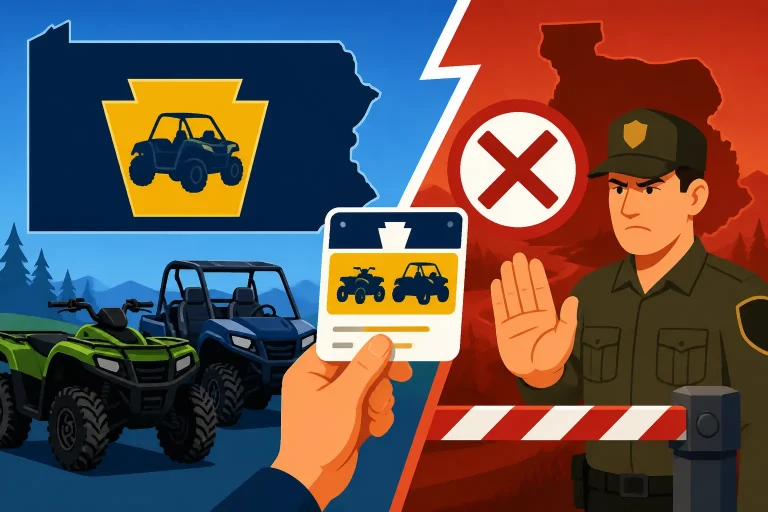
That is not the same as saying a club membership replaces a state permit. The two payments go to different organizations and apply to different places. A state permit, where required, applies to the trail system and conditions named by the state. A club fee applies to the access the club controls. One does not ordinarily transfer to the other.
Pennsylvania has state forest riding opportunities with different access rules. Some state forest trails are free to use, while certain designated trail systems require a trail permit. The requirements depend on where you ride, not simply whether you have paid a riding fee somewhere in Pennsylvania. See Pennsylvania ATV Trail Permits Explained and Pennsylvania’s Free State Forest Trails to understand why checking the specific trail system matters.
Before heading out, identify the land manager for every part of your route. A ride that begins on club land might connect to a state forest trail, a township road, or another property. The permission and permit requirements can change at that boundary. Do not assume that a club’s route map grants access to every connecting trail, road, or staging area.
A practical way to sort it out is:
- Name the exact riding area. “A club trail near the forest” is not precise enough. Find the trailhead, system name, or property.
- Confirm who manages each segment. Ask whether the club controls the whole route or only part of it.
- Check the access rules for that manager. Ask the club about its trails and check the state or public-land manager’s current information for public trails.
- Match each payment to its purpose. A club fee, state permit, and vehicle registration are separate items unless the provider clearly says otherwise.
- Carry proof of what you need. Keep the club pass or membership proof available, along with applicable registration and insurance documentation.
If the club says its membership includes access to a state-managed trail, ask for a clear explanation of what that means. It might mean the club organizes rides or provides local information, not that the membership substitutes for a permit required by the land manager. Confirm the requirement with the organization responsible for that trail.
Payments that remain separate from trail access
A trail fee is only one part of riding legally. Pennsylvania ATV registration rules, insurance requirements, and land-access rules are separate questions. Paying a club does not register your ATV or UTV, and a state registration does not give you permission to ride private land.
Start by checking whether your machine needs Pennsylvania registration for the riding you plan to do. Registration type and use matter, and the rules for public land may differ from riding only on property you own. Pennsylvania ATV Registration and Trail Access explains why registration and trail access should not be treated as the same thing.
Insurance is another separate issue. A club may require proof of insurance as a condition of entry even when the state’s requirements for a particular ride are different. Conversely, having insurance does not give you permission to ride a trail. Check both the legal requirement and the club’s own terms, and confirm that your policy covers the kind of off-road use you intend. For related information, see Insurance the State Requires and Finding an Insurance Policy That Covers Off-Road Use.
The same principle applies to private property. Permission must come from the person or organization authorized to grant it. A club’s route map, sticker, or membership does not necessarily cover neighboring land, an access road, or a shortcut around a closed section. Pennsylvania Rules for Riding Private Property and Asking a Landowner for Permission can help clarify what to verify.
If your machine will move between different areas during a day, plan the route before unloading. Check whether you need a club pass for one section and a state permit for another, and whether a road connection is actually open to ATVs. Avoid treating an unmarked connector as public access simply because it appears on a map or has tire tracks.
How to choose the right option before riding
The least expensive option on paper is not necessarily the right one if it does not cover the trails you want. Compare the actual riding area, dates, included machines, and conditions rather than comparing a club membership price with a state permit in isolation. For a one-time visit, a club day pass might suit you better than an annual membership. For repeat visits, a membership might make sense if it provides reliable access to trails you plan to use. Confirm the current terms directly with the club.
Use this short checklist before paying:
- Match the payment to the property. Find out whether the club owns, leases, or has permission to use the trails.
- Ask what is included. Get the access period, trail boundaries, rider and machine limits, and guest policy.
- Check for separate public-land requirements. If the route enters a state forest or another managed area, confirm whether a permit is required there.
- Verify vehicle requirements. Check applicable registration, insurance, safety, and machine-size rules.
- Check closures and conditions. A pass does not mean a trail is open every day or safe after weather or maintenance work.
- Keep proof handy. Have the club’s confirmation or pass available, plus the vehicle documents and permits required for the route.
If you are unsure, ask the club a direct question: “Does this fee authorize my machine to ride these specific trails on this date, and does any part of the route require a separate state permit?” Then confirm any public-land requirement with the land manager. That two-part check can prevent paying for access that does not cover your destination or riding into an area where a different permit is required.
In short, paying a club instead of the state can work when the club’s fee grants access to the private or club-managed trails you intend to ride. It is not a general substitute for state permits, registration, insurance, or landowner permission. Pay the organization that controls the trails you will actually use, and verify every transition between properties.
Disclaimer
This article is for general informational purposes only and does not constitute professional advice. Laws, prices and regulations vary by location and change over time. Consult a qualified professional for guidance on your specific situation.