Finding a County Youth Instructor
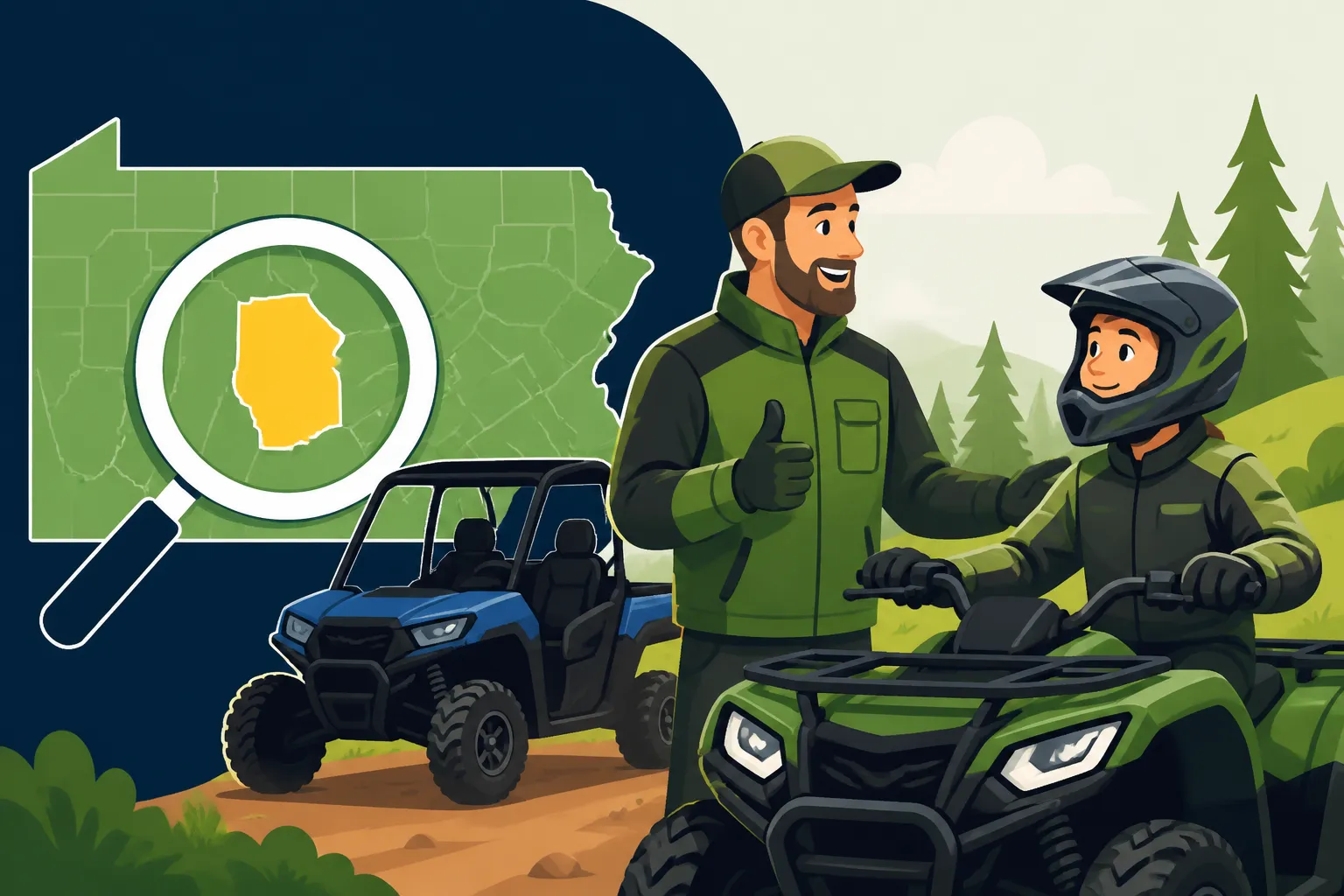
Finding a county youth instructor can be harder than knowing your child needs ATV safety training: listings may be organized by area, and course dates can change. The safest approach is to confirm the requirement first, look for current instructor or course information through Pennsylvania’s official channels, then verify the details directly before making plans.
Confirm what training your young rider needs
Start by checking the rules that apply to the child’s age and where the ATV will be ridden. Pennsylvania has specific safety-certificate requirements for young riders, but a course requirement is not the same thing as permission to ride any machine, on any trail, or at any age. Review Pennsylvania ATV Safety Certificate Requirements and Pennsylvania Safety Certificates for Ages 8 to 15 before looking for a class.
For young riders, the important questions are whether the child falls within the age group covered by the requirement, whether the intended riding area is covered by that rule, and whether the course produces the certificate needed for that use. If you are unsure, confirm the current requirement with the Pennsylvania agency responsible for ATV information rather than relying on a course listing, a social media post, or advice from another rider.
Age and machine size also matter. Pennsylvania sets restrictions for young riders, including a 70cc limit for the youngest age group covered by the rule. Do not assume that completing a safety course removes age or machine restrictions. Check the rules for your child’s age and intended machine before booking a class or buying equipment. Pennsylvania Rules for Riders Aged 8 to 15 and A 70cc Cap for the Youngest Riders explain related issues.
A safety certificate is only one part of preparing a young rider. You may also need to consider supervision, protective equipment, trail access, registration, and any permit required for the place you plan to ride. A course does not itself authorize riding on private property, state forest trails, or other land. For a broader look at requirements that apply to children, see Pennsylvania Supervision Rules for Minors.
Before you start searching, write down the basics:
- The rider’s age on the planned course date
- The county where you want the class, plus nearby counties you could travel to
- Whether you need an in-person class or are considering an online option
- The type of riding the child plans to do and where
- Any deadline, such as a planned trip or riding season
That information makes it easier to identify a suitable class and ask the right questions. It also helps prevent a common mix-up: finding a general ATV training course is not enough unless it meets the state requirement for the certificate your child needs.
Where to look for a county instructor
Use official Pennsylvania ATV safety information as your starting point. The state’s Pennsylvania’s DCNR Snowmobile and ATV Section is a useful place to check for current guidance and directions to course information. A listing may point to scheduled courses, instructors, or a way to ask about local availability. If you do not see a course in your county, ask whether an instructor serves nearby counties or whether additional sessions are planned.
Do not assume that every county has a permanent, publicly listed instructor or that a course runs on a fixed annual schedule. Training availability can depend on instructor schedules, enrollment, and local arrangements. A county name in a search result may refer to where a course is held rather than the instructor’s home county, while a course advertised by a local group may require you to confirm that it meets Pennsylvania’s certificate requirements.
Use more than one route to find a class, but verify every lead:
| Search route | What it can help you find | What to confirm |
|---|---|---|
| Pennsylvania’s official ATV safety information | Current directions to recognized training or course details | Whether the course is accepted for the certificate your child needs |
| A listed instructor or course contact | Dates, location, enrollment, and age eligibility | The child’s age range, course format, and what proof is issued |
| A nearby county or regional contact | Classes outside your home county when local options are limited | Travel details, open seats, and whether the course is still scheduled |
| A local club or community announcement | Possible leads for a local class | That the instructor and course meet the state’s requirements |
| An online course listing | Whether an online option is available for a particular age group | Whether that format is allowed for your child and the certificate needed |
If the official information does not provide a county-by-county list, contact the state ATV information office and ask how to locate a youth instructor serving your area. For contact options and the distinction between registration help and broader ATV questions, see Calling the DCNR Registration Line only if that is the correct contact route for your inquiry; otherwise, use the contact details provided with the official safety-course information. Registration staff and course instructors may handle different questions, so ask to be directed to the person responsible for youth training.
You can also check announcements from local ATV clubs, recreation organizations, or community groups for leads. Treat these as a way to find a possible class, not as final confirmation. Before registering, contact the instructor or the official course contact and confirm that the class is recognized for the certificate required in Pennsylvania.
Expand the search without losing track
If you cannot find an instructor in your county, widen your search one step at a time. Check neighboring counties, ask whether instructors hold classes at rotating locations, and find out whether there is a waiting list or a way to hear about a future session. A class may be listed under the training site’s county even when the instructor serves a wider area.
Keep a short record of the people or offices you contact, the date, and the answer. That prevents repeated calls and gives you a clear next step if a class is full or postponed. If a course is not available soon, ask whether the agency expects another session or can refer you to an authorized option elsewhere. Do not rely on an old flyer or a search result that shows no current course date.
Questions to ask before enrolling
A quick phone call or email can establish whether a course fits your child and your plans. Ask for clear answers before you travel or pay any enrollment charge. Course arrangements vary, so confirm the details with the person responsible for that specific session.
- Is this course appropriate for my child’s age? Give the child’s age on the course date, not just their current age if a birthday is approaching.
- Does successful completion provide the Pennsylvania ATV safety certificate my child needs? Ask what certificate or proof is issued and how it is delivered.
- Is the class in person, online, or a combination? Confirm the format and whether your child is eligible for it. Do not assume an online option intended for older riders applies to younger children.
- What are the date, location, start time, and expected duration? Ask about check-in time, breaks, and whether the course has any outdoor or practical component.
- Does the student need to bring anything? Confirm identification, paperwork, equipment, or other requirements rather than guessing.
- Is there a registration charge, and how is enrollment handled? For any cost, payment method, or cancellation policy, check directly with the course provider.
- What happens if the course is full or canceled? Ask about a waitlist, another session, or a nearby instructor.
- How will I know the certificate has been issued? Confirm whether the child receives it at the end of the class or later, and what to do if it does not arrive.
The question about recognition is especially important. A course can be useful for general riding skills without necessarily satisfying a particular state certificate requirement. If the course contact is uncertain, ask them to point you to the official Pennsylvania information that confirms the course’s status. It is better to resolve that before enrolling than to discover afterward that you need a different class.
Also clarify who must attend. Some youth programs ask a parent or guardian to participate in registration or remain on site. That is a course-specific arrangement, not something to infer from the word “youth.” Check the instructor’s directions and make sure you understand whether the child needs a guardian at drop-off, throughout class, or only for paperwork.
If you are weighing a classroom course against another format, Taking the Course in a Classroom can help you understand what to consider. For course eligibility and the training options aimed specifically at young riders, compare Pennsylvania ATV Course for Ages 8 to 15 with the current official course instructions.
Prepare for the class and keep the certificate useful
Once you have a confirmed place, follow the instructor’s instructions closely. Save the confirmation message, write down the location, and check for any update before setting out. If the course involves practical instruction, ask what clothing or protective gear is appropriate and whether the provider supplies equipment. Do not bring a child on an ATV for training unless the instructor has specifically explained what is required and permitted.
Make sure the child is ready to take part. Explain that the course is about safe decisions as well as operating controls: recognizing hazards, understanding limits, and following rules matter just as much as learning how the machine works. Avoid presenting the certificate as a guarantee that the child can ride anywhere or without supervision. Training gives a young rider important knowledge, but it does not replace the applicable age, machine-size, supervision, or land-access rules.
When the course is complete, check that the certificate or proof of completion has been issued and that the child’s identifying details are correct. Store it somewhere you can find it again, and keep a digital copy if the provider’s documentation allows. Ask the instructor what to do if the certificate is delayed, lost, or contains an error. Do not assume that a registration card, trail permit, or class confirmation is a substitute for a safety certificate.
Before the first ride, check the rules for the place you intend to use. Public roads, state forest trails, private land, and other riding areas can have different access conditions. A certificate does not replace an ATV registration or trail permit when those are required. It also does not give permission to ride on land where access is restricted. For a child’s first outing, choose a place where the machine is allowed and where the rider can operate within their age and ability limits.
A practical sequence is:
- Confirm the child’s age-related training and machine restrictions.
- Find a course through Pennsylvania’s official ATV safety information or a verified referral.
- Contact the instructor to confirm course recognition, age eligibility, schedule, and enrollment details.
- Attend the class and obtain the certificate or proof of completion.
- Check the separate riding, supervision, registration, and permit rules for the location.
- Keep the certificate accessible and review the rules again if the child’s age, machine, or riding area changes.
If your search turns up no nearby class, do not treat the lack of a local listing as proof that training is unavailable. Ask the official contact for a regional referral, check adjacent counties, and verify future dates directly. A little confirmation up front helps you find the right instructor and avoid confusing a general riding lesson with the certificate your young rider may need.
Disclaimer
This article is for general informational purposes only and does not constitute professional advice. Laws, prices and regulations vary by location and change over time. Consult a qualified professional for guidance on your specific situation.